
Regional manager visibility means having a live, shared record of every unit turn's status, owner, and verification step across all your communities, not a phone full of texts from site staff. The single highest-priority fix is deploying one shared turn record with a standard status taxonomy (Ready, On Track, At Risk, Overdue) and a mandatory verification step before any unit goes to leasing. Do that this week before touching anything else.
TL;DR:
- Deploy a shared turn record with standardized status categories and a mandatory verification step before units are marked ready to eliminate guesswork.
- Ensure real-time visibility by using a system that displays live status flags, vendor info, inspection results, and proof photos accessible from a mobile device.
- Conduct short daily blocker reviews instead of weekly meetings, focusing on immediate issues to prevent delays and missed lease opportunities.
- Track only a few key metrics, such as cycle time, stage time, and vendor SLA compliance, to identify stalls and improve vendor performance promptly.
- Roll out new visibility tools gradually with pilot programs, standardize processes beforehand, and focus on accountability and discipline to sustain operational improvements.
Table of Contents
- What Does Real Operational Visibility Look Like?
- What Features Actually Matter for Tracking Turns?
- How Do You Keep Turn Status Accurate Day to Day?
- Which Metrics Actually Tell You Something?
- How Do You Roll Out Visibility Across a Portfolio?
- The Habits That Actually Move the Needle
- Where TurnTrack Fits Into This Playbook
- Sources
What Does Real Operational Visibility Look Like?
Visibility isn't a dashboard you check once a week. It's the ability to open one system, right now, and know exactly where every active turn stands without calling a site manager.
At minimum, you should be able to see:
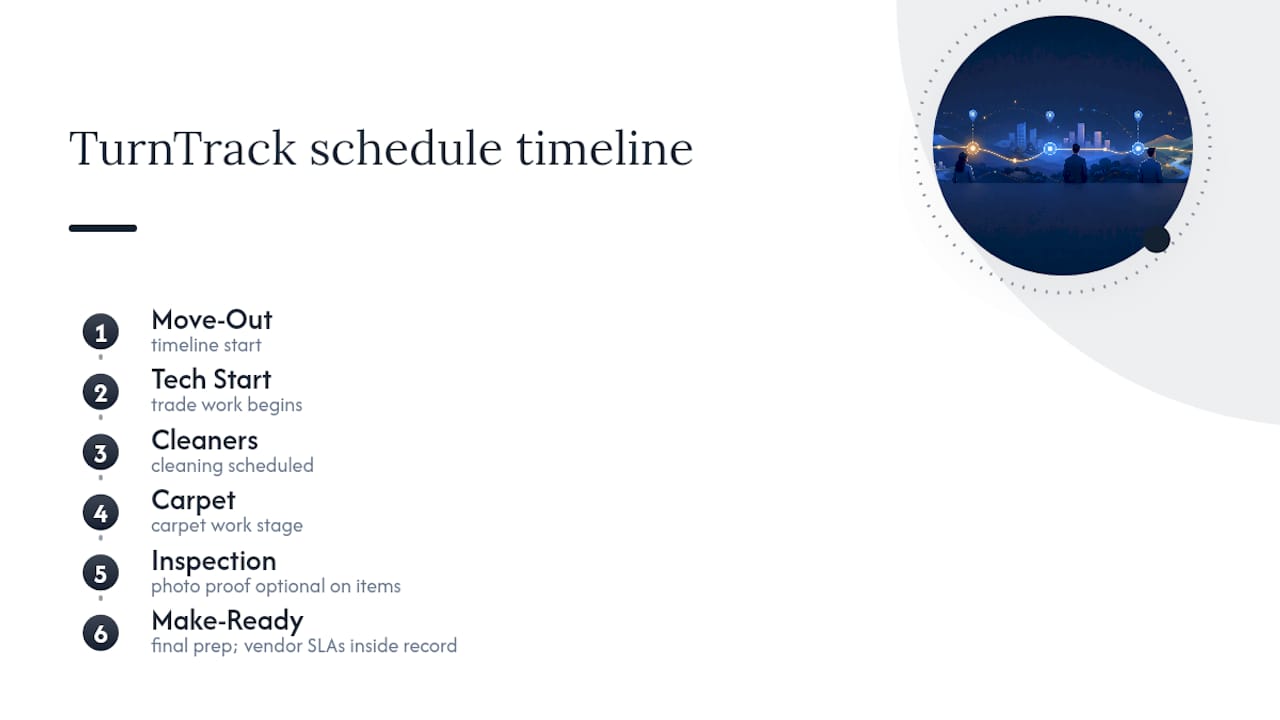
- A shared timeline for each unit moving through Move-Out, Tech Start, Cleaners, Carpet, Inspection, and Make-Ready, with a status flag attached at every stage.
- An activity feed showing time-stamped updates, with photos attached where the property requires proof, not on every single task by default.
- Vendor contacts, scheduled start windows, and SLA markers embedded directly in the turn record, not buried in a separate spreadsheet.
- Inspection results and a completed verification step before a unit is marked Ready.
If you can't answer "what's blocking unit 214" in under thirty seconds without a phone call, you don't have visibility. You have a rumor network. Make-ready boards that sequence inspection, repairs, cleaning, and a mandatory verification step exist specifically to close that gap.
What Features Actually Matter for Tracking Turns?
Most tools and processes claim to offer "visibility." Few actually deliver the parts that matter when you're running turns across five, ten, or twenty properties at once. Here's what to prioritize, in order:
- Real-time status flags on a shared timeline. Every turn needs a status that updates the moment conditions change, visible to everyone without a refresh request or a call to the site.
- Vendor coordination built into the turn itself. SLA windows and vendor contact info should live inside the record, not in a separate app or a contact list someone has to dig through.
- A structured inspection workflow with a verification step. Converting inspection findings into structured work orders before sign-off is what actually prevents rework, and optional photo proof gives you documentation without slowing every single task down.
- A property standards library. Ambiguity about paint color, filter size, or fixture model wastes more hours than any scheduling problem. Specs need to live somewhere a tech can find them without texting you.
- Mobile-first access with an audit trail. If your field team can't update status from a phone standing in the unit, the system will die within a month.
Pro Tip: Don't evaluate a tool by its feature list. Evaluate it by whether a tech standing in an empty unit can answer "what goes here" without calling anyone.
The multifamily unit readiness checklist format works well as a template if you're building this from scratch rather than adopting software.
How Do You Keep Turn Status Accurate Day to Day?
Visibility only stays useful if the underlying workflow forces status to stay current. That means fewer meetings and more structural discipline.
Start the clock at notice, not at move-out. Building a T-minus timeline the moment a resident gives notice, rather than waiting for keys back, is what cuts idle time between vacate and verified ready. If your process only kicks off after the unit is empty, you're already behind.
From there, a few rules keep things honest:
- Assign one named owner per turn, and one per stage. Shared ownership means no ownership.
- Run a short daily review focused only on blockers, five to ten minutes, not a full status meeting covering every unit in the portfolio.
- Encode vendor SLAs and escalation triggers into the workflow itself, so a missed window flags automatically instead of surfacing three days later when leasing calls asking why the unit isn't ready.
- Treat inspection output as a task generator. Every flagged item becomes an assigned, trackable task, not a note in a binder.
Where lease timing allows it, designated move-out days give your team predictable windows instead of a constant trickle of surprise vacancies, which makes the whole schedule easier to hold. The apartment make-ready execution guide walks through how these stage handoffs typically get sequenced.
Which Metrics Actually Tell You Something?
Most regional managers track too many numbers and act on none of them. Six metrics cover almost everything you need:
- Average make-ready cycle time, move-out to verified ready. This is your headline number.
- Time-in-stage for each phase (cleaning, carpet, inspection), so you know exactly where turns stall.
- Repeat work rate after verification, which tells you whether your inspection process is actually catching problems.
- Vendor SLA compliance rate, tracked per vendor, not as a portfolio average.
Dashboards built around cycle time, stage time, and repeat work are what let you spot a stalled turn before it becomes a lost lease, and what let you make procurement decisions on vendor performance instead of gut feeling.
Cycle time and SLA compliance connect directly to vacancy cost. Properties that respond within 24 hours to maintenance issues see better resident retention, and the same discipline applied to turns keeps units off the vacant-and-unrented list longer than it needs to be.
How Do You Roll Out Visibility Across a Portfolio?
Don't try to fix every property at once. A four-week pilot at two or three sites tells you more than a six-month rollout memo.
- Audit your current tracking sources. List every text thread, spreadsheet, and shared drive currently holding turn data. This alone usually reveals the gaps.
- Standardize the status taxonomy and timeline across pilot sites before adding any tool. Everyone needs to agree what "At Risk" means before software can enforce it.
- Pilot shared turn records with vendor contacts and a verification step built in from day one, not added later.
- Train field staff and vendors on the minimum status discipline required, updating stage and flagging blockers immediately.
- Measure cycle-time and SLA compliance weekly during the pilot, and compare against your pre-pilot baseline before expanding.
Pro Tip: Pick your worst-performing property for the pilot, not your best one. If the system works there, it works everywhere.
The unit turn workflow guide has a sample timeline if you need a starting benchmark for what "on schedule" should look like in days.
The Habits That Actually Move the Needle
The theory in this guide only matters if it survives contact with a Monday morning full of maintenance calls. What actually works, based on how well-run make-ready operations behave, comes down to two habits.
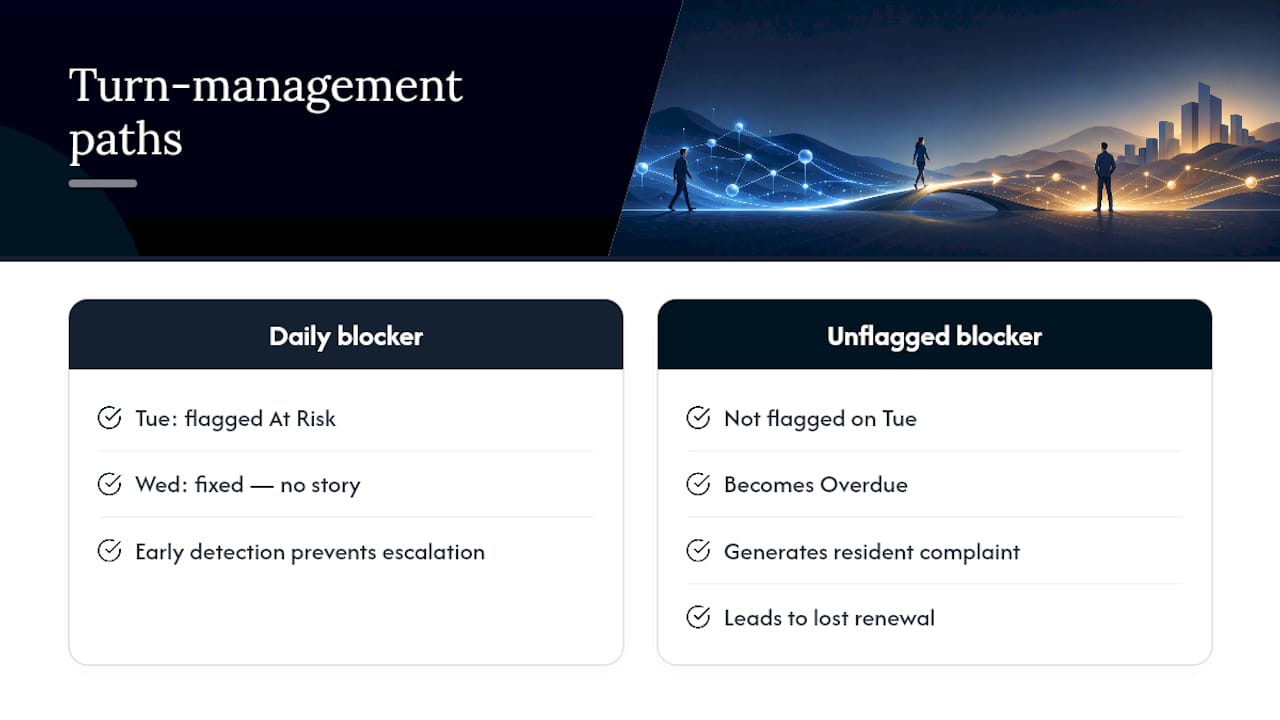
First, the daily blocker review beats the weekly status meeting every time. Ten minutes spent asking "what's stuck and why" catches a missing carpet crew on day two instead of day six, when leasing has already promised the unit to someone. Early detection is the entire game. A turn that's At Risk on Tuesday and fixed by Wednesday never becomes a story. A turn nobody flagged until it's already Overdue becomes a resident complaint and a lost renewal.
Second, vendor accountability doesn't require micromanaging vendors. It requires SLA windows they agreed to, visible in the same place you're tracking everything else, so a missed window is a fact instead of an argument. Scorecards built from SLA compliance data do more for vendor relationships than any phone call ever will, because both sides are looking at the same numbers.
Regional oversight isn't about watching more closely. It's about building a system where the truth surfaces on its own, before you have to go looking for it.
— TurnTrack Team
Where TurnTrack Fits Into This Playbook
TurnTrack is unit-turn and make-ready software built specifically for the workflow described above, not a property management system. It doesn't touch rent, leases, or tenant communications. What it does handle: a shared turn record with the same Ready, On Track, At Risk, and Overdue status flags this guide recommends, a schedule timeline running Move-Out through Tech Start, Cleaners, Carpet, Inspection, and Make-Ready, and an activity feed that logs updates as they happen.
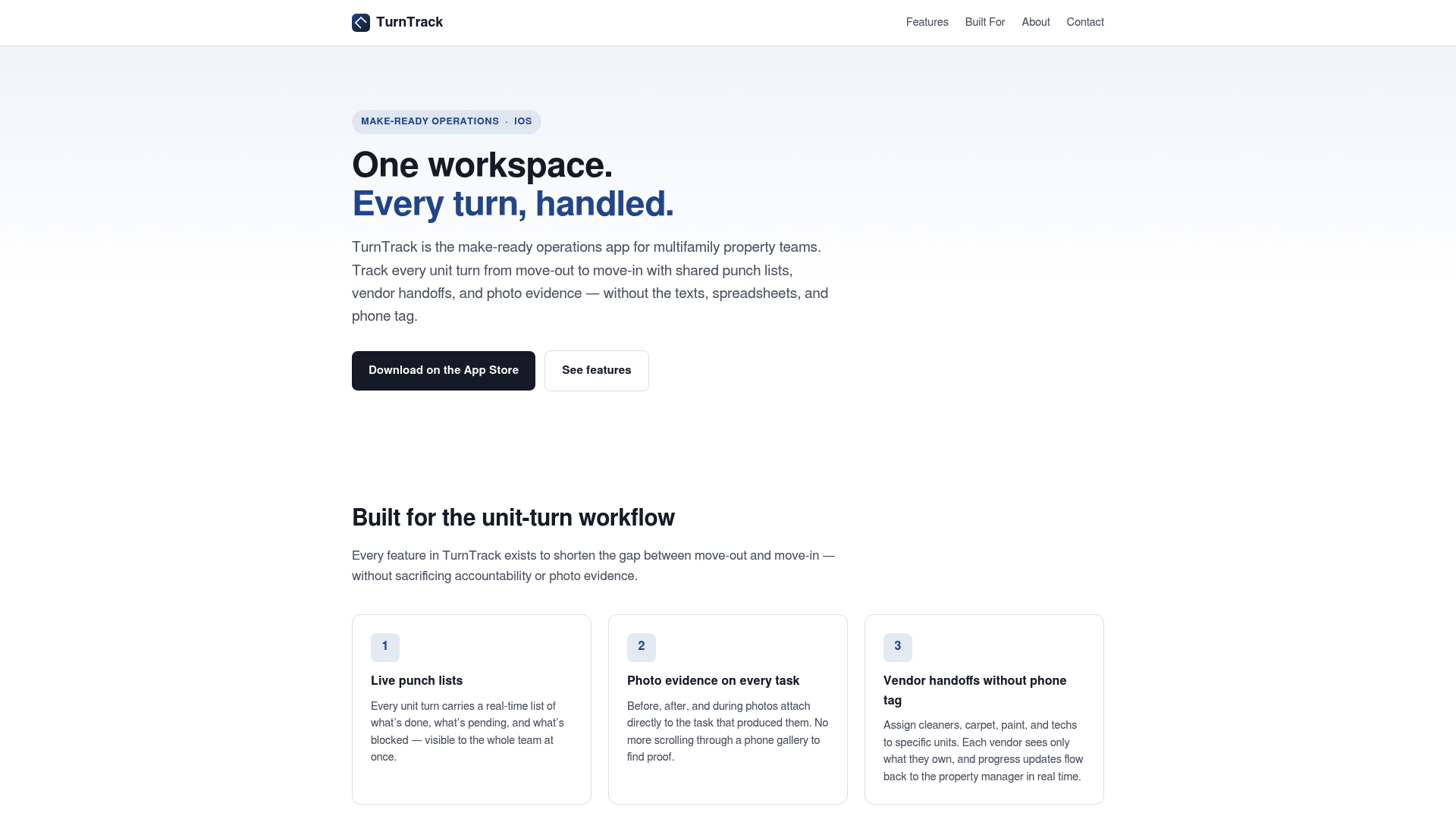
Vendor coordination lives inside each turn record, so the contact and SLA window are right there instead of buried in a separate app. The Property Standards Library hold property-specific specs, like exact paint shades or filter sizes, and share them with a tech or vendor without requiring that vendor to create an account. Photo proof is optional and attaches to inspection items and activity updates only where a property actually needs the documentation.
The subscription runs a monthly fee per workspace, covers your invited team, and includes a free trial. See the provider’s website for current pricing details. It's available now on iOS through the App Store, with an Android version on the way. If you're running the four-week pilot outlined above, start your trial at your test property and track cycle time before and after.
Sources
For deeper benchmarking, see the NAAHQ turnover guidance and the turnover punch list guide.
- Apartment Turnover (NAAHQ)
- Make-Ready maintenance workflow (TaskEstate)
- Property maintenance guide (Spanr)