
A multifamily unit readiness checklist is a structured, room-by-room process that prepares a vacant rental unit for the next tenant. In the industry, this process is called a "make-ready" or "unit turn," and the checklist is the operational backbone that keeps every step on track. A standard turn costs $1,000–$5,000 and takes 5–10 days from move-out to rent-ready. Every day a unit sits vacant costs real money, and a missed step on the checklist is usually what causes the delay. Property managers who run consistent, documented turns fill units faster, defend deposits more easily, and avoid the kind of rework that eats into margins.
What does a multifamily unit readiness checklist cover?
A complete make-ready checklist covers every area of the unit, every system, and every piece of documentation. The goal is a single record that any team member can read and immediately understand the unit's status, without calling anyone for clarification.
Room-by-room inspection items:
- Kitchen: Test all appliances (range, oven, dishwasher, refrigerator, microwave). Check cabinet interiors and drawer slides. Inspect sink faucet, garbage disposal, and under-sink plumbing for leaks. Verify exhaust fan operation.
- Bathrooms: Test hot and cold water at sink, tub, and shower. Inspect caulk and grout lines. Check toilet flush, fill valve, and seat. Confirm exhaust fan works and light fixtures are operational.
- Living areas and bedrooms: Test all outlets and switches. Check window locks, screens, and blinds. Inspect closet doors, tracks, and hardware. Look for wall damage, scuffs, and nail holes.
- HVAC: Replace filter (note the exact size in your property specs). Test heat and cooling. Inspect vents and returns for blockage or damage.
- Safety devices: Test smoke detectors and carbon monoxide detectors. Replace batteries or units as required. Document the change with a date-stamped note or photo.
- Exterior and entry: Inspect door locks, deadbolts, and weather stripping. Check patio or balcony surfaces and railings.
Documentation requirements:
Standardized condition categories like "Damaged," "Missing," or "Operational" remove ambiguity from inspection reports. Vague terms like "fair" or "okay" create inconsistent work orders and deposit disputes. Every item on the checklist should resolve to one of these defined states.

Photos belong at the end of the process, not during it. Photos taken after the final clean and before the new tenant moves in create a verifiable condition baseline. Photos taken mid-turn, while trash is still on the floor or walls are half-painted, provide weak legal defense.
Pro Tip: Build your property's exact paint color (for example, Sherwin-Williams SW 7012 Creamy), HVAC filter size, and preferred vendor contacts into a single reference sheet. TurnTrack's Property Standards Library stores these specs and shares them directly with a tech or vendor, so nobody has to call you to ask what white goes on the walls.
How do you coordinate maintenance and communication during a turn?
Coordination failures cause more delays than actual repair work. When vendors get missed, units get shown before they're ready, and no one has a clear picture of where the turn stands.
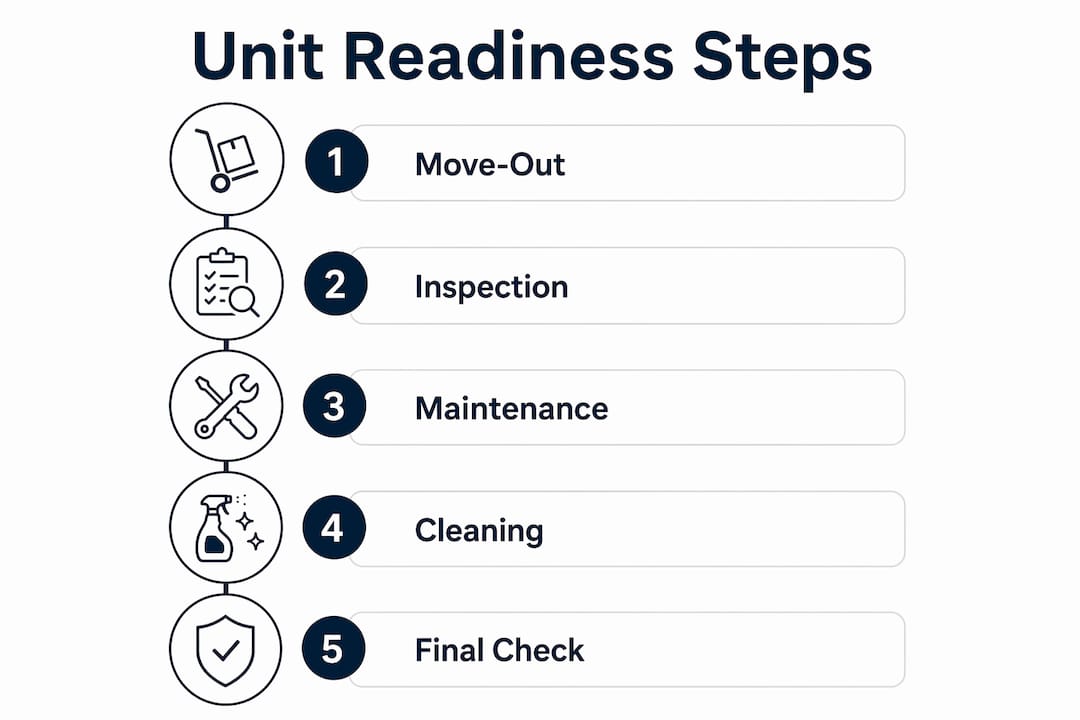
1. Set a shared timeline from day one. Every turn should have a visible sequence: Move-Out, Tech Start, Cleaners, Carpet, Inspection, Make-Ready. When everyone sees the same timeline, scheduling conflicts surface before they become delays.
2. Use specific access windows, not vague notices. Centralized maintenance communication with exact time windows, such as "Tuesday 10:00 AM–12:00 PM," increases tenant compliance from 68% to 94%. A notice that says "sometime this week" gets ignored. A specific window gets results.
3. Keep vendor contacts inside the turn record. When a tech is working a unit and needs the carpet crew, the contact should be right there in the turn record. Digging through a phone or a separate spreadsheet costs time and causes missed calls.
4. Log updates as the work happens. An activity feed tied to each turn stage creates documentation as a byproduct of the work. Managers see real-time progress without texting every tech for a status update.
5. Confirm completion with photos where it matters. Not every task needs a photo. But for items like smoke detector replacements or freshly painted walls, a date-stamped photo attached to the task closes the loop and protects the property.
Organizations using centralized communication systems see up to 38% fewer tenant maintenance complaints and 48% better contractor response rates in the first 30 days. Better communication does not just feel better. It produces measurable results.
Pro Tip: Tailor your communication by role. Tenants need advance notice with a specific time window. Contractors need scope, access instructions, and a contact number. Managers need a status they can read in five seconds. One message does not serve all three.
What is the step-by-step execution plan from move-out to move-in?
The sequence of a unit turn matters as much as the checklist itself. Doing steps out of order creates rework. Painting before patching, or cleaning before repairs, means doing the same work twice.
Pre-move-out inspections scheduled 7–14 days before lease end reduce deposit disputes and give the maintenance team a head start on ordering parts or scheduling vendors. California Civil Code Section 1950.5 requires property managers to offer tenants an initial inspection before move-out. This is not just a legal obligation. It is a practical tool that surfaces issues while the tenant can still address them.
The standard execution sequence runs as follows:
- Day 1: Move-out walkthrough with documented photos. Note all damage, missing items, and cleaning needs.
- Days 1–2: Trash-out and junk removal. The unit must be clear before any repair work starts.
- Days 2–4: Maintenance repairs and painting. Patch walls before painting. Replace damaged fixtures before the final clean.
- Days 4–5: Carpet cleaning or replacement. Carpet work comes after painting to avoid overspray and before the deep clean to avoid tracking debris.
- Days 5–6: Deep cleaning focusing on cabinets, appliances, tile grout, and baseboards. An effective deep clean runs 4–8 hours beyond a basic clean.
- Days 6–7: Final walkthrough and photo documentation. Mark the unit rent-ready only after this step is complete.
| Turn type | Typical duration | Common triggers |
|---|---|---|
| Standard turn | 5–7 days | Normal wear, minor repairs |
| Deep turn | 10–14 days | Heavy cleaning, multiple repairs |
| Major renovation | 3–4 weeks | Flooring replacement, full repaint, appliance swap |
The turnover sequence avoids rework and shortens vacancy time. Skipping steps or reordering them to accommodate a vendor's schedule almost always costs more time than it saves.
What mistakes undermine a unit readiness checklist?
The most common errors are not technical. They are process failures that compound over time.
Vague condition language creates inconsistent work orders. When one tech writes "wall looks okay" and another writes "wall needs paint," the manager cannot tell which units actually need work. Standardized condition categories solve this. Every item resolves to a defined state, and every team member uses the same language.
Marking a unit rent-ready before it is actually ready is the fastest way to damage a new tenant relationship. A resident who moves into a unit with a broken garbage disposal or a dirty oven will remember it. That first impression drives lease renewals and online reviews.
Repeated minor issues across multiple units often signal systemic failures. Inspections should identify patterns, not just isolated unit defects. If three units on the same floor have failing HVAC filters every turn, the issue is the filter spec or the change interval, not bad luck.
Treating each unit in isolation is the most expensive mistake in multifamily management. Multifamily inspections should leverage the repeated floor plan layout by identifying patterns of damage across units. A single leaking faucet is a repair. Five leaking faucets in the same building is a plumbing system problem.
Skipping digital documentation leaves property managers exposed in deposit disputes. A consistent operational record that any team member can read and interpret, without further explanation, is the standard to aim for. Paper logs and text threads do not meet that standard.
Key Takeaways
A complete multifamily unit readiness checklist, executed in the correct sequence with standardized condition language and proper photo documentation, is the single most effective way to reduce vacancy time and prevent deposit disputes.
| Point | Details |
|---|---|
| Sequence drives speed | Follow Move-Out through Make-Ready in order to avoid rework and shorten vacancy. |
| Standardize condition language | Use defined categories like Damaged, Missing, or Operational to eliminate ambiguous work orders. |
| Photo timing matters | Take final photos only after the deep clean and before move-in for legal defensibility. |
| Pre-move-out inspections save money | Schedule walkthroughs 7–14 days before lease end to reduce deposit disputes and prep time. |
| Patterns reveal system failures | Track repeated issues across units to catch systemic problems before they become expensive repairs. |
What we've learned running turns in the field
The checklist is not the hard part. Getting everyone to use the same checklist, in the same order, with the same language, every single time — that is the hard part.
The biggest operational gap we see is not a missing inspection item. It is the information that lives in one person's head. The service manager who knows the paint code, the vendor who only works Tuesdays, the unit that always has a slow drain. When that person is out, the turn stalls. The fix is not a better memory. It is a shared record that holds all of it.
We also see property managers underestimate the cost of launching leasing too early. Showing a unit that is not truly rent-ready, or moving a resident in before the punch list is closed, creates a trust problem that is hard to recover from. The checklist exists to protect that moment. Mark it ready when it is ready, not when you need it to be ready.
The other thing worth saying: not every turn needs the same depth. A standard 5-day turn and a 3-week renovation are different operations. The checklist framework stays the same. The scope adjusts. Build your process to handle both without starting from scratch each time.
— TurnTrack Team
TurnTrack keeps your make-ready operations in one place
Running 5–15 active turns at once means tracking move-out dates, vendor schedules, unit conditions, and property specs across every unit simultaneously. When that information lives in texts, emails, and spreadsheets, things fall through.
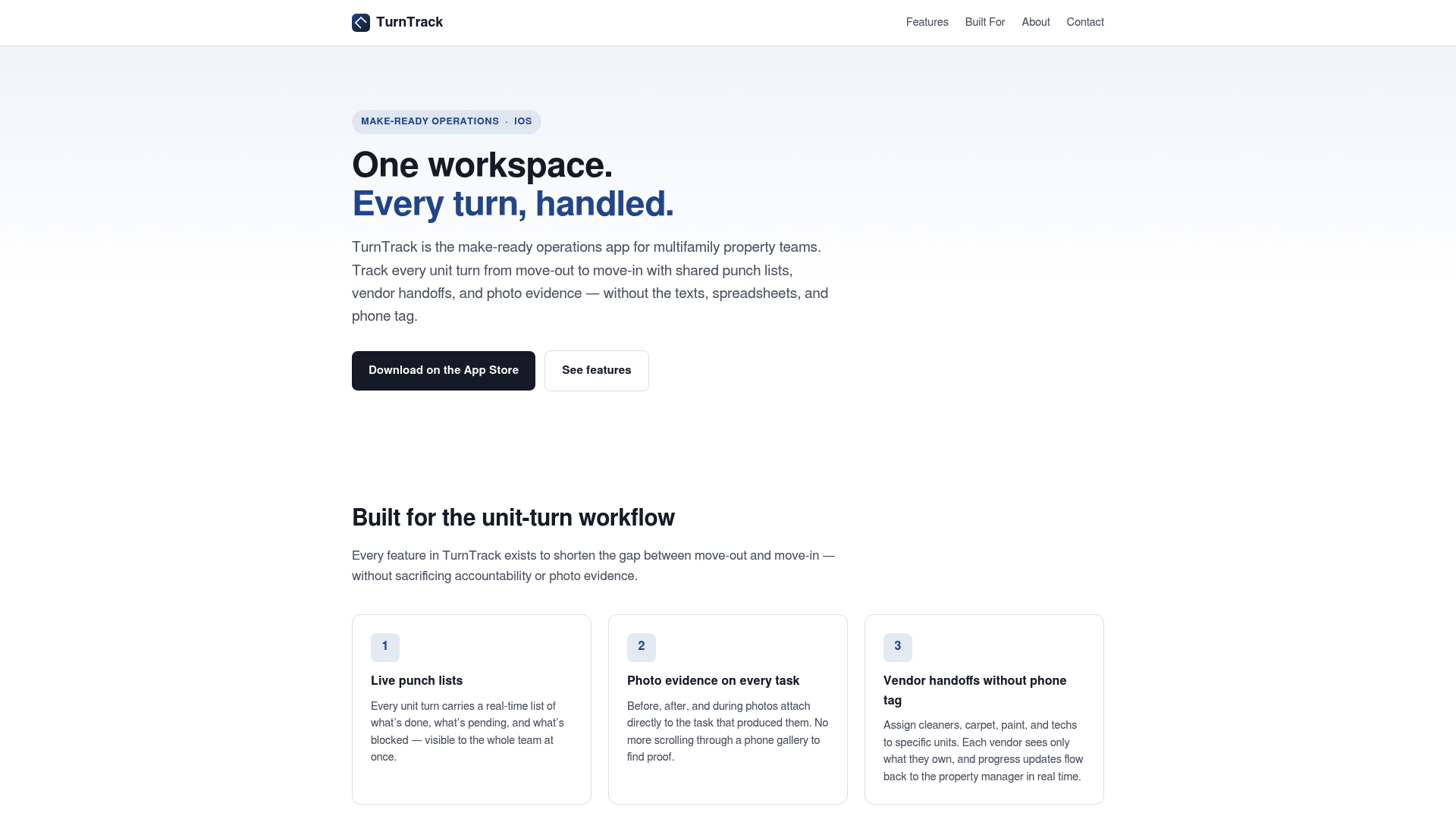
TurnTrack gives every turn a shared record with a status (Ready, On Track, At Risk, Overdue) and a timeline the whole team can see. Inspections are walked area by area on a phone. Vendor contacts live inside the turn. The Property Standards Library keeps your paint codes, filter sizes, and preferred vendors in one place, shareable with any tech or vendor without requiring them to create an account. A workspace subscription runs $14.99/mo with a free trial, iOS only. Built for the teams still doing the work, not for enterprise software budgets.
FAQ
What is a multifamily unit readiness checklist?
A multifamily unit readiness checklist is a structured, room-by-room guide that documents every inspection, repair, cleaning, and documentation step required to prepare a vacant unit for the next tenant. In the industry, this process is called a make-ready or unit turn.
How long does a standard apartment turn take?
A standard turn takes 5–7 days, a deep turn takes 10–14 days, and a major renovation takes 3–4 weeks. The make-ready timeline depends on unit condition, scope of repairs, and vendor availability.
When should move-out inspection photos be taken?
Photos should be taken after the final clean and before the new tenant moves in. Photos taken mid-turn during active work provide poor legal defense in deposit disputes.
What condition categories should a property inspection checklist use?
Use defined categories like Damaged, Missing, or Operational instead of vague terms like "fair" or "okay." Standardized language prevents inconsistent work orders and reduces deposit disputes between managers and tenants.
How does pre-move-out inspection reduce deposit disputes?
Scheduling a walkthrough 7–14 days before lease end gives tenants time to address issues before move-out. California Civil Code Section 1950.5 requires this initial inspection right, and following it reduces the likelihood of contested charges after the tenant leaves.