
For property and service managers running unit turns, the best MaintainX alternatives split into two clear camps: lightweight operator workspaces built around make-ready workflows, and mid-market or enterprise CMMS platforms built around asset lifecycle. If your bottleneck is vendor coordination, inconsistent inspections, and units not hitting make-ready on time, start with TurnTrack. It is the only option on this shortlist built specifically for the move-out-to-move-in timeline, with a Property Standards Library that puts paint specs, filter sizes, and vendor contacts directly in a tech's hands.
Key facts before you read further:
- TurnTrack ($14.99/mo per workspace, free trial, iOS): operator-focused, make-ready timeline, vendor coordination, Property Standards Library, optional photo proof
- UpKeep: mobile-first CMMS with stronger inventory and asset tracking; a better fit when spare-parts management is the primary gap
- eMaint, Fiix, IBM Maximo, Limble, Hippo CMMS, Facilio: mid-market to enterprise options with deeper asset analytics, longer rollout windows, and higher total cost
- None of these tools handle rent, leases, or tenant communications natively; you still need a PMS alongside any of them
Table of Contents
- How do the main MaintainX alternatives compare for unit turns?
- Which tool fits your actual operations problem?
- What should you evaluate when testing alternatives?
- Enterprise CMMS vs. lightweight workspaces: what actually changes for unit turns?
- Why TurnTrack fits make-ready operations specifically
- Key Takeaways
- Built by operators, for operators
- TurnTrack: a straight-facts look at the make-ready workspace
- Further reading and sources
How do the main MaintainX alternatives compare for unit turns?
| Category | Best For | Core Features | Property-Specific | Mobile | Inventory | Integrations | Pricing Entry | Implementation | Scale |
|---|---|---|---|---|---|---|---|---|---|
| Operator workspace (TurnTrack) | Make-ready, vendor coordination, mid-size multifamily | Turn record, timeline, inspections, punch list, activity feed | Property Standards Library, move-out→make-ready statuses | iOS, field-first | No | No native PMS integration | $14.99/mo per workspace | Days | Single-site to multi-site |
| Mobile CMMS (UpKeep) | Facilities, small-mid teams needing inventory | Work orders, asset tracking, inventory, PM scheduling | Limited make-ready templates | iOS + Android | Yes, multi-location | API, SAP, some PMS | Per-user/mo | Days to weeks | Small to mid-market |
| Mid-market CMMS (Limble, eMaint, Hippo CMMS, Fiix) | Teams needing custom workflows and reporting | PM, work orders, asset hierarchy, reporting dashboards | Minimal native property-turn features | iOS + Android | Yes | ERP, accounting, some PMS | Per-user/mo, modular | Weeks to months | Mid-market to enterprise |
| Enterprise EAM (IBM Maximo, Facilio) | Portfolio-scale operators, IoT/BMS environments | Full asset lifecycle, IoT/BMS connectivity, energy management | Minimal out-of-box | iOS + Android | Deep | Native ERP, BMS, IoT | Custom/portfolio pricing | Months | Enterprise, multi-site |
Notes:
- Operator workspaces like TurnTrack get teams running in days. The tradeoff is no spare-parts module and no native PMS sync.
- Mid-market CMMS (Limble, eMaint, Fiix) offer more workflow customization but require manual workarounds to model move-out→make-ready status flows.
- Enterprise EAM (IBM Maximo, Facilio) are purpose-built for portfolio scale and IoT. Implementation packages for enterprise alternatives often start at about $1,500 and involve longer rollout periods, which is a real budget and timeline consideration for smaller operators.
Which tool fits your actual operations problem?
Match the pain point to the right category before you shortlist anything:
- Vendors getting missed or double-booked: Operator workspace. Vendor contacts live inside the turn record, not in a separate list or your phone.
- Inconsistent inspections across units: Operator workspace or mobile CMMS. TurnTrack walks inspections area by area with optional photo attachments; UpKeep handles inspection checklists with stronger inventory tie-in.
- Spare-parts shortfalls slowing turns: Mobile CMMS. UpKeep's inventory depth and scan-to-checkout features are built for this; TurnTrack does not include a parts module.
- No shared property standards (paint specs, filter sizes, preferred vendors): Operator workspace. The Property Standards Library is a TurnTrack-specific feature; most CMMS require you to build this manually in custom fields.
- Multi-site portfolio with energy and IoT monitoring: Enterprise EAM. Facilio's native IoT/BMS connectivity and portfolio pricing are designed for this scale; mid-market CMMS typically treat IoT as an add-on.
- High-volume turns with fast tech onboarding: Mobile-first UX and low-friction onboarding are the key adoption drivers when turn volume is high and staff turnover is frequent.
Pro Tip: If your team does not have a dedicated maintenance admin, enterprise CMMS complexity will slow daily operations rather than speed them up. The signal to move up-market is when you are managing 500+ units across multiple sites and need asset depreciation, energy reporting, or ERP integration — not just faster make-readies.
What should you evaluate when testing alternatives?
Run every vendor through this checklist before committing:
- Does the tool have a native move-out→make-ready timeline template, or do you have to build one from scratch?
- Can inspections attach optional photos to specific items without making photos mandatory on every task?
- Does vendor coordination live inside the turn record, or is it a separate module?
- Is there a property standards library, or do you manage specs in a separate document?
- Does the mobile app work offline for techs in units with poor signal?
- What is the implementation timeline for a multi-site rollout?
- What integrations exist with your PMS or accounting software?
Demo questions worth asking directly:
- "Can you attach property standards to an inspection item and share them with a vendor who does not have an account?"
- "How do you handle vendor-only access and scheduling without giving full system access?"
- "Walk me through the total cost: subscription, implementation fees, and any hardware required for core features."
Red flags to watch for:
- Per-user-only pricing with no workspace option (costs balloon as your vendor list grows)
- Core features locked behind higher-tier paywalls
- No mobile offline capability
- Implementation windows longer than your next lease-up cycle
- Hidden costs like implementation fees and IoT hardware that do not appear in the base subscription quote
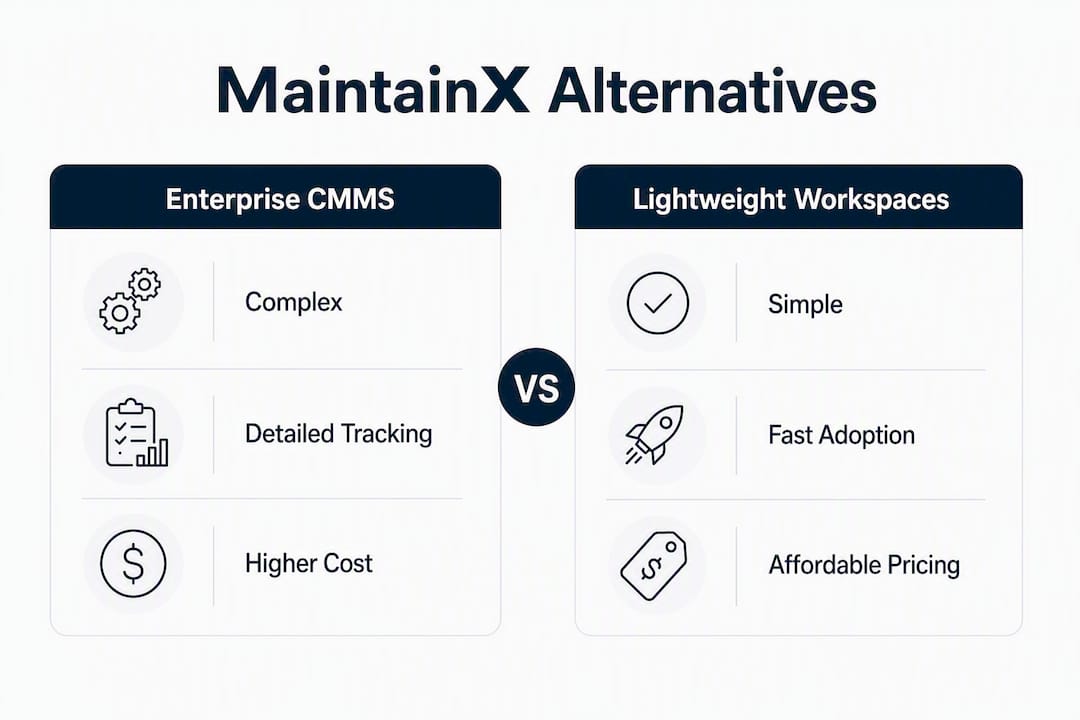
Enterprise CMMS vs. lightweight workspaces: what actually changes for unit turns?
The honest tradeoff is not features versus simplicity. It is adoption speed versus analytical depth.
A lightweight operator workspace gets a service manager and two vendors coordinating on the same turn record within a day. An enterprise EAM like IBM Maximo or Facilio gives you asset depreciation, energy dashboards, and BMS integration, but a typical enterprise rollout runs months, not days, and requires someone to own the configuration.
For unit-turn operations specifically, the depth enterprise tools add rarely maps to the bottlenecks that actually delay make-ready. Most delays come from missed vendor calls, inconsistent inspection standards, and techs not knowing the property specs. None of those require asset lifecycle analytics to fix.
Mid-market CMMS like Limble, eMaint, Fiix, and Hippo CMMS sit in the middle: offering more customization than a lightweight workspace, shorter rollout than enterprise, but still built around general maintenance workflows rather than the move-out→make-ready status model multifamily operators actually use. Teams often end up building manual workarounds for turn-specific statuses.
The practical summary:
- Lightweight workspace: days to deploy, low admin overhead, turn-focused by design, limited asset depth
- Mid-market CMMS: weeks to months, moderate admin, customizable but not property-native
- Enterprise EAM: months to deploy, dedicated admin required, deep analytics and IoT, high total cost of ownership
Why TurnTrack fits make-ready operations specifically
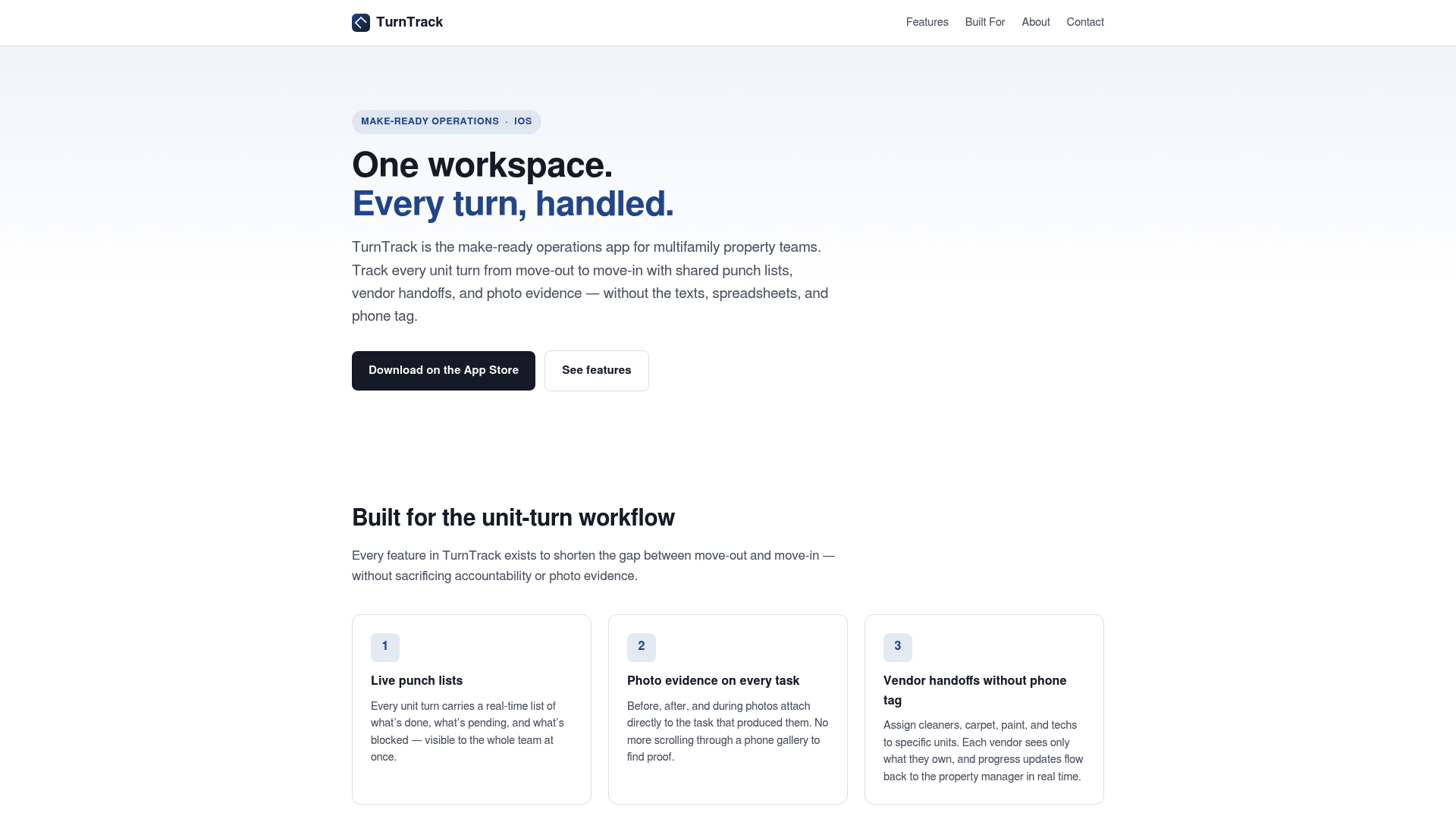
TurnTrack is not a CMMS and not a PMS. It manages one thing: the unit-turn workflow from move-out to make-ready.
Core features:
- Turn record with live statuses: Ready, On Track, At Risk, Overdue
- Schedule timeline: Move-Out → Tech Start → Cleaners → Carpet → Inspection → Make-Ready
- Inspections: Move-Out, Mid-Turn, Move-In, walked area by area on a phone
- Vendor coordination built into the turn record
- Punch list tied to each unit
- Activity feed with optional photo attachments
- Property Standards Library: paint specs, filter sizes, faucet models, preferred vendors, shareable to techs and vendors without requiring a TurnTrack account
Pricing: $14.99/month per workspace, free trial available, iOS via the App Store. One workspace subscription covers the invited team.
The workspace pricing model matters for property operations. Per-user CMMS pricing scales with every tech and vendor you add. At $14.99 per workspace, a service manager running 10 active turns with three vendors and two techs pays the same as one running a single unit. That math changes the pilot decision entirely.

For mid-size multifamily operators who find enterprise tools overbuilt and overpriced, TurnTrack is worth running as a 30-day make-ready pilot on a sample set of units before committing to anything heavier.
Key Takeaways
For multifamily unit turns, the right alternative to MaintainX depends on whether your bottleneck is make-ready coordination or asset lifecycle management.
| Point | Details |
|---|---|
| Match tool to bottleneck | Vendor coordination and inspection gaps call for an operator workspace; spare-parts gaps call for a CMMS with inventory depth. |
| Enterprise cost starts high | Implementation packages for enterprise alternatives commonly start at about $1,500, and rollout adds months to timelines. |
| Workspace pricing changes the math | TurnTrack's workspace pricing covers the invited team with a fixed monthly fee, unlike per-user CMMS pricing that increases cost as you add more vendors. |
| Run a 30-day pilot first | Track on-time make-ready completion and tech adoption rate during the pilot before committing to a full rollout. |
| TurnTrack for make-ready teams | TurnTrack covers the move-out→make-ready timeline, vendor coordination, inspections, and the Property Standards Library at $14.99/mo with a free trial. |
Built by operators, for operators
The shortlist and evaluation criteria here come from the TurnTrack Team, built by service managers with direct experience running unit turns in multifamily communities. The product design reflects what actually causes delays: missed vendor calls, techs without property specs, and inspections that produce no usable record. That field background is what shaped the features prioritized in this comparison and the red flags flagged in the vendor checklist.
TurnTrack: a straight-facts look at the make-ready workspace
Every tool on this list handles work orders. TurnTrack handles the specific sequence that gets a unit leased: the move-out inspection, the vendor schedule, the mid-turn punch list, the make-ready sign-off, and the property standards that keep every unit consistent regardless of who does the work.
The workspace costs $14.99/month. One subscription covers your invited team. There is a free trial available through the App Store, no sales call required. The practical next step is to run a 30-day pilot on a set of active turns and measure on-time make-ready completion before deciding whether to expand or look at a heavier system.
Start a free trial and see how the make-ready timeline and Property Standards Library work on your actual units.
Further reading and sources
TurnTrack resources:
- Make-ready workflow guide — common unit-turn pitfalls and how standards reduce rework
- Property management software cost guide — pricing model comparison for procurement decisions
- Audit trail guide for property management — activity feeds and documentation best practices
- Multifamily property management guide — operational KPIs for multifamily operators
External analysis and market sources:
- Gartner Peer Insights: MaintainX alternatives 2026 — verified buyer comparisons across enterprise and mid-market CMMS
- UpKeep vs. MaintainX comparison — feature-level breakdown of asset tracking, inventory, and mobile UX differences
- Limble: MaintainX alternatives roundup — market overview grouping solutions by scale
- Facilio: MaintainX alternatives for enterprise teams — enterprise FM and IoT positioning context
- FieldServiceSoftware: MaintainX vs. UpKeep — adoption speed and mobile UX analysis