
An audit trail in property management is a continuous, timestamped record of every action, change, and communication tied to a unit turnover. The industry term for this is a compliance audit trail, and it covers everything from move-out inspection notes to vendor sign-offs and deposit records. Retention periods typically require at least 7 years, and logs must be immutable to hold up in court or during a regulatory review. For property managers and service coordinators running multiple active turns at once, this record is not a back-office formality. It is the difference between winning a dispute and losing one.
What are the essential components of an audit trail in property management?
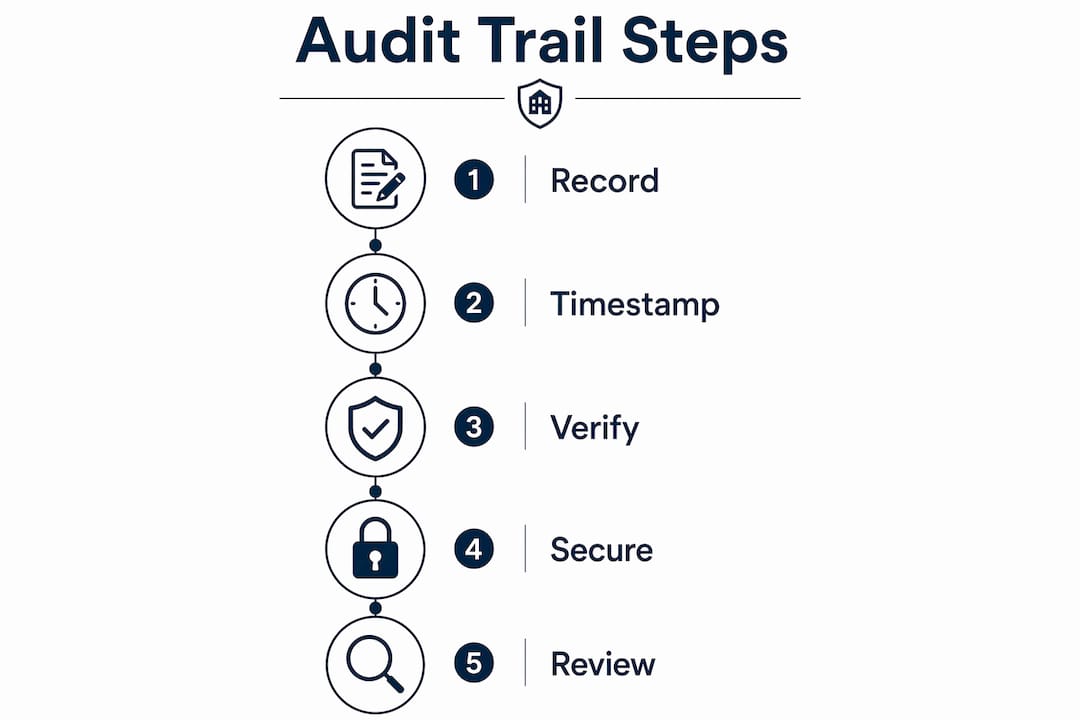
A defensible audit trail requires four data points on every recorded action: a timestamp, a user ID, the original value, and the modified value. Miss any one of these, and the record loses its legal weight. A professional-grade audit trail must capture all four to defend against disputes and liability claims.
The core components of an effective property management audit trail are:
- Timestamp accuracy. Every entry must record the exact date and time of the action. Vague or approximate times create gaps that opposing counsel or auditors will exploit.
- User attribution. The log must identify who performed each action, not just what changed. This is the accountability layer that separates a real audit trail from a shared spreadsheet.
- Before and after values. When a record changes, both the original and the updated value must be stored. This proves what the condition was before a tenant moved out, not just what it became.
- Immutability. Once entered, records cannot be altered or deleted without detection. Immutable, append-only logs with cryptographic hash chaining detect any tampering, including modification, deletion, or reordering of entries.
- Continuous generation. Logs must be produced in real time, not reconstructed after the fact. Retroactive documentation carries serious legal risk and is often inadmissible.
- Retention compliance. Records must be stored for the required period, typically 7 or more years, and must be accessible on demand for inspections or tribunal reviews.
Pro Tip: Set a calendar reminder at the start of each quarter to verify that your log retention settings match your jurisdiction's requirements. Retention rules change, and a gap discovered during an audit is far more costly than a 15-minute check.
The immutability requirement is the one most often underestimated. Property managers who rely on editable spreadsheets or email threads have no way to prove a record was not changed after the fact. That gap costs real money in deposit disputes and liability claims.
How do modern property management workflows integrate audit trails naturally?
The most effective audit trails are not built separately from daily operations. Audit trails are most efficient when generated automatically by the system managing daily property operations, not as separate compliance tasks. That distinction matters more than any specific feature.
When a tech logs a completed repair in the same platform used to assign the work, the timestamp and user ID are captured automatically. No one has to remember to document it. The same applies when a cleaner marks a stage complete or a coordinator uploads a photo of a replaced smoke detector. The operational record and the compliance record become the same thing.
"Operational data should be stored as final compliant records at the point of entry, not converted later into compliance documents. Converting records after the fact introduces human error and opens the door to manipulation."
This principle reshapes how property managers should think about record keeping for properties. The goal is not to add a documentation step at the end of each turn. The goal is to choose tools where documentation happens as a byproduct of the work itself. Inspection templates that capture area-by-area condition data, activity feeds that log every status update, and vendor coordination records that timestamp each contact all contribute to a complete trail without adding manual overhead.
Compliance audit trails must be continuous records produced instantly for inspections or courts, replacing manual record-keeping. That standard applies to centralized logs covering safety certificates, deposit records, rent history, and proof of notices served. Property managers who still rely on scattered emails and text threads cannot meet this standard, regardless of how diligent their team is.
What technologies and software capabilities support robust audit trail management?
The technical foundation of a trustworthy audit trail is hash chaining. Tamper-evident append-only audit logs use SHA-256 hash chains verified externally to detect unauthorized edits, reordering, or deletions. Each event's hash links to the previous one, so any change to a past record breaks the chain and triggers an alert. This is the same architecture used in financial systems and healthcare records.

Beyond hash chaining, the software features that matter most for property management compliance fall into two categories:
| Feature category | What it does for you |
|---|---|
| Role-based access controls (RBAC) | Limits who can view or edit sensitive records, reducing internal manipulation risk |
| Automated evidence bundles | Groups certificates, rent records, and inspection data into ready-to-produce packages for audits |
| PII redaction in logs | Strips personally identifiable information from exported logs to meet privacy requirements |
| Automated certificate alerts | Flags expiring safety certificates before they lapse, preventing compliance gaps |
| Version control | Preserves every version of a document or record, not just the most recent |
Pre-organized audit packages that group certificates, rent records, and compliance data into logical bundles reduce audit turnaround and disruption. This is the practical payoff of good software architecture. When a council inspector or tribunal requests documentation, you produce it in minutes rather than spending days reconstructing records from multiple sources.
Pro Tip: When evaluating audit trail software, ask specifically whether the log is append-only and whether hash verification is external or internal. Internal-only verification can still be manipulated by a system administrator. External verification cannot.
Audit logs must incorporate role-based access controls and have configurable retention and revert windows to secure sensitive operations. Automated alerting for unusual activities adds another layer of accountability. These are not premium features. They are the baseline for any platform you trust with compliance documentation.
How to apply audit trail best practices during unit turnover processes
Knowing what an audit trail requires is one thing. Building the habit of maintaining one across 5–15 active turns at once is another. These steps give property managers and service coordinators a practical framework.
-
Run monthly internal audits. Continuous compliance with monthly internal audits and real-time monitoring prevents issues from escalating and simplifies end-of-year reviews. Set a fixed date each month to review active turn records for gaps, missing sign-offs, or overdue stages.
-
Centralize all logs in one platform. Maintenance requests, inspection results, tenant communications, and vendor activities must live in the same system. Logs split across email, text, and spreadsheets cannot be verified or produced quickly.
-
Document every stage of the turn timeline. Move-Out, Tech Start, Cleaners, Carpet, Inspection, and Make-Ready each need a timestamped record. A status update without a timestamp is not an audit trail. It is a note.
-
Attach photo proof where the property requires it. A photo of a replaced smoke detector with the date written on the unit, attached to the specific task, is far stronger evidence than a written note alone. Use photos selectively where they add legal or operational weight, not on every task.
-
Maintain a compliance defense pack. Maintaining pre-organized compliance defense packs with all necessary audit documents reduces audit time and operational disruption when inspections occur. Build this pack for each unit before the turn closes, not after an inspection is announced.
-
Track vendor activity inside the turn record. Every vendor contact, scheduling confirmation, and completed task should be logged against the specific unit turn. If a vendor misses a deadline or a dispute arises over work quality, the record is already there.
-
Train your team on the "why," not just the "how." Techs and vendors who understand that their log entries are legal records treat them differently than teams who see documentation as busywork. A five-minute explanation at onboarding changes behavior for the entire turn cycle.
Property maintenance records are increasingly legal evidence. Without audit trails, records may be inadmissible or incomplete in court. That is not a hypothetical risk. It is a documented outcome in deposit disputes and liability claims across the country.
Key Takeaways
A complete, continuously generated audit trail is the single most effective protection a property manager has against disputes, failed audits, and liability claims during unit turnovers.
| Point | Details |
|---|---|
| Four required data points | Every log entry needs a timestamp, user ID, original value, and modified value to be defensible. |
| Immutability is non-negotiable | Append-only logs with hash chaining prevent tampering and prove record integrity to courts and auditors. |
| Build trails into daily operations | Documentation created as a byproduct of normal work is more reliable and complete than retroactive records. |
| Prepare defense packs in advance | Pre-organized audit packages reduce disruption and response time when inspections or disputes arise. |
| Monthly audits prevent escalation | Regular internal reviews catch compliance gaps before they become legal or financial problems. |
The record you never think about until you need it
Here is what nine-plus years of field work taught us: the audit trail is the last thing a service manager thinks about and the first thing that matters when something goes wrong. A tenant disputes a charge. An inspector shows up unannounced. A vendor claims they completed work that your team says was never done. In every one of those situations, the outcome depends entirely on what was recorded, when it was recorded, and whether anyone can prove it was not changed afterward.
The mistake most operators make is treating documentation as a separate task. They finish the work, then try to write it up. That gap, even a few hours, creates a retroactive record. Retroactive records are legally weak. They are also the first thing an opposing attorney or auditor will challenge. In lawsuits or insurance claims, proof of timely, verifiable action recorded via audit trails is more important than just performing the work. Read that again. Doing the work is not enough. Proving you did it, at the time you did it, is what protects you.
The other mistake is assuming that enterprise-level compliance tools are the only option. Smaller operators do not need a platform that manages rent, leases, and accounting alongside their turn records. They need a tool where the work and the documentation happen in the same place, at the same time, without adding steps. That is the standard worth holding any software to. Check whether it generates the record automatically or asks someone to fill it in later. That single question separates a real audit trail from a liability.
— TurnTrack Team
TurnTrack keeps your turn records audit-ready by default
Running 5–15 active turns at once means documentation gaps are inevitable when your records live across texts, emails, and memory. TurnTrack is built specifically for the make-ready workflow, and every action taken inside a turn creates a timestamped activity log automatically.
The unit turn record tracks status from Move-Out through Make-Ready, with an activity feed that logs every update and optional photo attached to the task that needs it. Vendor contacts live inside the turn, not in a separate list. The Property Standards Library keeps unit-specific specs, from paint codes to filter sizes, accessible to any tech or vendor without requiring them to have a TurnTrack account. A free trial is available, and a workspace subscription runs $14.99 per month on iOS. For property managers who want their make-ready operations to produce a clean record without extra steps, TurnTrack is built for exactly that.
FAQ
What is an audit trail in property management?
An audit trail in property management is a continuous, timestamped log of every action, change, and communication related to a unit or tenancy. It must include user attribution and immutable records to be legally defensible.
How long must property management audit trail records be retained?
Retention periods typically require at least 7 years for most property management records. Specific requirements vary by jurisdiction, so verify the rules that apply to your state or locality.
What makes an audit trail tamper-evident?
Tamper-evident logs use append-only architecture with SHA-256 hash chaining, where each entry links cryptographically to the previous one. Any modification, deletion, or reordering of records breaks the chain and is detectable.
Can a spreadsheet serve as a property management audit trail?
A spreadsheet cannot serve as a compliant audit trail because it is editable and provides no user attribution or immutability. Courts and auditors require records that prove they were not altered after the fact.
What should a compliance defense pack include?
A compliance defense pack should include safety certificates, deposit protection records, rent payment history, copies of all notices served, and inspection reports. Pre-organizing these documents before an inspection is announced reduces response time and operational disruption significantly.