
Multifamily property management is the professional administration of residential buildings containing multiple housing units under one ownership, covering leasing, maintenance, financial oversight, tenant relations, and regulatory compliance. The discipline is formally recognized by the National Apartment Association (NAA) and the National Multifamily Housing Council (NMHC) for its scale and complexity across overlapping jurisdictions. Unlike managing a single rental home, multifamily management requires coordinated systems, defined staffing roles, and consistent policy enforcement to keep operations running at any unit count. Fair Housing laws, state landlord-tenant codes, and local ordinances all apply simultaneously, making compliance a daily operational requirement rather than a periodic check.
What is multifamily property management, and what does it cover?
Multifamily property management is the full-scope administration of apartment complexes, duplexes, triplexes, and larger residential communities where multiple tenants occupy separate units within one property or portfolio. The term "make-ready management" is sometimes used informally for the unit-turn side of the work, but the recognized industry term covers the entire operational cycle from lease-up to move-out. Professional firms handling this work charge fees of 4–10% of gross revenue, depending on property scale and service scope. That range reflects how much the job expands as unit count grows.
The core responsibilities fall into four categories: leasing and tenant screening, maintenance and common-area upkeep, financial management, and regulatory compliance. Each category requires its own processes, documentation standards, and accountability structures. A property manager who handles all four well protects both the asset's physical condition and its income stream. Letting any one category slip creates problems that compound quickly across dozens or hundreds of units.

What are the primary responsibilities of a multifamily property manager?
The multifamily property manager job covers more ground than most people outside the industry realize. The daily workload spans leasing, maintenance coordination, financial reporting, and tenant communication, often simultaneously.
Core operational responsibilities include:
- Leasing and tenant screening: Running digital applications, verifying income at 3× rent, conducting credit, criminal, and eviction checks, and approving or denying within 24 hours to keep vacancy periods short.
- Maintenance coordination: Scheduling repairs, managing vendors, tracking work orders, and keeping common areas clean and code-compliant.
- Financial management: Collecting rent, managing operating budgets, and conducting monthly P&L reviews with a variance threshold of 3% to catch budget drift before it becomes a problem.
- Compliance: Keeping centralized, organized documentation for Fair Housing requirements, landlord-tenant codes, and local ordinances so that compliance records are accessible on demand.
- Tenant communication: Responding to service requests, enforcing lease terms consistently, and managing move-in and move-out processes with documented inspections.
Pro Tip: Set a calendar reminder for monthly P&L reviews on the same date each month. Catching a 3% budget variance in week four is far cheaper than discovering a 12% variance at year-end.
Effective multifamily management also involves tiered supervisory roles, from on-site managers handling day-to-day tasks to regional and corporate asset managers overseeing portfolio performance. That structure lets larger operators maintain consistent standards across multiple properties without relying on any single person's memory or judgment.
How does multifamily management differ from single-family management?
The difference is not just scale. It is a fundamentally different operational model with different staffing, compliance, and technology requirements.
| Category | Single-family management | Multifamily management |
|---|---|---|
| Staffing | Often one remote manager | On-site staff plus regional oversight |
| Compliance complexity | One jurisdiction, one lease | Multiple overlapping codes and leases |
| Maintenance volume | Reactive, unit by unit | Scheduled, systemic, common-area included |
| Financial reporting | Simple income/expense | Full P&L, budget variance tracking |
| Technology needs | Basic rental software | Integrated platforms for leasing, maintenance, and reporting |
| Tenant communication | Direct owner-to-tenant | Structured policies and ticketing systems |
Single-family managers typically handle one lease, one set of systems, and one tenant relationship at a time. A multifamily manager running a 100-unit community may have 15 active maintenance tickets, 3 units in the turn process, 2 lease applications pending, and a Fair Housing inquiry, all on the same Tuesday morning.
The compliance burden also multiplies. Fair Housing laws apply to every leasing decision across every unit. Lease terms must be consistent. Common areas require their own maintenance schedules and liability documentation. None of that exists in single-family management at the same level of complexity.
Integrated digital systems are not optional at scale. They are the only way to maintain consistent standards, track accountability, and give ownership accurate reporting without requiring a manager to hold everything in their head.
What are the best practices for multifamily management in 2026?
The old playbook of cutting costs and waiting for rent checks is obsolete. Modern multifamily success depends on providing high-value resident services and running operations with the discipline of a business, not a landlord.
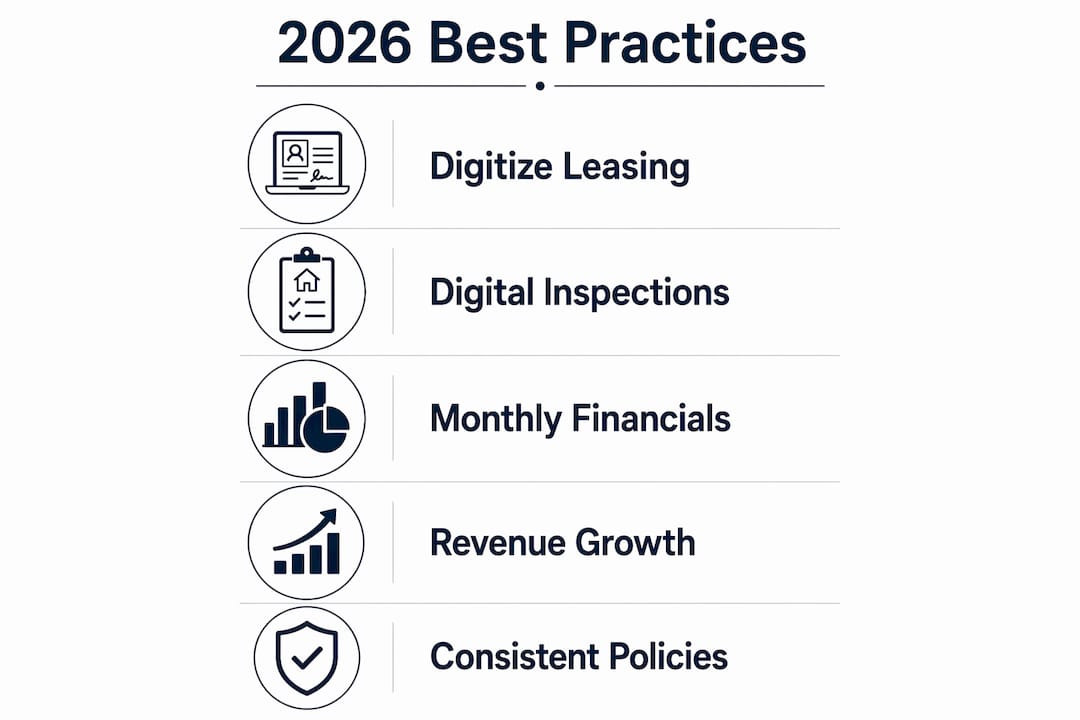
1. Digitize leasing and screening end to end. Require a single online application. Pre-screen income at 3× rent before scheduling a showing. Use integrated credit, criminal, and eviction checks. Approve or deny within 24 hours. Speed and consistency here reduce vacancy days and fair housing risk simultaneously.
2. Use digital inspection and maintenance ticketing. Photo-verified move-out and move-in inspections reduce deposit disputes and create an objective condition record for every unit. Maintenance tickets should be logged, assigned, and tracked in one system so nothing falls through the cracks.
3. Review financials monthly with a defined variance threshold. A 3% P&L variance threshold triggers a review before a budget problem becomes a budget crisis. Monthly reviews also give ownership accurate data for refinancing, sale, or capital planning decisions.
4. Build revenue beyond base rent. Transforming cost centers into revenue centers is the defining shift in modern multifamily operations. Bundling resident services, charging for premium amenities, and offering flexible lease terms all generate income that pure cost-cutting never can.
5. Enforce policies consistently across all tenants. Inconsistent enforcement creates fair housing liability and erodes tenant trust. A manager who enforces late fees for one tenant but waives them for another is one complaint away from a regulatory problem.
Pro Tip: Build your Property Standards Library before you need it. Document the exact paint color, HVAC filter size, and preferred vendor for each property. When a tech asks "what white goes on these walls?" the answer should be in the system, not in someone's memory.
What are effective strategies for managing tenant relations?
Tenant satisfaction drives occupancy. High turnover is expensive. The connection between the two is direct and measurable.
- Communicate on a defined schedule. Send maintenance updates within 24 hours of a request. Notify tenants of scheduled work at least 48 hours in advance. Predictable communication reduces complaints and builds trust.
- Handle maintenance requests fast and completely. A tenant who waits two weeks for a leaking faucet repair does not renew. Speed and follow-through on service requests are the single biggest driver of lease renewal decisions.
- Apply Fair Housing standards to every interaction. Consistent Fair Housing compliance is not just a legal requirement. It is the foundation of a professional operation that tenants and owners can trust.
- Use feedback to find problems before they become vacancies. A short survey at the 90-day mark and again at renewal time surfaces issues while there is still time to fix them. Waiting until a tenant gives notice is too late.
- Build community intentionally. Resident events, clear community rules, and responsive management create an environment where tenants want to stay. Retention is always cheaper than leasing.
Consistent policy enforcement builds professional respect more reliably than trying to be liked. Tenants who know the rules are applied fairly to everyone are more likely to follow them and more likely to renew.
Key Takeaways
Multifamily property management requires integrated systems, consistent policy enforcement, and financial discipline to protect asset value and keep tenants in place.
| Point | Details |
|---|---|
| Define the scope clearly | Multifamily management covers leasing, maintenance, financials, and compliance across all units simultaneously. |
| Screen tenants fast and consistently | Digital applications with 24-hour approval decisions reduce vacancy and fair housing risk. |
| Review financials monthly | A 3% P&L variance threshold catches budget problems before they compound. |
| Document every unit turn | Photo-verified inspections at move-out and move-in protect against deposit disputes and liability. |
| Enforce policies uniformly | Consistent enforcement builds tenant trust and reduces regulatory exposure across the portfolio. |
The part most operators get wrong
The TurnTrack Team has seen this pattern repeatedly: a property runs well when the right service manager is on site. Then that person takes a week off, or leaves, and suddenly nobody knows which vendor handles carpet, what paint goes in Unit 14, or whether the HVAC filter was changed last month. The knowledge was never in a system. It was in a person.
The operators who scale without chaos are the ones who treat documentation as a byproduct of the work, not a separate administrative task. When a tech completes a task, the record updates. When an inspection is walked, the before-and-after condition is captured. When a vendor is called, the contact was already in the turn record. None of that requires extra effort if the system is built right.
The other mistake is treating unit turns as a cost to minimize rather than a process to control. A delayed turn is a vacant unit. A vacant unit is lost revenue. The math is simple, but the fix requires visibility into where every turn stands at any given moment, not a status update buried in a text thread.
The operators who do this well are not necessarily the largest. They are the most consistent. They have standards written down, vendors coordinated in advance, and inspection records that can settle a deposit dispute in five minutes instead of a courtroom.
— TurnTrack Team
TurnTrack for multifamily make-ready operations
Running 5–15 active unit turns at once means tracking move-out dates, vendor schedules, inspection results, and property specs across every unit simultaneously. When that information lives in texts, emails, and people's memory, things get missed.
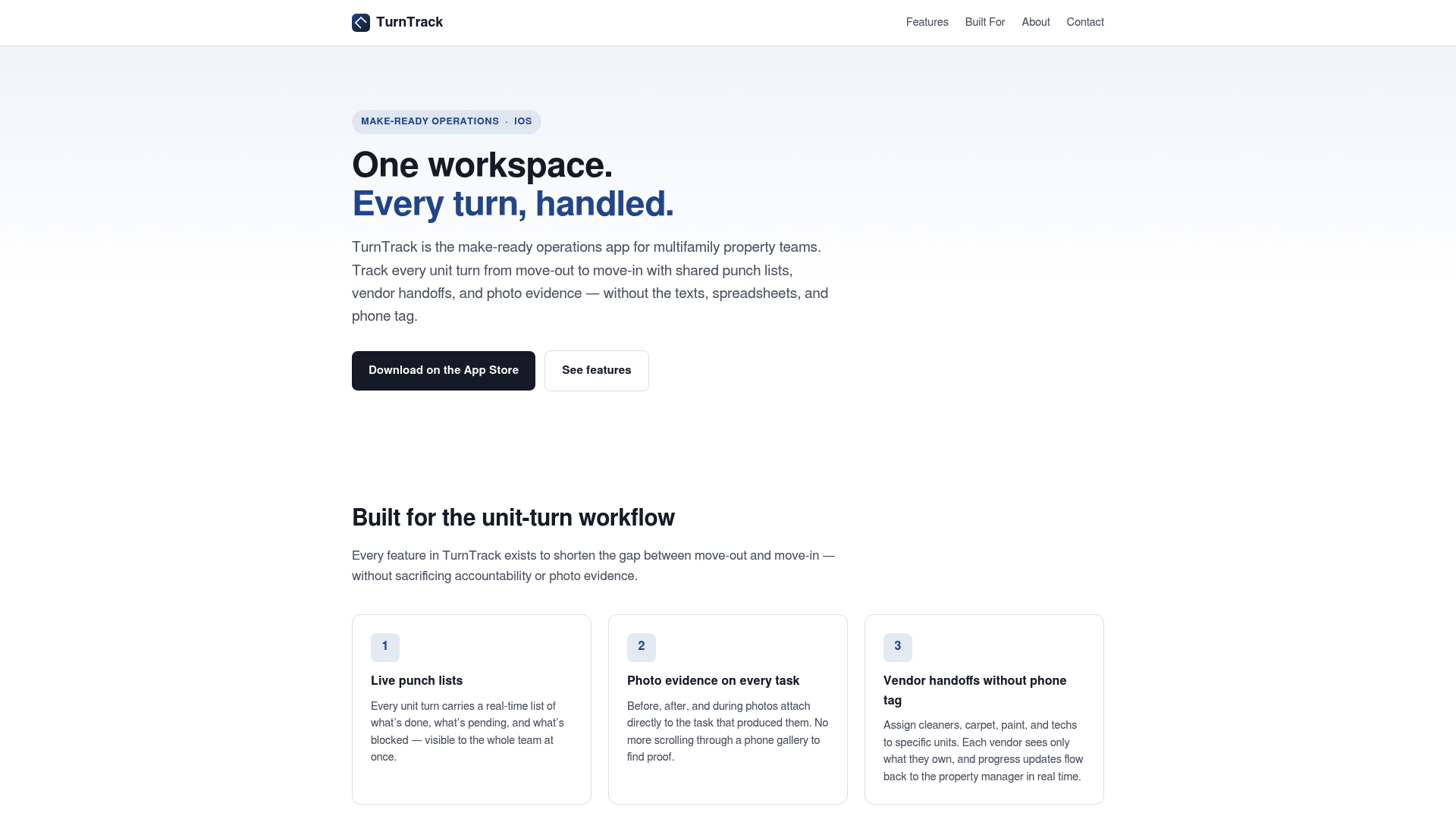
TurnTrack gives every turn a shared record with a status (Ready, On Track, At Risk, Overdue) and a timeline the whole team can see: Move-Out → Tech Start → Cleaners → Carpet → Inspection → Make-Ready. Vendor contacts live inside the turn, so there is no digging through a phone to find the carpet crew. The Property Standards Library keeps property-specific specs, from the exact Sherwin-Williams paint shade to the HVAC filter size, accessible to any tech or vendor without requiring them to have a TurnTrack account. Move-Out, Mid-Turn, and Move-In inspections are walked on a phone, area by area, building a before-and-after condition record as a byproduct of the work. TurnTrack runs at $14.99/mo per workspace with a free trial, iOS only.
FAQ
What is multifamily property management?
Multifamily property management is the professional administration of residential properties with multiple units, covering leasing, maintenance, financial oversight, tenant relations, and regulatory compliance. It is formally recognized by the NAA and NMHC as a distinct operational discipline.
What do property managers do in multifamily settings?
Property managers handle tenant screening, rent collection, maintenance coordination, budget reporting, and Fair Housing compliance across all units. In larger communities, they also supervise on-site staff and report to regional or corporate asset managers.
How much do multifamily property management companies charge?
Professional multifamily management firms typically charge 4–10% of gross revenue, depending on property size and the scope of services included.
What are the biggest challenges in multifamily property management?
The most common challenges are maintaining consistent policy enforcement across all tenants, coordinating unit turns efficiently to minimize vacancy, and keeping compliance documentation current across multiple overlapping regulations.
What software do property managers use for multifamily operations?
Property managers use a range of digital tools for multifamily operations, from full property management systems handling rent and leases to specialized tools like TurnTrack that manage unit-turn and make-ready workflows specifically.