
A unit is ready for rent when it meets every operational, safety, and aesthetic standard required for immediate occupancy. That means rekeyed locks, a thorough walkthrough with a checklist, tested HVAC, deep cleaning, mold removal, and documented condition. It is not just about looking presentable. A unit that passes visual inspection but has a broken exhaust fan or a lock the previous tenant still has a key to is not ready.

The make-ready process is the industry term for this work. "Ready for rent" is the outcome. Getting there reliably, across multiple units at once, is where most service managers run into trouble.
Key components of a rent-ready unit:
- Security: Rekey all entry points so prior tenants have no access
- Maintenance: Replace or repair non-functional items, test HVAC and plumbing
- Cleaning: Professional-grade cleaning, including appliances and hard-to-reach areas
- Mold and mildew: Remove mold before any showing or move-in
- Documentation: Condition photos and a signed move-out inspection report
- Compliance: Smoke detectors, CO detectors, and any local habitability requirements
Tools like TurnTrack and programs like Rent Ready exist specifically to help managers close the gap between "we think it's done" and "we can prove it's done."
What does the ready-for-rent process look like step by step?
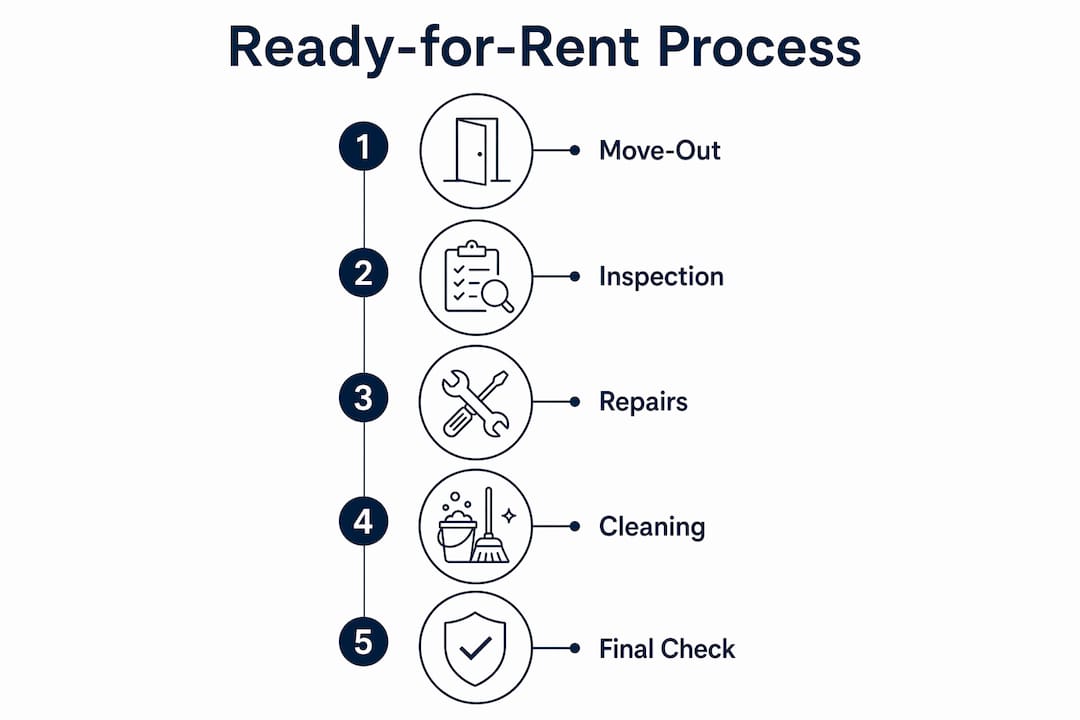
The unit turn process runs from the day a tenant gives notice to the day a new tenant gets keys. Every step has a dependency, so skipping or rushing one creates problems downstream.
- Move-out inspection. Walk the unit the day the tenant vacates. Document condition area by area, compare to the original move-in record, and note every item needing repair or replacement.
- Punch list creation. Convert inspection findings into a task list with assigned owners and deadlines. Vague lists ("fix bathroom") cause delays. Specific ones ("replace caulk around tub, re-grout tile floor") do not.
- Vendor scheduling. Book trades in the right sequence: general repairs before paint, paint before carpet, carpet before cleaning. Scheduling them out of order adds days.
- Maintenance and repairs. Address all punch list items. Test HVAC, plumbing, appliances, and electrical. Replace filters, light bulbs, and any worn hardware.
- Paint and flooring. Touch up or repaint walls to the property's specified color. Clean or replace carpet based on condition.
- Professional cleaning. A clean, functional unit with no mold or mildew significantly improves tenant attraction and cuts time on market. Hire professionals for this stage.
- Rekey locks. Do this after cleaning, not before, so contractors are not working with the new key.
- Final inspection. Walk the unit again with a checklist. Sign off only when every item passes.
- Move-in prep. Set the thermostat, leave any required documentation, and confirm the unit status as ready.
Pro Tip: Schedule your vendors in a shared calendar tied to the unit, not just in your head or a group text. When the carpet crew finishes early, you need to know immediately so cleaning can move up.
How do you coordinate vendors without losing control of the turn?

Vendor coordination is where most turnovers fall apart. A tech finishes repairs, but nobody tells the painter. The painter wraps up, but the carpet crew was never booked. Each gap costs a day, sometimes two.
The fix is treating vendor coordination as part of the turn record, not a separate communication thread. Every vendor involved in a unit should be visible in the same place where the turn status lives.
Common maintenance and repair tasks that require vendor coordination:
- Drywall patching and texture matching
- Appliance repair or replacement
- Plumbing fixture replacement
- Carpet cleaning or replacement
- HVAC filter change and system test
- Exterior lock rekeying
Quality control checkpoints matter as much as scheduling. A mid-turn inspection catches problems before the final walk, when fixing them is faster and cheaper. A move-in inspection with photo documentation creates a clean baseline for the next tenancy.
Transparent scheduling and vendor coordination can cut turnover times by up to 30%, reducing both vacancy days and associated costs.
Common pitfalls to avoid: booking vendors without confirming availability, assuming a task is done without a sign-off, and using different contact lists for each property so nobody knows who the preferred vendor is.
What are typical turnaround timelines and costs?
Industry benchmarks suggest that standard unit turns vary depending on unit size and the scope of maintenance needed, with smaller units turning faster and larger ones taking longer.
| Task | Typical Duration | Cost Range |
|---|---|---|
| Move-out inspection | 1–2 hours | Staff time |
| Repairs and maintenance | 1–5 days | Varies by scope |
| Paint (touch-up or full) | Typically a few days | Cost varies based on scope |
| Carpet cleaning or replacement | Typically around a day | Cost varies widely depending on condition and materials |
| Professional cleaning | Several hours | Cost varies based on unit size and condition |
| Rekeying | Usually under an hour | Cost depends on number of locks and region |
| Final inspection | 1–2 hours | Staff time |
Costs for a full turn, including cleaning, repairs, and security updates, vary widely by market and unit condition. The biggest cost driver is not any single task. It is unplanned delays that push the vacant unit past its target date.
Factors that speed up a turn: pre-scheduled vendors, a clear punch list from day one, and a shared status visible to everyone involved. Factors that slow it down: waiting on approvals, discovering deferred maintenance mid-turn, and poor communication between trades.
How does TurnTrack help you manage unit turns more efficiently?
TurnTrack is a make-ready operations workspace built specifically for unit turn management. It does not handle rent, leases, or accounting. What it does is give every active turn a shared record that the whole team can see and update in real time.
Each turn carries a status: Ready, On Track, At Risk, or Overdue. The timeline runs Move-Out to Tech Start to Cleaners to Carpet to Inspection to Make-Ready. Everyone working the unit sees the same picture.
| Feature | What it does |
|---|---|
| Unit turn record | Tracks status and timeline for every active turn |
| Activity feed | Logs updates and optional photos tied to each stage |
| Inspections | Move-Out, Mid-Turn, and Move-In walked area by area on a phone |
| Vendor coordination | Vendor contact lives inside the turn, not in a separate list |
| Property Standards Library | Stores paint specs, filter sizes, faucet models, and preferred vendors |
| Punch list | Task-level tracking with optional photo proof |
The Property Standards Library is one of the features that saves the most back-and-forth. A tech on site asking "what white goes on these walls?" gets the answer from the spec sheet in the app, without needing to call the office or wait for a reply. The exact Sherwin-Williams color, the HVAC filter size, the preferred carpet vendor. All of it, shared without requiring the tech to have a TurnTrack account.
Built by a service manager with 9+ years in the field, TurnTrack is designed for the people still doing the work, not for enterprise procurement teams evaluating feature lists.
Audit-ready records are a byproduct of normal use. Photos attach to inspection items where the property requires documentation. Smoke detector replaced with the date written on it? Attach the photo to the task. No extra step, no separate filing system.
Pro Tip: Use TurnTrack's Property Standards Library before a new tech or vendor ever sets foot in a unit. Send them the spec sheet from the app so they arrive knowing the paint color, filter size, and any property-specific requirements.
TurnTrack runs on iOS and costs $14.99/month per workspace, with a free trial. One subscription covers the team you invite.
How does real-time tracking improve quality assurance?
Real-time tracking closes the gap between "I think it's done" and "I can confirm it's done." When a turn status updates from In Progress to Inspection, the manager knows to schedule the walk without chasing anyone for an update. When a task slips past its deadline, the At Risk flag appears before the move-in date is in jeopardy.
Detailed checklists and audit trails reduce errors and improve operational transparency across the board. Quality assurance is not a separate phase. It runs through every stage of the turn, from the move-out inspection to the final sign-off.
How should you communicate with tenants during a turnover?
Outgoing tenants need clear move-out instructions: cleaning expectations, key return procedures, and the timeline for security deposit disposition. Vague instructions lead to disputes. A written checklist sent at notice reduces damage claims and speeds up the inspection.
Incoming tenants want to know when the unit will be ready and what to expect at move-in. Confirm the move-in date only after the final inspection passes. Showing a unit before it is fully ready, or promising a date you cannot meet, creates a bad first impression before the tenancy even starts. For multifamily property management teams, a consistent communication template for both sides of the turn saves time and reduces misunderstandings.
What strategies cut vacancy time most effectively?
The fastest way to reduce vacancy is to start the turn the same day the unit empties. Every day of delay before the first vendor arrives is a day of lost rent with no offsetting benefit.
Pre-scheduling vendors before move-out is the single highest-leverage tactic for property management communication. If you know the move-out date two weeks in advance, the painter, carpet crew, and cleaners can be on the calendar before the tenant leaves. Pair that with a unit readiness checklist and a shared turn record, and the coordination overhead drops significantly.
Listing the unit as available for lease before the turn is complete is common practice, but only works if the move-in date is accurate. Overpromising on vacant rental listings damages your reputation with prospective tenants and leasing agents alike.
What legal and regulatory requirements apply to rent-ready units?
Every state sets minimum habitability standards that a unit must meet before it is legally available for rent. Common requirements include functioning heat, hot water, working locks, smoke and carbon monoxide detectors, and freedom from pest infestation. Failing to meet these before a tenant moves in exposes the property to liability and, in some jurisdictions, rent withholding.
Security deposit law varies by state and governs how quickly you must return deposits and what deductions are permissible. Documenting unit condition at move-out and move-in with photos and signed inspection reports is the primary protection against disputes. Local building codes may also require permits for certain repairs, particularly electrical and plumbing work. Check with your local housing authority before starting any work that might trigger an inspection requirement.
Key Takeaways
A unit is not ready for rent until every safety, maintenance, and documentation standard is confirmed, not assumed.
| Point | Details |
|---|---|
| Start turns immediately | Begin vendor scheduling the day the unit empties to avoid unnecessary vacancy days. |
| Sequence vendors correctly | Book repairs before paint, paint before carpet, carpet before cleaning to prevent rework. |
| Document every stage | Move-out and move-in inspections with photos protect against deposit disputes and liability. |
| Use a shared turn record | A tool like TurnTrack gives the whole team one status view, reducing missed tasks and delays. |
| Know your legal baseline | State habitability laws set the floor; meet them before listing any unit as available for lease. |