
Auditing property management companies is the systematic process of verifying their financial records, operational procedures, and compliance standards to confirm your investment is managed effectively and securely. The industry term for this work is a property management audit, which covers financial statement reviews, trust account reconciliations, vendor payment verification, and operational workflow assessments. Property owners who skip this process often discover problems only after significant losses. A structured audit gives you documented evidence of performance, not just verbal assurances.
What financial aspects to audit in property management companies
Financial audits of property management companies start with three core documents: owner statements, rent rolls, and the management agreement. Every fee charged must match what the agreement authorizes. Discrepancies between the rent roll and bank deposits are the most common sign of misappropriation.
Trust account management is the highest-risk area in property management finance. Negative trust account balances can trigger immediate license suspension in several jurisdictions. That single fact makes monthly bank reconciliations non-negotiable, not optional.

Vendor payment verification is where most financial fraud hides. Monthly reviews of owner statements should include checks of rental income, fees, repairs, and delinquency rates, while quarterly surprise audits verify vendor payments against actual work and market rates. Pulling 10 or more random vendor payments per quarter and comparing them to invoices, work orders, and comparable market pricing catches inflated billing before it compounds.
Payment approval controls matter just as much as the payments themselves. Dual-approval timestamps from different authorized users in system logs are the strongest proof that payment controls are operating. Signatures on PDFs or screenshots do not meet that standard.
Key financial red flags to watch for:
- Financial closings consistently past the 20th of the following month
- Trust accounts showing negative balances for any beneficiary
- Vendor invoices without corresponding work orders
- Adjustments to transactions with no written explanation
- A single person controlling both payment initiation and approval
Pro Tip: Run a quarterly surprise audit by requesting the full vendor payment register for one random month, then pull the underlying invoices and work orders for at least 10 payments. Compare amounts to local market rates. This one exercise catches more fraud than a full annual review of summary statements.
How to assess operational performance and compliance during audits
Operational audits reveal problems that financial statements never show. Operational audits must examine interconnected systems like staffing, software, and workflows rather than isolated symptoms. A slow tenant onboarding process, for example, often traces back to poor documentation or fragmented software, not just undertrained staff.
Maintenance workflows deserve close attention. Recurring maintenance charges for the same unit signal poor first-time fix protocols and insufficient technician documentation. These repeated charges leak profitability beyond the direct cost of each repair, because unresolved issues accelerate asset depreciation.
Staffing structure creates its own audit risk. Key-person risk arises when critical functions like trust account reconciliation or report generation reside with a single individual. If that person leaves or acts dishonestly, the entire control structure collapses. Audits should verify whether operational knowledge is documented and shared across roles.
Compliance requirements add a legal dimension to operational audits. In regulated markets, annual audits of service-charge collections and escrow funds must be performed by government-authorized auditors, with penalties for missing reports including disciplinary and criminal liability. Even in less regulated markets, financial reporting accuracy and escrow fund management follow recognized standards that property owners can reference.
Evidence quality determines whether an audit finding holds up. Under auditing standards including AU-C 500, inquiry alone cannot prove audit effectiveness. System-generated logs and reproducible data are required for sufficient and appropriate audit evidence. Verbal explanations are the weakest form of evidence an auditor can accept.
"Verbal assurances are the weakest audit evidence. System-generated logs, automated reports, and dual-approval timestamps are what auditing standards require. If your property manager cannot produce those records, that absence is itself a finding."
Pro Tip: When reviewing operational performance, always ask for system-generated reports rather than manually prepared summaries. A manager who can only provide screenshots or narrative explanations of their processes has a documentation gap worth investigating.
Step-by-step approach to conducting an effective property management audit
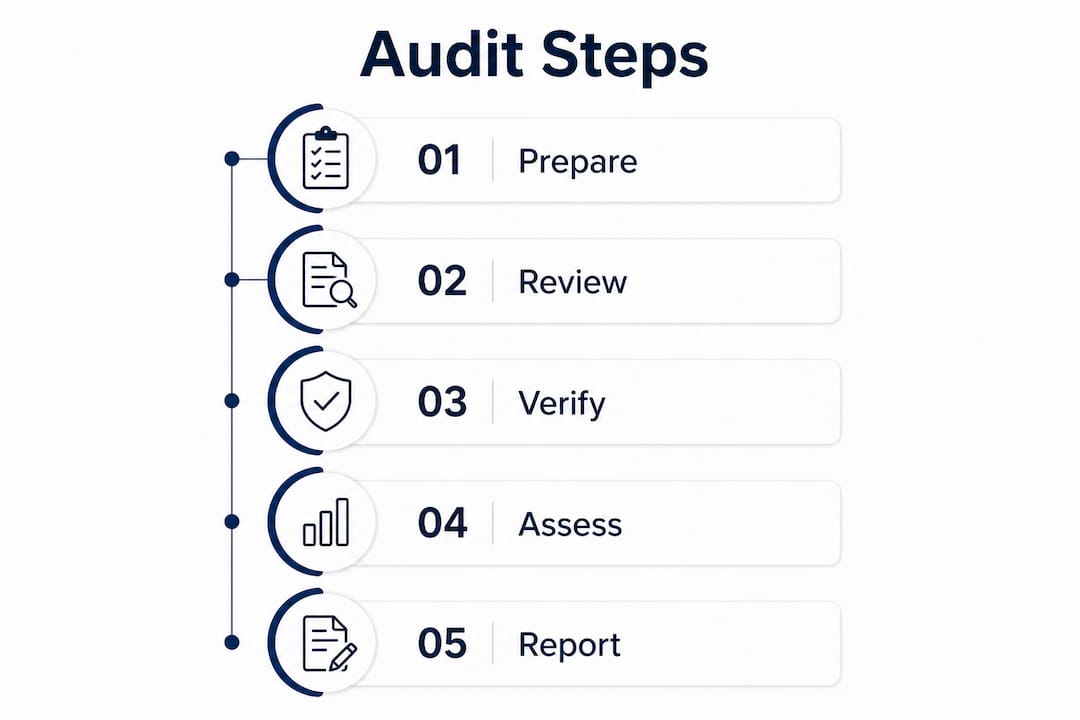
A structured audit program runs at three frequencies: monthly, quarterly, and annually. Each level has a different scope and purpose.
- Monthly reviews. Review owner statements, rent rolls, and maintenance charges. Confirm all fees match the management agreement. Flag any unexplained adjustments or late closings. This review should take at least 15 minutes per property and cover rental income, delinquency rates, and repair charges.
- Quarterly surprise audits. Pull vendor payment registers without advance notice. Sample at least 10 payments and verify them against invoices and work orders. Review lease renewals and occupancy trends. Check that bank reconciliations were completed on time.
- Annual comprehensive audits. Engage an independent CPA or fractional CFO to review financial statements, trust accounts, and internal controls. In regulated jurisdictions, this annual audit is a legal requirement. Independent reviews eliminate the conflict of interest that makes self-auditing unreliable for fraud detection.
Evidence management is as important as the audit itself. Collect system-generated reports, not manually prepared summaries. Store findings in a structured format that links each finding to supporting documentation.
The 5 C's model gives audit findings a consistent structure that makes follow-up actionable:
| Element | Purpose |
|---|---|
| Criteria | The standard or requirement that applies |
| Condition | What the audit actually found |
| Cause | Why the gap exists |
| Consequence | The financial or operational impact |
| Recommendation | The specific corrective action required |
Internal audits focus on improving processes and risk management with ongoing or periodic scope, while external audits focus on annual financial statement accuracy by independent auditors. Property owners benefit from running both: internal reviews monthly and quarterly, external reviews annually.
Pro Tip: Use the 5 C's model for every finding you document. A finding without a clearly stated consequence and recommendation gets ignored. A finding with all five elements gets fixed.
Common red flags and pitfalls to watch for in property management audits
Red flags in property management audits fall into two categories: financial control failures and operational documentation gaps. Both carry real financial risk, but they require different remediation approaches.
Financial control red flags:
- Unrestricted bank account access for a single employee
- Manual payment processes with no system-enforced approval workflow
- Reconciliations completed more than 20 days after month-end
- Vendor relationships that cannot be verified through independent sources
- Adjustments or voids in the accounting system without written authorization
Operational pitfalls are harder to spot but equally damaging. Fragmented software means data lives across texts, emails, spreadsheets, and individual memory. When a key person leaves, that knowledge leaves with them. Poor workflow documentation makes it impossible to verify whether standard procedures were followed or simply claimed.
Key-person dependency is the most underestimated risk in smaller property management operations. When one person controls report generation, vendor payments, and trust account reconciliation, the audit cannot rely on any of those records without independent corroboration.
Missing required audits in regulated markets carries the most severe consequences. Service-charge and escrow fund audits mandated by law are not optional filings. Failure to complete them exposes both the property manager and the property owner to regulatory penalties.
Pro Tip: Ask your property manager to demonstrate their payment approval workflow live, in the system, not on paper. If they cannot show you a system log with dual-approval timestamps from two different users, the control does not exist in a form that meets audit standards.
Key Takeaways
Effective property management audits combine financial verification, operational review, and compliance checks to protect your investment from mismanagement and fraud.
| Point | Details |
|---|---|
| Audit at three frequencies | Run monthly statement reviews, quarterly surprise vendor audits, and annual independent CPA reviews. |
| Trust accounts are highest risk | Negative beneficiary balances can trigger license suspension; verify reconciliations monthly. |
| Demand system-generated evidence | Verbal explanations and screenshots do not meet AU-C 500 audit evidence standards. |
| Key-person risk needs documentation | Critical tasks controlled by one person create fraud and continuity risk; verify knowledge is shared. |
| Use the 5 C's for findings | Structure every audit finding with Criteria, Condition, Cause, Consequence, and Recommendation. |
The audit mindset that actually protects your investment
Most property owners audit reactively. Something goes wrong, money disappears, a vendor overbills for months, and then the audit begins. That sequence is backwards. The goal of a property management audit is not to catch fraud after it happens. The goal is to make fraud structurally difficult before it starts.
The owners I have seen protect their assets most effectively do not micromanage their property managers. They set up a review cadence, demand system-generated evidence, and engage an independent professional annually. That combination creates accountability without interference. The property manager knows the controls exist. That knowledge alone changes behavior.
Operational audits get skipped more often than financial ones, and that is a mistake. A property manager who handles finances correctly but runs fragmented workflows, ignores first-time fix rates, and lets critical knowledge concentrate in one person is still a liability. The financial statements look clean until the operational failures start showing up as vacancies, asset damage, and vendor disputes.
Technology matters here, but not in the way most people think. The value of a digital workflow tool is not automation. The value is documentation as a byproduct of the work itself. When a tech completes a task in a system, the timestamp, the status, and the photo are already there. You do not need to chase evidence after the fact. That is the kind of operational transparency that makes audits faster, cheaper, and more reliable.
Commit to continuous improvement, not one-time reviews. An audit that produces findings and no follow-up is a wasted investment. Build remediation tracking into your process and revisit findings at the next review cycle.
— TurnTrack Team
How TurnTrack supports operational transparency and audit readiness
Property owners who want cleaner audits need cleaner operations. TurnTrack is a make-ready workflow platform built for multifamily property teams that need a shared record of every unit turn, not another spreadsheet.
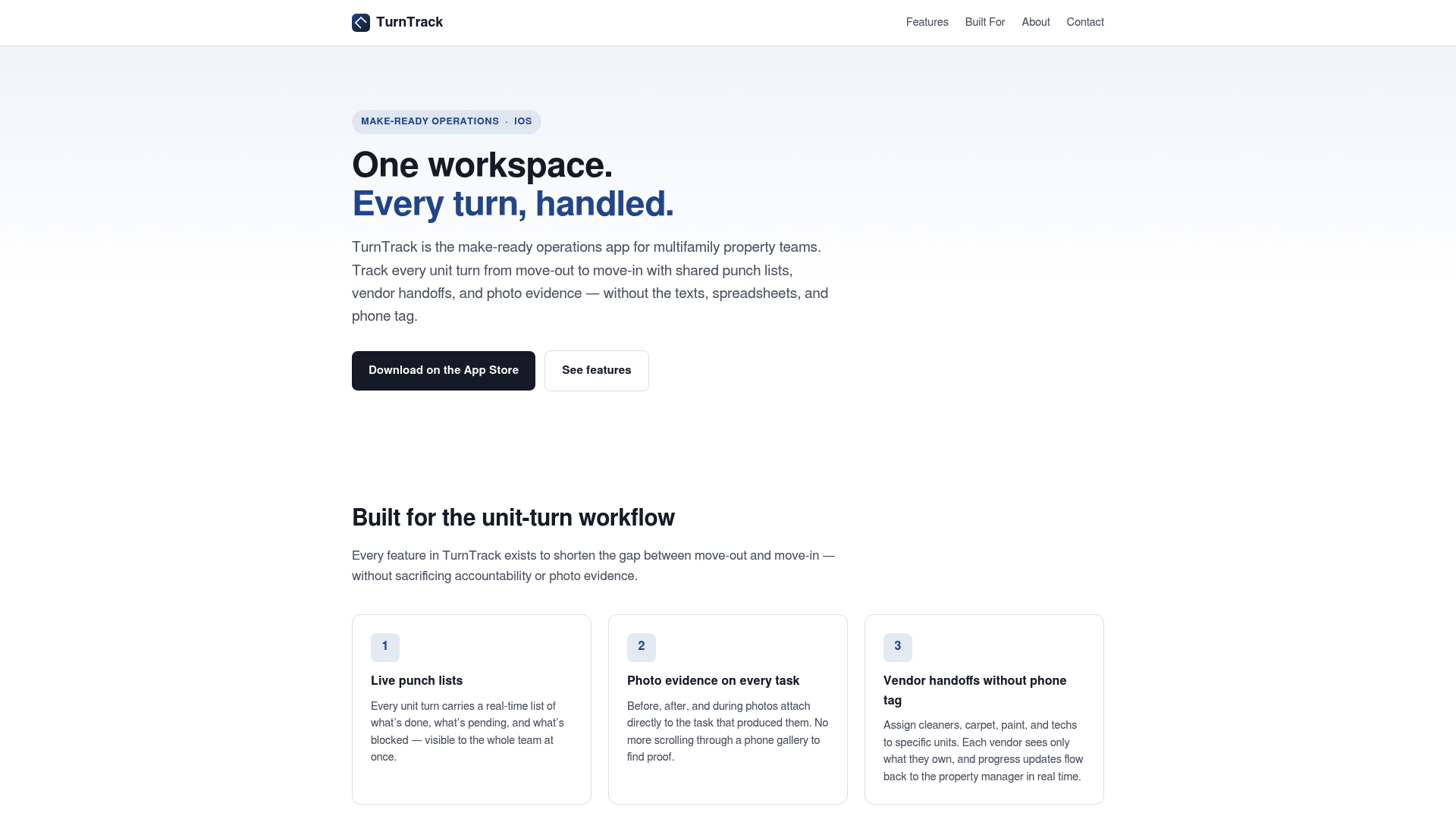
Every turn in TurnTrack carries a status (Ready, On Track, At Risk, Overdue) and a full timeline from Move-Out through Tech Start, Cleaners, Carpet, Inspection, and Make-Ready. The activity feed logs updates and optional photos tied to each stage, creating documentation as a byproduct of the work. The Property Standards Library keeps property-specific specs in one place, from paint colors to HVAC filter sizes, and shares them to techs and vendors without requiring a separate account. Vendor contacts live inside each turn, so coordination is traceable. TurnTrack runs on iOS at $14.99/mo per workspace, with a free trial available.
FAQ
What does auditing a property management company involve?
Auditing a property management company involves reviewing financial records, trust account reconciliations, vendor payments, operational workflows, and compliance with applicable regulations. The process uses system-generated evidence rather than verbal explanations to meet recognized auditing standards.
How often should property owners audit their property manager?
Property owners should review owner statements monthly, conduct surprise vendor payment audits quarterly, and commission an independent CPA review annually. This three-frequency approach catches discrepancies at different levels of detail.
What are the biggest red flags in a property management audit?
The biggest red flags include negative trust account balances, financial closings past the 20th of the following month, manual payment processes without dual-approval controls, and critical operational knowledge concentrated in a single employee.
Do property management companies have to be audited by law?
In regulated markets, yes. Annual audits of service-charge collections and escrow funds are legally required and must be performed by authorized auditors, with penalties for non-compliance including disciplinary and criminal liability. Requirements vary by jurisdiction.
What is the difference between an internal and external property management audit?
Internal audits focus on ongoing process improvement and risk management, while external audits provide independent verification of annual financial statement accuracy. Property owners benefit from running both types on separate schedules.