
Cloud property management in 2026 is defined by three converging forces: AI-driven workflow automation, unified lifecycle platforms, and compliance-by-design as a baseline requirement. The cloud property management trends 2026 brings are not incremental upgrades. They represent a structural shift in how property managers run portfolios, coordinate vendors, and manage risk. AI adoption has jumped from 20% in 2025 to 58% in 2026 among property management firms, and 78% of real estate executives now rank technology adoption as their top strategic priority. That pace of change means property managers who wait to evaluate their tech stack are already behind.
How are AI-driven workflows changing property management in 2026?
AI automation is the single biggest operational shift in property management this year. AI agents now handle tenant communications, rent collection reminders, maintenance coordination, and real-time operational monitoring without constant manual input. That removes entire categories of repetitive work from a property manager's day and lets teams focus on decisions that actually require human judgment.
The practical applications fall into three categories:
- Leasing assistants: AI chatbots qualify leads, answer availability questions, and schedule tours around the clock. A prospect asking about a unit at 11:00 PM gets a real response, not a voicemail.
- Maintenance triage: AI routes incoming maintenance requests by urgency and trade type, flags repeat issues on the same unit, and schedules the right vendor automatically.
- Rent collection automation: Reminder sequences, payment plan offers, and escalation notices go out on schedule without a team member manually tracking each resident's status.
The jump from 20% to 58% AI adoption in a single year is not a gradual trend. It signals that AI integration has crossed from early adopter territory into standard operating practice. Property managers who have not yet evaluated AI tools for at least one workflow category are now in the minority.
Pro Tip: Pick one workflow problem, such as maintenance triage or rent reminders, and pilot an AI solution against that specific need. Buying a broad AI platform because it sounds capable rarely delivers ROI as fast as solving one concrete problem well.
Why are property managers moving from tool stacks to unified platforms?
The six-tool stack is becoming a liability. The industry has shifted from multiple disconnected tools to integrated cloud platforms built around the resident lifecycle, with mobile-first design and compliance-by-design as standard requirements. When your leasing data lives in one system, maintenance in another, and financials in a third, you spend more time reconciling data than acting on it.

Unified platforms solve this by organizing every function around a single resident record. Leasing, renewals, maintenance history, and payment records all connect to the same unit and the same tenant. That structure makes audits faster, reduces data entry errors, and gives managers a complete picture without pulling reports from three different dashboards.
| Attribute | Point-solution stack | Unified lifecycle platform |
|---|---|---|
| Data visibility | Siloed by tool | Single record per unit and resident |
| Audit readiness | Manual reconciliation required | Built-in audit trails |
| Mobile access | Varies by tool | Mobile parity as standard |
| Compliance features | Add-on or absent | Compliance-by-design |
| Vendor coordination | External lists and texts | Integrated within workflow |
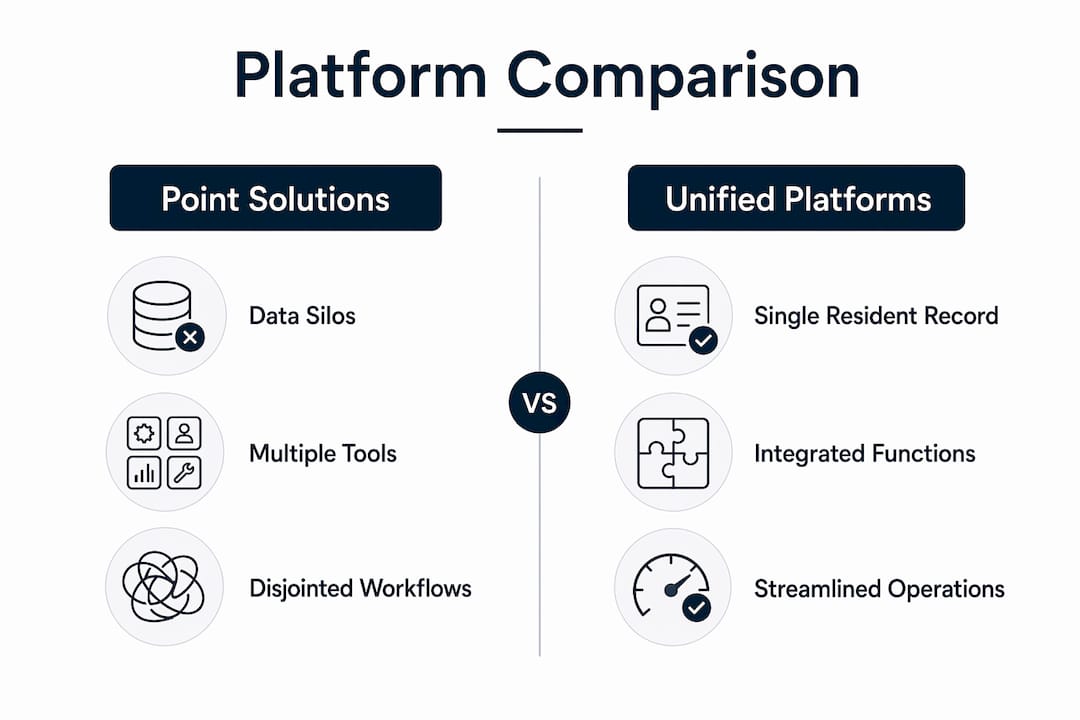
The mobile-first requirement deserves specific attention. Field teams, maintenance techs, and vendors do not work from desks. A platform that requires desktop access for core functions creates a gap between the office and the field that costs time on every turn.
Pro Tip: When evaluating a unified platform, test the mobile experience before the desktop demo. If a tech in the field cannot complete a work order or log an inspection update from their phone in under two minutes, the platform will not get used consistently.
What compliance risks are shaping platform selection in 2026?
Compliance is no longer a feature category. It is a selection filter. Legal settlements like Greystar and RealPage have put algorithmic rent pricing and tenant screening under direct regulatory scrutiny. Property managers using platforms that cannot document their pricing logic or screening decisions now carry real legal exposure.
The compliance features that matter most in 2026 platform selection include:
- Audit trails: Every pricing decision, screening action, and communication must be logged with a timestamp and user attribution.
- Role-based permissions: Staff should only access the data their role requires. Open access across a platform creates both security and compliance risk.
- Fair housing safeguards: Compliance-by-design now includes built-in fair housing guardrails that flag inconsistent application of screening criteria.
- Configurable record retention: Retention policies need to match state and local requirements, which vary significantly across markets.
The EU AI Act adds another layer for operators with international portfolios. It requires traceable algorithmic logic and documented decision processes for any AI system affecting individuals. Even US-based operators with European properties need platforms that can produce that documentation on demand. Poorly documented AI algorithms now elevate legal risk in a way that was theoretical two years ago and is concrete today.
How does cloud technology reduce operating costs at scale?
Cloud-native AI delivers measurable cost reduction when implemented with a clear operational target. Douglas Elliman launched a multi-year AI transformation built on Google Cloud technology specifically to reduce non-commission operating expenses and reset its cost structure over a three-year timeline. That is not a technology experiment. It is a business decision driven by margin pressure.
The cost reduction mechanisms that cloud and AI enable follow a clear pattern:
- Predictive maintenance: Real-time monitoring flags equipment issues before they become emergency repairs. Emergency HVAC calls cost three to five times more than scheduled maintenance. Catching a failing unit before it fails eliminates that premium.
- Staffing efficiency: Automated workflows handle volume that previously required additional headcount. A team managing 200 units with AI-assisted maintenance routing and communication can operate at the same service level as a larger team without automation.
- Portfolio analytics: Centralized real-time dashboards pull occupancy, rent roll, maintenance spend, and cash flow data across multiple properties instantly. Managers make pricing and staffing decisions based on current data, not last month's report.
- Faster unit turns: Every day a unit sits vacant between residents is direct revenue loss. Cloud-coordinated turn workflows reduce the time between move-out and move-in by keeping every vendor and task on a shared timeline.
The operational efficiency gains compound. Faster decisions, fewer emergency costs, and tighter vendor coordination each contribute independently, and they reinforce each other when they run on the same platform.
How should property managers build their technology roadmap for 2026?
The best property operators in 2026 prioritize platforms that fit their resident lifecycle and build lightweight internal automations rather than chasing broad vendor feature lists. That principle applies directly to how you should approach your technology roadmap.
Practical adoption guidance for property managers evaluating cloud tools this year:
- Pilot one trend at a time. Deploying AI leasing, a new maintenance platform, and a unified dashboard simultaneously creates change fatigue and makes it impossible to measure what is working.
- Match tool complexity to portfolio size. Enterprise platforms built for 10,000-unit portfolios overserve and overprice operators managing 200 to 500 units. Evaluate tools against your actual workflow, not the vendor's largest case study.
- Train before you automate. AI tools produce bad outputs when the underlying data is messy. Clean your unit records, vendor lists, and maintenance categories before turning on automation.
- Use no-code tools to fill gaps. Property managers are building custom automations using low-code platforms like Claude, Cursor, and Replit to handle workflow gaps their primary software does not address. You do not need a developer to automate a recurring report or a vendor notification sequence.
- Evaluate your property management software options against lifecycle fit, not feature count. A platform that covers 80% of your workflow well beats one that covers 120% of it poorly.
The operators gaining ground in 2026 are not the ones with the most tools. They are the ones who implemented fewer tools more completely.
Key Takeaways
Cloud property management platforms in 2026 require AI integration, compliance-by-design, and unified lifecycle data to deliver real operational efficiency gains.
| Point | Details |
|---|---|
| AI adoption is now mainstream | AI use among property management firms jumped from 20% to 58% in one year, making it a standard expectation. |
| Unified platforms replace tool stacks | Integrated lifecycle platforms reduce data silos, speed up audits, and improve field team access. |
| Compliance is a selection filter | Audit trails, role-based permissions, and fair housing safeguards are mandatory criteria, not optional features. |
| Cloud cuts costs through predictive action | Real-time monitoring and automated workflows reduce emergency costs and improve staffing efficiency. |
| Pilot before scaling | Deploying one technology at a time produces measurable ROI and avoids operational overload. |
The technology gap that most operators still miss
The conversation about cloud property management trends in 2026 focuses heavily on leasing, AI, and portfolio analytics. That is the right conversation for the front office. But the gap most operators still have is in the field, specifically in unit turn and make-ready coordination.
A service manager running 10 active turns at once is managing move-out dates, vendor schedules, unit-specific conditions, and inspection timelines simultaneously. Without a shared system, that coordination lives in texts, phone calls, and memory. AI and unified platforms do not solve that problem because they are not built for it. They handle leasing and financials. The turn workflow falls through the gap.
The operators I have seen gain the most from cloud adoption in 2026 are the ones who closed that gap deliberately. They did not wait for their primary platform to add turn management. They used a purpose-built tool for make-ready coordination and connected it to their broader workflow. The result is a complete picture: the front office knows what the platform says, and the field team knows what the unit actually needs.
The compliance argument applies here too. A before-and-after condition record built during the turn, with optional photo documentation attached to each inspection stage, is exactly the kind of audit trail that protects operators in deposit disputes. That documentation does not happen automatically. It happens when the workflow requires it and makes it easy.
The technology roadmap for 2026 is not just about AI and unified platforms. It is about closing every operational gap, including the ones that happen between move-out and move-in.
— TurnTrack Team
TurnTrack: built for the make-ready gap in your cloud stack
Property managers adopting cloud platforms in 2026 still need a dedicated tool for unit turn and make-ready coordination. TurnTrack handles exactly that workflow, and nothing else.
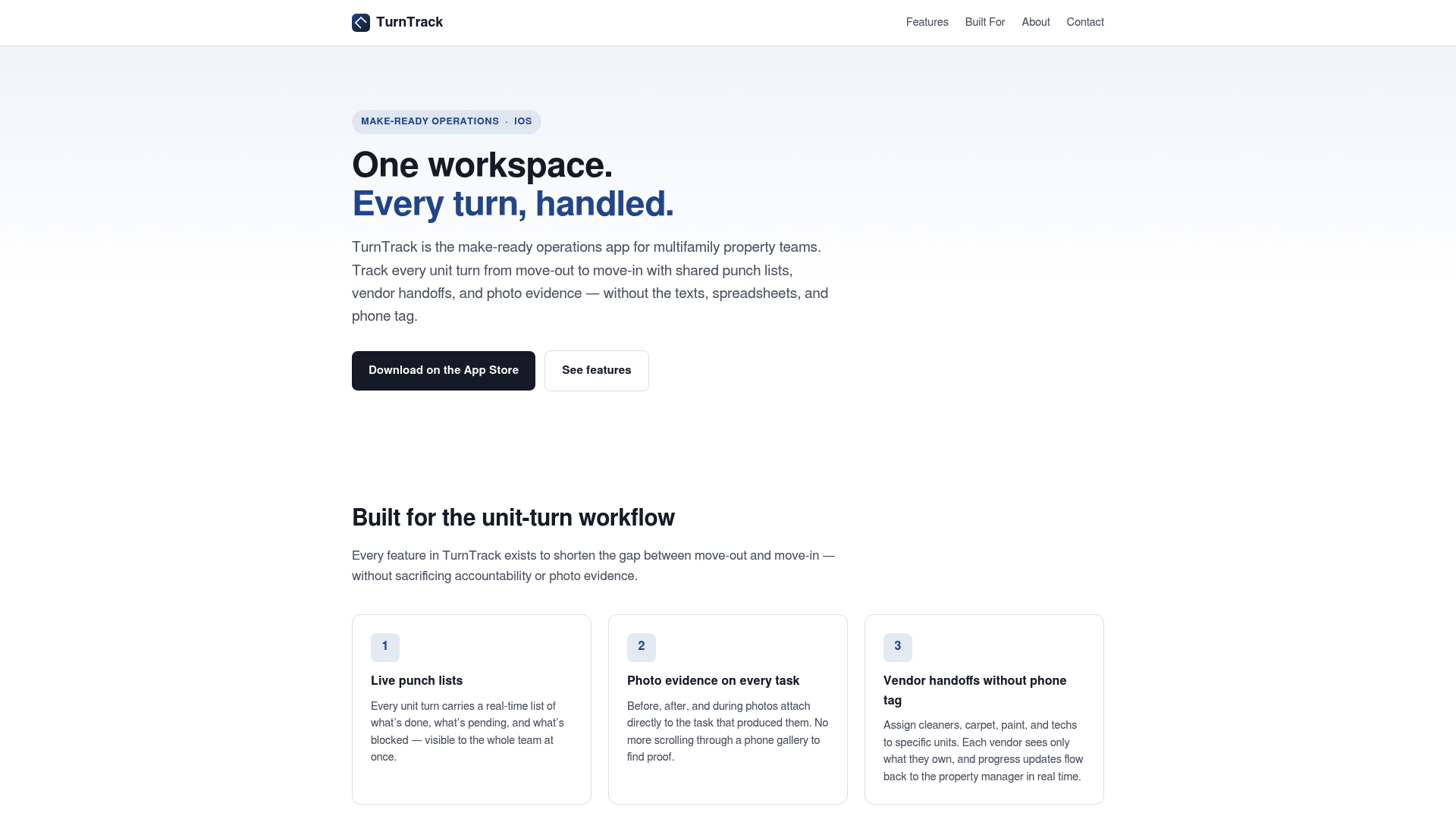
Every turn gets a shared record with a status (Ready, On Track, At Risk, or Overdue) and a timeline that runs from Move-Out through Tech Start, Cleaners, Carpet, Inspection, and Make-Ready. Vendor contacts live inside the turn record, so no one is digging through their phone to find the carpet crew. The Property Standards Library keeps unit-specific specs, including paint colors, filter sizes, and preferred vendors, accessible to any tech or vendor without requiring them to have a TurnTrack account. A workspace subscription runs $14.99 per month with a free trial available on iOS. Built by a service manager with 9+ years in the field, for the teams still doing the work.
FAQ
What are the top cloud property management trends in 2026?
The top trends are AI-driven workflow automation, unified lifecycle platforms replacing disconnected tool stacks, and compliance-by-design as a mandatory platform feature. AI adoption among property management firms reached 58% in 2026, up from 20% the prior year.
How does AI improve property management operations?
AI automates tenant communications, maintenance triage, and rent collection reminders, reducing manual workload and improving response times. The result is faster service delivery without adding headcount.
Why is compliance-by-design important for property management software in 2026?
Legal settlements involving algorithmic rent pricing have made audit trails, role-based permissions, and fair housing safeguards mandatory selection criteria. Platforms without these features expose operators to direct legal and regulatory risk.
How will property management change in 2026 for smaller operators?
Smaller operators benefit most from purpose-built tools that match their actual workflow rather than enterprise platforms built for large portfolios. Piloting one technology at a time and using make-ready workflow tools alongside a core platform delivers the best results at manageable cost.
What is the difference between a point-solution stack and a unified platform?
A point-solution stack uses separate tools for leasing, maintenance, and financials, creating data silos and manual reconciliation work. A unified platform connects all functions to a single resident record, improving audit readiness and operational visibility.