
The fastest way to speed up unit turns is to inspect within 24 hours, scope the entire job once, sequence trades in the right order, coordinate vendors against a shared calendar, and start marketing before the unit is clean. Standard turns sequenced this way typically land in 3–5 days, with most operators targeting a 5–7 day average across the portfolio. The five levers that move that number: inspection speed, scope discipline, sequencing, vendor scheduling, and pre-marketing.
TL;DR:
- Inspect units within 24 hours of move-out to produce a single, photographic punch list that separates chargeable damage from standard make-ready work.
- Sequence repairs first, followed by painting, flooring, cleaning, and final quality assurance to prevent rework and minimize delays.
- Assign clear ownership and deadlines for each turn phase, and coordinate vendors via shared records to avoid handoff gaps that cause schedule setbacks.
- Start pre-leasing activities early, including marketing and applicant screening, to secure leases before final inspections and reduce vacancy duration.
- Track turn times and costs consistently to identify delays, improve the process, and plan contingencies for common bottlenecks like vendor availability and property condition risks.
Table of Contents
- A short 5-step playbook to reduce days vacant
- Inspect within 24 hours and build one scoped punch list
- Sequence the work so nothing gets redone
- Vendor coordination and capacity-aware scheduling
- Market early: pre-lease and lease-while-make-ready tactics
- Measure, analyze, and iterate: the metrics to track
- Training and management of maintenance and cleaning teams for faster turnaround
- Budgeting and cost control specifically for accelerating unit turns
- Contingency planning for unexpected delays during unit turns
- Author perspective: operator-to-operator notes and common pitfalls
- Putting the playbook into a shared system
- Sources
A short 5-step playbook to reduce days vacant
Days vacant get eaten by delays that compound. A unit that sits one extra day waiting on a vendor callback, then two more days because the punch list grew mid-job, turns a five-day job into a ten-day loss of rent. The fix is a repeatable sequence, not heroics from any one person.
- Pre-move-out prep: confirm move-out date, pull the unit's condition history, and line up vendors before the resident even leaves.
- Inspect and scope: walk the unit within 24 hours, photograph everything, and produce one final punch list.
- Schedule and sequence: assign every line item to a trade with a start date, following the correct phase order.
- Execute with QA: crews work the plan, and someone walks the unit before it's called ready.
- Market and close: get the unit listed and a lease signed as early in the process as the paperwork allows.
Each step needs an output, not just an activity. Pre-move-out prep produces a confirmed vendor lineup. Inspection produces a signed scope. Scheduling produces assigned owners and dates. Execution produces a completed QA checklist. Marketing produces a signed lease.
Triage the queue by pre-lease status first, then by daily rent exposure on the rest. A unit with an approved applicant waiting to move in jumps ahead of a unit that's still vacant with no prospects, even if the second one came available first.
Inspect within 24 hours and build one scoped punch list
Waiting two or three days to inspect a vacated unit is the single most common reason turns run long, because every day of delay pushes the whole schedule back before work even starts. A 24 hour inspection window gives you time to scope the job properly while still leaving room to hit a 5 to 7 day turn.
- Walk the unit within 24 hours of move-out and photograph every deficiency, comparing against the move-in condition report.
- Sort findings into two buckets: chargeable damage tied to the departing resident, and standard make-ready work the property absorbs.
- Write one final punch list before any crew shows up. Adding items after work starts is what causes re-cleans and repeat trips.
- Assign each line to a specific trade with an estimated duration and a parts list, so nobody discovers mid-job that the faucet needed a special order part.
Pro Tip: Photograph the move-in and move-out inspections the same way, room by room, in the same order. When a resident disputes a charge six months later, a side-by-side photo record settles it in minutes instead of becoming a he-said-she-said conversation.
A single locked scope also protects the schedule. Once vendors are working off one punch list instead of a moving target, they can quote accurate durations. That accuracy is what makes the rest of the timeline predictable instead of aspirational.
Sequence the work so nothing gets redone
Phase order determines whether a turn finishes in five days or fourteen. The sequence that works: repairs first, then paint, then flooring, then final clean, then QA. Reverse any two of those and you'll pay for it. Clean before paint touches up nail holes and the cleaner's work is undone by drywall dust. Install flooring before paint cures fully and you risk scuffing a floor you just paid to finish.
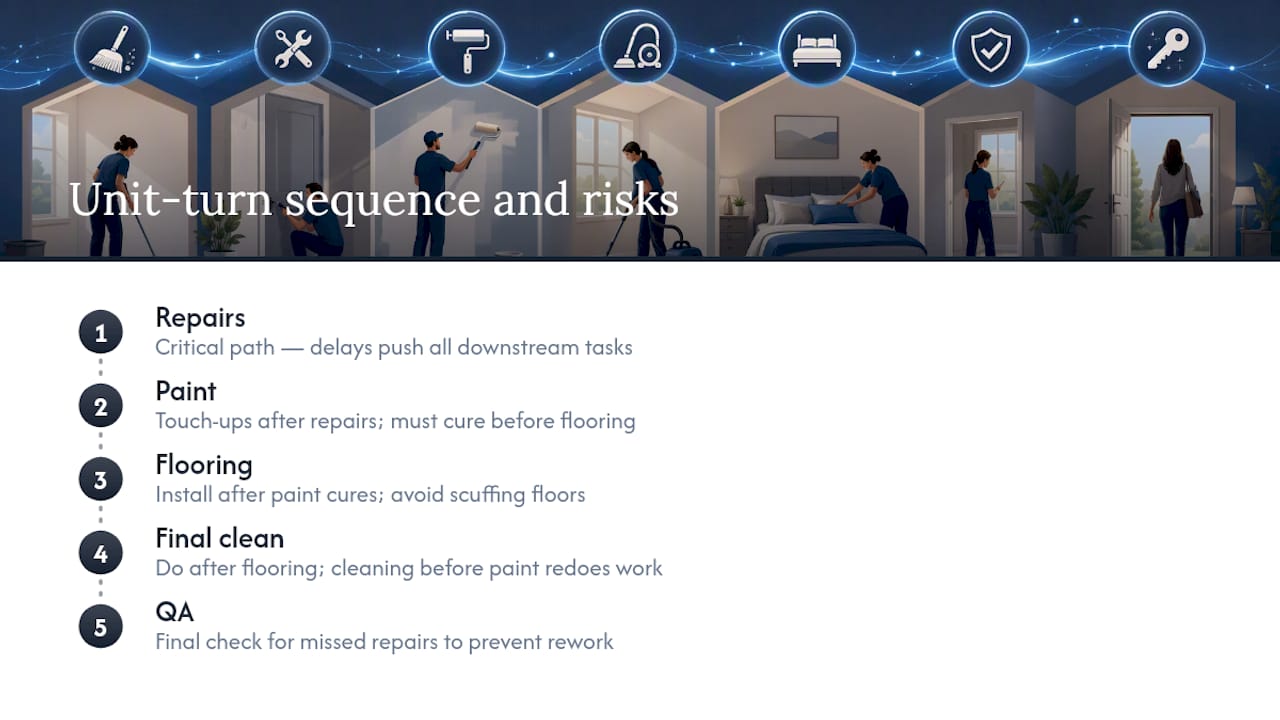
The most expensive sequencing error is sending cleaners in before paint has cured, which forces a second clean nobody budgeted for. The second most expensive is scheduling carpet or flooring before repairs are confirmed complete, since a missed repair often means pulling flooring back up.
Map the critical path before you schedule anyone. That's the chain of tasks where one delay pushes every downstream task back with it. Usually it runs through repairs, since paint, flooring, and cleaning all wait on repairs being done. Stage parts and materials ahead of time so a missing part doesn't stall the critical path.
Not everything has to wait in line. Batch identical tasks across multiple units so one vendor makes one trip instead of five. Parallelize anything that doesn't depend on another trade. Blinds can go up in one unit while paint cures in another. A landscaper can handle a patio while an electrician is inside.
Vendor coordination and capacity-aware scheduling
Vendor scheduling breaks down for one reason more than any other: nobody owns the handoff between trades. The painter finishes and assumes someone told the flooring crew. Nobody did. That gap between "finished" and "next crew notified" is where turns quietly lose a day or two, repeated across every unit in the pipeline.
- Name one owner for each phase of the turn, and put deadlines in a shared record everyone on the team can see.
- Keep each vendor's contact info, service window, and expected turnaround time attached to the turn itself, not buried in a separate contact list or a group text thread.
- Score turns using a priority matrix: pre-lease status, daily rent exposure, and estimated days to complete. Send scarce vendor capacity to the highest-exposure units first.
Standardizing phases and assigning fixed owners is what separates operators who consistently hit five-day turns from ones stuck averaging two weeks. The difference usually isn't crew speed. It's whether anyone was watching the handoff.
Market early: pre-lease and lease-while-make-ready tactics
Waiting for a unit to be spotless before listing it costs money every single day. Pre-marketing is essential to minimizing vacancy days, and the goal should be a signed lease before final QA wraps, not after.
- Start marketing the moment you get notice, using the same photos and floor plan from the last turn if the unit's finish package hasn't changed.
- Run applicant screening in parallel with make-ready work instead of waiting until the unit is move-in ready to start the process.
- Push for a signed lease before the final walkthrough whenever the pipeline allows it, so move-in day lines up right after QA clears.
- Never loosen screening standards to close the gap faster. Compress the calendar, not the criteria.
A unit leased before it's finished isn't a unit sitting vacant collecting no rent while marketing photos get scheduled. For portfolio-wide visibility into which turns are furthest from lease-ready, a structured vacancy playbook helps you rank turns the same way every time. Property managers who also want listing visibility tactics can look at property management marketing guidance for improving how fast a pre-leased unit surfaces to prospects.
Measure, analyze, and iterate: the metrics to track
You can't fix what you don't measure, and turn time hides in plain sight until someone tracks it consistently across every unit.
Statistic Callout: Standard turns should average 3–7 days when sequenced correctly; renovations run 10 to 14 days and belong on a separate track entirely, per DiscoveryMark's turnover benchmarks.
To prioritize which turns deserve attention first, divide monthly rent by 30 to get a daily vacancy cost. A $1,500 monthly rent unit bleeds roughly $50 a day, which makes the case for expediting it obvious to anyone who questions the priority.
After each turn, run a short review: what caused any delay, who owned that step, what corrective action was taken, and whether the playbook itself needs updating. Feed that into the next cycle. Over a few dozen turns, these turn time metrics start predicting vacancy loss before it happens instead of explaining it after the fact.
Training and management of maintenance and cleaning teams for faster turnaround
A fast crew that doesn't know the property's standards will still slow you down, because every question they can't answer themselves becomes a phone call, and every phone call is a delay. The fix isn't hiring faster people. It's giving your current people a reference they can check without waiting on you.
Standardize the small decisions before they become bottlenecks: which paint sheen goes on which wall, which vendor handles which trade, what the acceptable tolerance is for a scuffed cabinet versus one that needs replacing. Write it down once, in a place every tech and cleaner can reach, and the same question stops generating the same interruption turn after turn.
Cross-train cleaning crews on basic maintenance checks, like verifying smoke detectors and testing outlets, so a single walkthrough catches issues instead of requiring a second visit from maintenance. Set a clear QA standard that every unit gets checked against before it's called ready, not just the ones where something looked off during the final walk.

Rotate ownership of the final walkthrough so it isn't always the same person, and give feedback on missed items immediately rather than letting patterns repeat across ten units before anyone flags them. Teams improve fastest when the correction happens on unit three, not unit thirty.
Budgeting and cost control specifically for accelerating unit turns
Speed and cost control aren't opposing goals, but they get treated that way when budgets are set per unit without accounting for vacancy cost. A turn that costs $200 more but finishes three days sooner almost always wins, because three days of vacant rent on a typical unit usually exceeds that difference by itself.
Build the budget around three categories: standard make-ready costs that repeat on nearly every turn, chargeable repairs billed back to the departing resident, and rush costs for expediting a high-priority unit. Keep these separate. Blending them makes it impossible to tell whether a turn ran over budget because of resident damage, a slow vendor, or a genuine decision to pay for speed.
Negotiate standing rates with a small bench of reliable vendors rather than shopping every job individually. A fixed rate for standard turns removes a pricing negotiation from the critical path and gives vendors predictable volume in return for predictable pricing.
Track cost per unit alongside turn time, not separately. A property that shaves two days off average turn time but doubles rework costs hasn't actually improved anything. When a turn comes in fast and under budget, note what was different and repeat it. When one runs long and expensive, the post-turn review should catch why before the next cycle absorbs the same mistake.
Contingency planning for unexpected delays during unit turns
The operators who stay closest to their turn-time targets aren't the ones who avoid these problems. They're the ones who planned for them before they happened.
Keep a backup vendor for every trade that tends to bottleneck your schedule, even if that backup costs slightly more per job. Paying a premium once for a same-week replacement painter beats losing four days waiting on the primary vendor's next opening.
Build a small buffer into the schedule for turns with a known risk factor, like a unit with an older HVAC system or a resident who left the property in worse condition than usual. A one-day buffer on a risky turn is cheaper than a three-day scramble when that risk turns into an actual delay.
When a delay does happen, update the shared turn record immediately so the status reflects reality, whether that's On Track, At Risk, or Overdue. A turn quietly running late with nobody flagged is far more expensive than one visibly marked At Risk, because visibility is what lets a manager reallocate a vendor or adjust the marketing timeline before the delay compounds into a missed move-in date.
Author perspective: operator-to-operator notes and common pitfalls
Most teams don't lose time on the big stuff. They lose it on shortcuts that feel harmless in the moment. Skipping the 24 hour inspection to "save time" almost always backfires, because scope discovered on day three costs more than scope caught on day one. Ad hoc vendor scheduling, done over texts instead of a shared record, is the other repeat offender. It works fine until two vendors show up on the same day for the same unit, or nobody shows up at all.
The quick wins that actually move the needle: pre-stage parts you use on every turn, lock in fixed vendor windows instead of "whenever they can fit it in," and keep photo documentation to the moments that matter, like smoke detector dates, rather than forcing a photo on every single task. One turn record per unit, visible to everyone touching it, beats five people checking five different sources.
TurnTrack's own constraints reflect that philosophy. It's a $14.99 monthly workspace subscription on iOS, photos are optional where the property actually needs proof, and it doesn't try to be your accounting system or your leasing software. It does one job.
— TurnTrack Team
Putting the playbook into a shared system
Running this playbook on texts, spreadsheets, and memory works until you're juggling eight turns at once and someone forgets which vendor was supposed to show up Thursday. TurnTrack was built by by a service manager who lived that exact problem, and it maps directly onto the five-step process above instead of asking you to change how you work.
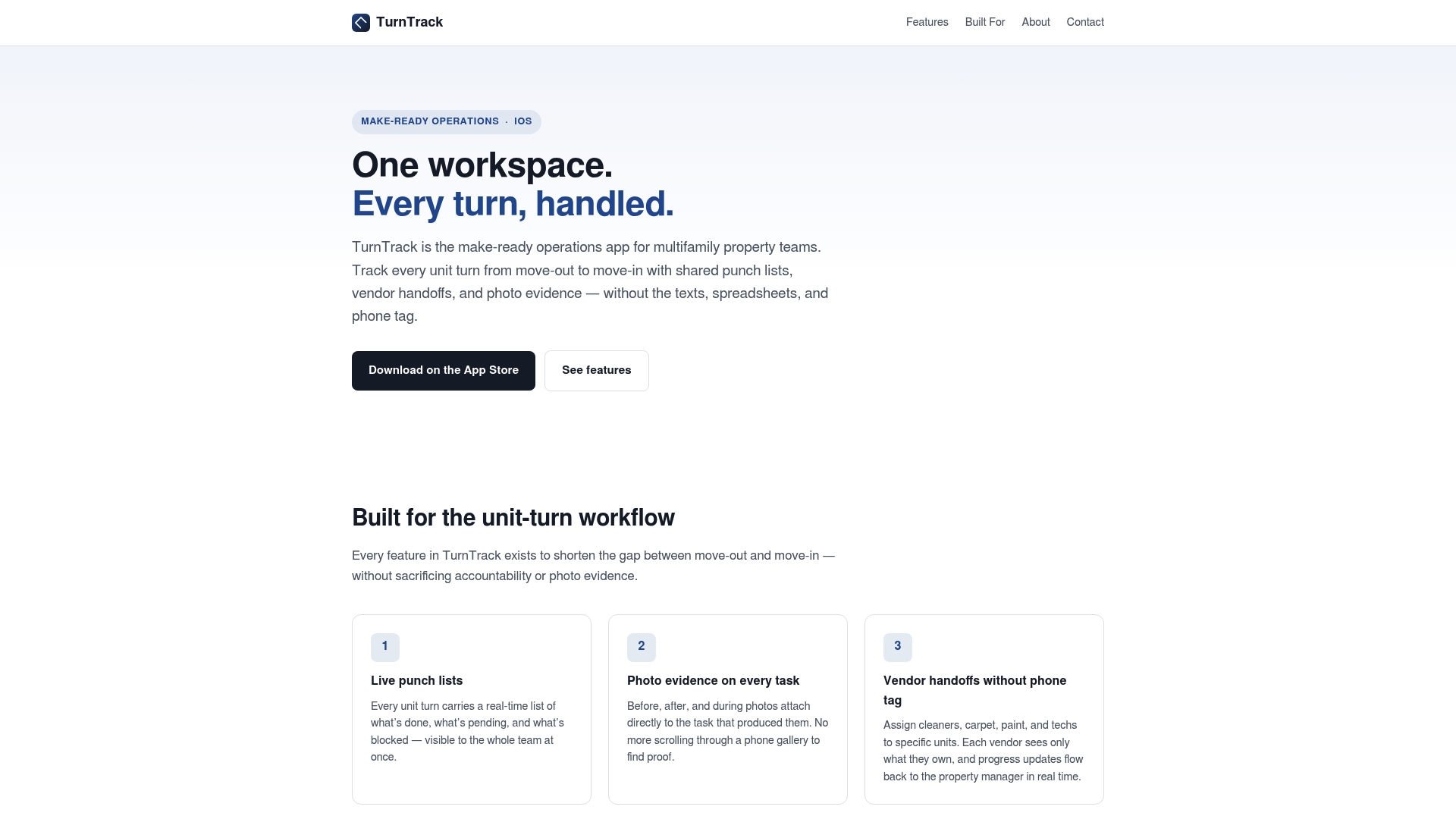
Every unit gets its own turn record with a status of Ready, On Track, At Risk, or Overdue, plus a timeline that runs Move-Out through Tech Start, Cleaners, Carpet, Inspection, and Make-Ready. Vendor contact info and service windows live inside the turn itself, not in a separate contact list. Inspections get walked room by room on a phone for Move-Out, Mid-Turn, and Move-In, building the punch list this article just walked through. The Property Standards Library holds property-specific specs, like the exact paint shade or filter size, so a tech's question gets answered from the app instead of a phone call to you. Photos attach where a property needs proof, like a dated smoke detector swap, without forcing a photo on every task.
TurnTrack runs on a workspace-level subscription with a free trial, available now on the App Store for iPhone and iPad. The Android version is coming soon to Google Play. If the punch list, vendor scheduling, or dashboard visibility described above sounds like what your team is missing, start the free trial on TurnTrack and run your next turn through it.
Sources
- Apartment Turnover 2025 — National Apartment Association
- Apartment Make-Ready Checklist + Free Toolkit (2026) | Lula
- Unit Turn Management for Multifamily Operators — WithBanner
- Unit make-ready software playbook — OxMaint