
Track four numbers starting this week: average days to turn, median duration for each make-ready stage, vendor on-time rate, and rework rate. Those four tell you more than any single "turnaround" figure ever will, because a total turn-time number hides where the delay actually lives.
A unit that takes 9 days to turn might have a cleaner who finishes in an hour, then sits idle for three days waiting on a carpet crew. Track only the total and you'll blame the cleaner. Break the turn into stages and the carpet vendor becomes obvious.
Start today with two things: log the exact Move-Out timestamp and the Make-Ready timestamp for every unit in progress, and name one person responsible for recording each. That's the whole first step.
- Average days to turn: total time from move-out to make-ready to ready-to-show
- Stage duration (median): time spent inside each phase, Move-Out through Make-Ready
- Vendor on-time rate: percentage of scheduled vendor visits that start and finish as promised
- Rework rate: percentage of turns requiring a redo after initial sign-off
Key Takeaways
Turn time metrics work best when tracked by stage, not as a single total, because stage-level data points directly to the fix a portfolio-wide average will always hide.
| Point | Details |
|---|---|
| Track four core metrics | Average days to turn, median stage duration, vendor on-time rate, and rework rate. |
| Break the turn into stages | Move-Out through Make-Ready reveals exactly where delay accumulates. |
| Gaps beat task speed as the culprit | Vendor scheduling gaps typically cost more time than slow work itself. |
| Standard turns target 5 to 7 days | Heavy renovation turns need separate, longer benchmarks. |
| TurnTrack centralizes the record | One shared turn record with status, timeline, vendor contacts, and Property Standards Library in one place. |
Table of Contents
- How to Define and Calculate Turn Time Metrics
- Building a Turn Record That Produces Clean Data
- Finding the Real Bottleneck in Your Turn Data
- What Good Turn Time Actually Looks Like
- Cutting Turn Time Without Creating More Rework
- How TurnTrack Puts These Metrics Into Practice
- What I'd Watch in Week One
- Track Every Turn Without the Spreadsheet Chaos
- Frequently Asked Questions
- Sources
How to Define and Calculate Turn Time Metrics
Every property manager measures turnaround process metrics differently, which is exactly the problem. Without shared definitions, one manager's "5-day turn" is another's "5-day turn plus two days of vendor no-shows nobody logged." Fix that with fixed timestamp events and simple formulas.
The six stages: Move-Out (keys returned, lease ends), Tech Start (first maintenance tech opens a work order), Cleaners (cleaning crew arrival and completion), Carpet (flooring vendor arrival and completion), Inspection (walkthrough sign-off), Make-Ready (unit flagged available to show).
- Average days to turn = (sum of days across all completed turns) ÷ (number of turns)
- Median stage duration = middle value of each stage's individual durations, sorted low to high (median resists outlier skew better than average)
- Vendor on-time % = (on-time vendor visits ÷ total vendor visits) × 100
- Rework rate = (turns requiring redo ÷ total turns) × 100
- Staff hours per turn = total maintenance labor hours logged ÷ number of turns completed
- Vacancy cost per day = monthly rent ÷ 30
A unit turned in 6 days with a 2-day cleaner stage, 1-day carpet stage, and 3 days of dead air between them tells you the fix is scheduling, not labor.
Building a Turn Record That Produces Clean Data
Bad turn-time data is worse than no data, because it sends you chasing the wrong fix. The cause is almost always ambiguous ownership: nobody knows who's supposed to log when the cleaners actually finished, so the field gets a guess or gets skipped.
Assign one owner per timestamp before the turn starts. The tech logs Tech Start. The cleaning lead logs Cleaner completion. Whoever walks the final inspection logs sign-off. No shared responsibility, because shared responsibility means nobody's responsible.
Every turn record needs these minimum fields:
- Unit ID and move-out date/time
- Tech start timestamp
- Vendor arrival and completion timestamps (per vendor)
- Inspection sign-off timestamp and inspector name
- Photos where the property requires evidence (not on every task, just the ones that matter)
- Notes field for anything that broke the normal sequence
Photos should attach to specific inspection items or activity updates, not blanket every task. A photo makes sense for "smoke detector replaced, date written on unit" or a disputed damage claim. It doesn't need to exist for "vacuumed hallway."
Pro Tip: Build the daily logging habit around one question asked at the same time every day: "What moved yesterday, and what's stuck?" Answering it out loud in a 5-minute stand-up beats any dashboard nobody opens.
Finding the Real Bottleneck in Your Turn Data
Most delay lives in the gaps between tasks, not inside them. A carpet crew that works fast but shows up two days late will wreck your average turn time worse than a crew that works slowly but shows up on schedule. Separate task duration from gap duration or you'll optimize the wrong thing.
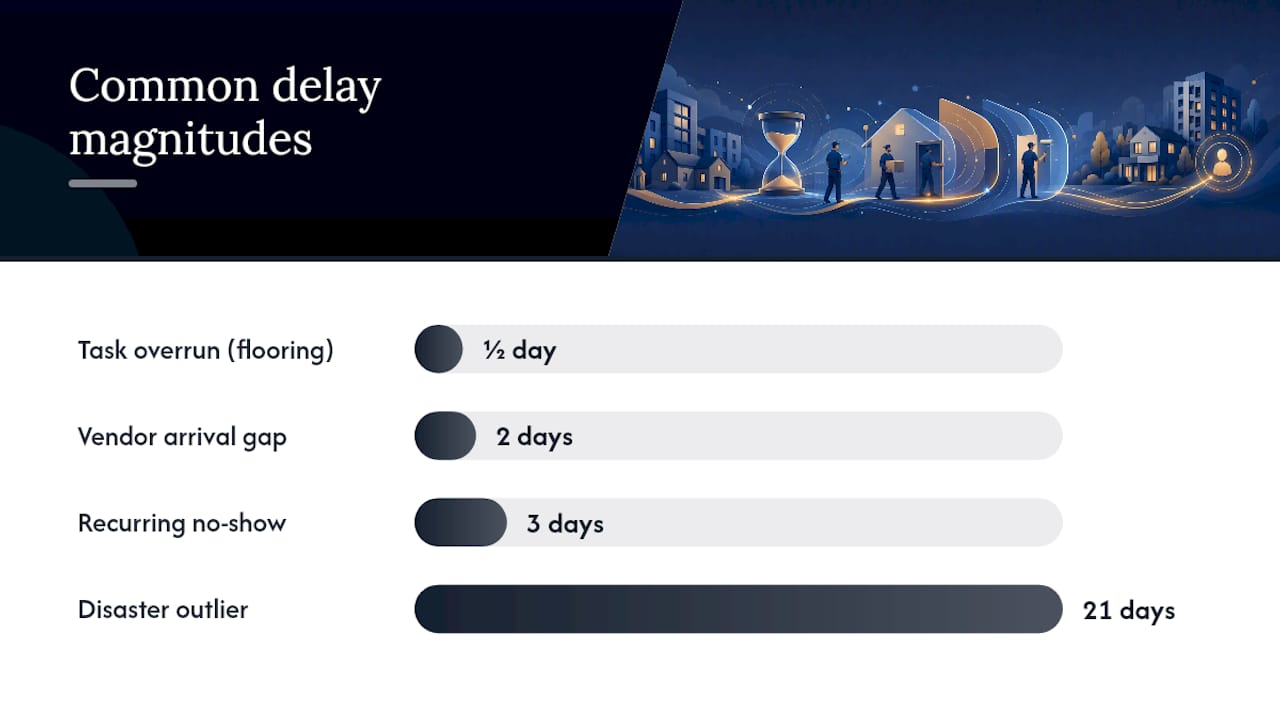
Use medians, not averages, when you're hunting for outliers. One 21-day disaster turn (fire damage, insurance delay, whatever) will drag your average up and hide the fact that every other turn ran 5 to 6 days. The median won't lie to you like that.
Run a 15 to 20 minute weekly review using three questions:
- Which units sat "At Risk" or "Overdue" longest, and at which stage?
- Which vendor missed the most scheduled windows this week?
- Which unit type (studio vs. two-bedroom, renovated vs. classic) keeps showing up in the slow column?
One pattern worth watching closely: vendor scheduling gaps, not vendor work speed, are the more common culprit. A vendor who takes an extra half-day to finish flooring is a minor variance. A vendor who takes three days to show up after being scoped is the bottleneck eating your whole turn window.
If the same vendor misses windows three weeks running, that's not a fluke. It's a vendor problem, and the fix is a scheduling conversation or a replacement, not a pep talk to your leasing team.
What Good Turn Time Actually Looks Like
Standard turns should target 5 to 7 days from move-out to make-ready, though make-ready cost benchmarks show real variation by scope: light turns run 3 to 5 days, standard turns 5 to 10 days, and heavy renovation turns extend well past that. Don't hold a gutted unit to the same target as a light clean and paint.

The vacancy-cost math that makes this concrete: divide monthly rent by 30 for daily rent, then multiply by days saved. One documented example shows cutting average turn time from 12 days to 7 days saves $275 per turn at $55 per day in lost rent. Multiply that across a portfolio's annual turnover count and the number stops looking small.
Make-ready speed and time-to-lease are two different clocks. A unit can hit make-ready in 5 days and still sit vacant for two weeks in a soft-demand market. Don't let a slow leasing quarter mask a make-ready process that's actually running fine, and don't let fast leasing hide a make-ready process that's quietly bleeding days.
Cutting Turn Time Without Creating More Rework
One firm running 340 units cut average turnover from 14.6 days to 5.2 days after standardizing its turnover workflow, a 64% improvement, with reported gains in vendor no-show rate and rework rate alongside the speed gain. That's not a fluke number. It's what happens when a team stops treating each turn as a one-off and starts running a repeatable process.
- Pre-walk within 48 hours of move-out. Tier the turn (light, standard, heavy) and order materials immediately, before the unit sits empty waiting on a decision.
- Sequence trades before cleaners and inspection. Paint and flooring go first. Sending cleaners in before the carpet crew tracks dust and debris through a freshly cleaned unit is a guaranteed rework trigger.
- Standardize scope with written specs. A Property Standards Library that documents the exact paint shade, filter size, and preferred vendor eliminates the back-and-forth questions that stall a turn for a day while someone tracks down an answer.
- Run a final quality gate using the move-out inspection checklist. If move-in inspection catches something move-out inspection should have flagged, you've got a scope gap, not a bad tech.
- Batch similar turns when volume justifies it. A dedicated turn crew working three studios back-to-back beats three separate one-off dispatches.
Pro Tip: Vendors who get scoped work orders immediately after move-out can price and schedule same-day. Vendors who wait for a callback to find out what they're walking into add days you'll never get back.
How TurnTrack Puts These Metrics Into Practice
TurnTrack was built around this exact stage-based model, not as an afterthought. Every unit gets one shared turn record with a status, Ready, On Track, At Risk, or Overdue, plus the same six-stage timeline: Move-Out, Tech Start, Cleaners, Carpet, Inspection, Make-Ready. Everyone on the team sees the same thing at the same time.
Vendor coordination lives inside the turn record itself. Working a unit and need the carpet crew's number? It's attached to that turn, not buried three text threads back. The Property Standards Library shares specs, paint shade, HVAC filter size, faucet model, directly with a tech or vendor without requiring them to create an account.
- Activity feed logs updates with optional photos tied to specific stages, not forced on every task
- Inspections (Move-Out, Mid-Turn, Move-In) get walked area by area on a phone
- Photo evidence attaches where the property requires it, building a before/after record as a byproduct of normal work
The subscription runs $14.99 per month, billed at the workspace level with a free trial, available on iOS through the App Store. One subscription covers your invited team.
| Point | Details |
|---|---|
| Shared turn record | One status per unit (Ready/On Track/At Risk/Overdue) replaces scattered texts and spreadsheets. |
| Stage timeline | Move-Out through Make-Ready stages match the metrics operators already need to track. |
| Vendor access built in | Contacts and specs sit inside the turn, so techs don't dig through separate lists. |
What I'd Watch in Week One
Require a move-out inspection within 24 to 48 hours of notice, no exceptions. That single habit sets the clock for everything downstream, and skipping it is the most common reason a "5-day turn" quietly becomes an 8-day turn.
Getting vendors and leasing onto one shared record takes less convincing than you'd think. Show a vendor that their schedule window lives in one place, visible to everyone, and most stop fighting you on it. They'd rather have clarity than a phone call asking why they're late.
Run a 15-minute weekly meeting with three questions: which units are stuck, which vendor missed windows, and what one fix are we assigning before next week. Keep it that short or it stops happening.
Track Every Turn Without the Spreadsheet Chaos
Spreadsheets and group texts work until you're running eight turns at once and nobody remembers who logged the last cleaner update. TurnTrack replaces that scramble with one shared record per unit, the same six-stage timeline this article walks through, so your team stops re-explaining status over the phone.
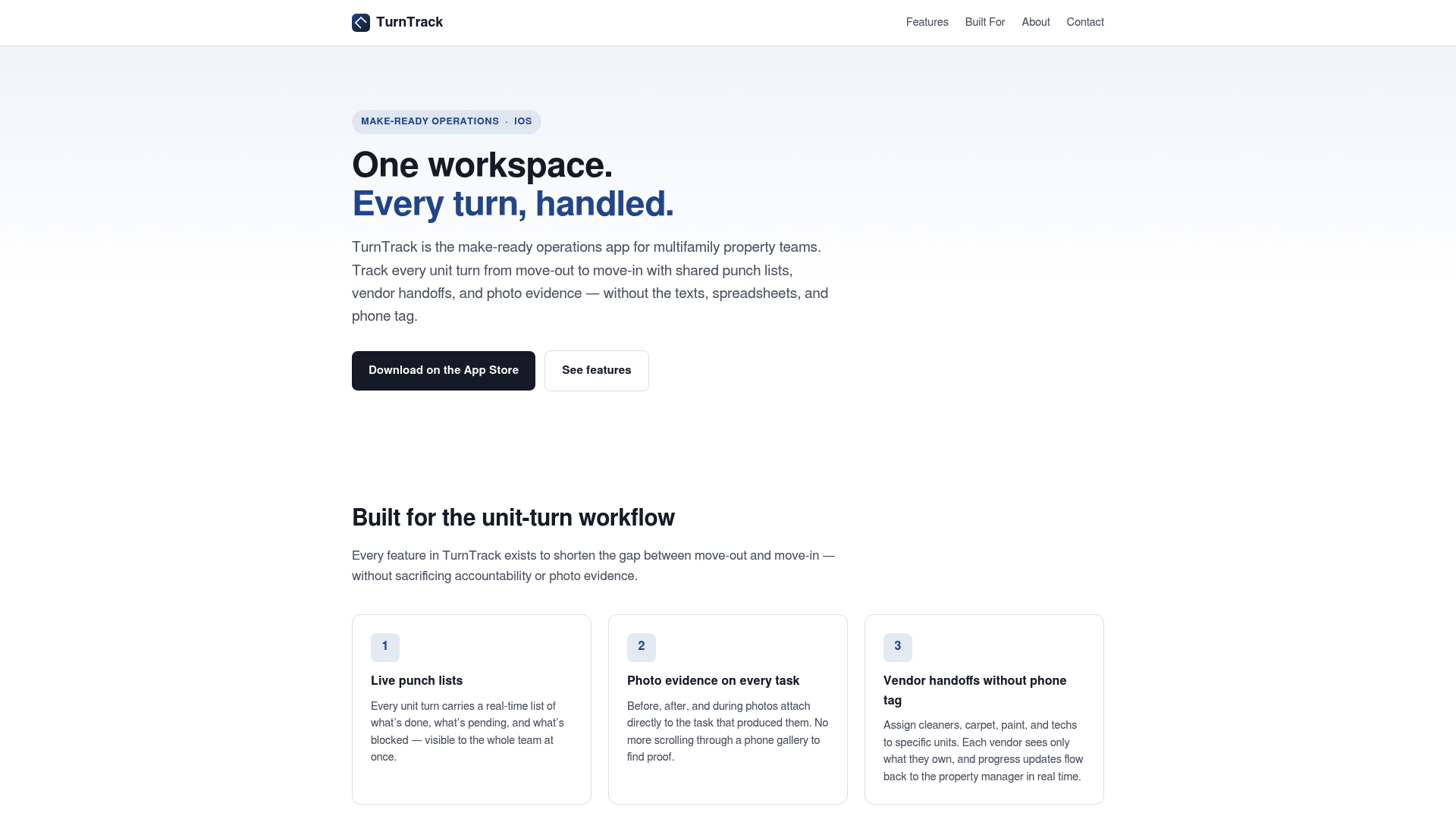
The Property Standards Library alone solves a problem every operator recognizes: a tech asking what shade of white goes on the walls, and nobody having a fast answer. Share the spec sheet directly, no extra account required for the vendor or tech reading it. Vendor contacts live inside the turn itself instead of a separate phone list you're always updating.
The subscription is $14.99 a month at the workspace level, with a free trial to run your next few turns through it before committing. Start your free trial and see whether your next turn actually beats last month's median.
Frequently Asked Questions
What's the difference between turn time metrics and time-to-lease? Turn time metrics measure how fast a unit goes from move-out to make-ready. Time-to-lease measures how fast that ready unit finds a new resident. A property can excel at one and lag on the other, especially in a soft-demand market.
How many turn time metrics should a small team actually track? Four: average days to turn, median stage duration, vendor on-time rate, and rework rate. Staff hours per turn is worth adding once you have labor cost pressure to justify tracking it.
Is average or median the better measure for turn time? Median, for spotting typical performance, since one disaster turn (fire, insurance delay) skews an average badly. Track average too, but read it alongside the median rather than alone.
What causes most turn time delays that KPIs reveal? Idle gaps between stages, usually vendor scheduling gaps, cause more delay than slow work within a stage. A vendor who's fast but shows up late will hurt your numbers more than one who's slow but on time.
Does TurnTrack replace a property management system? No. TurnTrack manages the unit-turn and make-ready workflow only, it doesn't handle rent, leases, accounting, or tenant communications. It's built to sit alongside whatever system already handles those functions.
Sources
- How a 340-Unit Firm Cut Turns to 5 Days Case Study
- How to Track and Reduce Make Ready Costs in Multifamily | BubbleGum BI