
A punch list is a closeout document that records deficiencies requiring correction before final completion. A work order is a written authorization to perform specified work, typically issued for operational, maintenance, or newly scoped tasks.
- Who issues it: The general contractor prepares the initial punch list when calling substantial completion; a work order is issued by an owner, PM, or authorized manager.
- Does it change scope or price? Punch list items fall within the original contract scope and do not change the price. Work orders may authorize new scope and carry a cost.
- When does each appear? Punch lists live at closeout, after substantial completion. Work orders can be issued at any point in the project lifecycle, including post-occupancy maintenance.
AIA A201-2017 sets the standard contract expectations around substantial completion and punch-list obligations. Unresolved punch items routinely hold up retainage and final payment. Tools like TurnTrack bring the punch list, vendor coordination, and inspection record into one shared workflow.
Table of Contents
- How do a punch list and a work order compare?
- Who creates and owns each document?
- What should you include on a punch list and a work order?
- How do punch lists and work orders interact day-to-day?
- How do punch lists affect final payment and contract closeout?
- Field-tested tips to keep punch lists short and work orders clean
- How software changes the punch list and work order workflow
- Key Takeaways
- The part most teams get wrong about closeout
- Ready to manage punch lists without the spreadsheet chaos?
How do a punch list and a work order compare?
| Dimension | Punch List | Work Order |
|---|---|---|
| Purpose | Record contract deficiencies to correct before final completion | Authorize and document specific work to be performed |
| Who issues it | GC (with owner/architect during punch walk) | Owner, PM, or authorized manager |
| Timing | At or after substantial completion | Any phase, including operations and maintenance |
| Level of detail | Location, deficiency description, assignee, due date | Scope of work, pricing method, permit/safety notes, sign-off |
| How it's tracked | Shared deficiency list, closed item by item | Formal work order system or job ticket |
| Effect on contract/payment | Unresolved items can withhold retainage and final payment | May trigger a change order if new scope is added |
Punch list example: Bathroom 204 — grout missing at tub surround, Spec Section 09 30 00, due Friday, assigned to tile sub.
Work order example: Owner requests addition of a keypad lock on Unit 12 storage room after substantial completion. New scope, priced separately, issued as a work order.
The line between the two is scope. Punch list items are deficiencies within the original contract; anything new or priced separately belongs in a work order or change order, not on the punch list.
Who creates and owns each document?
Accountability gaps during closeout almost always trace back to unclear ownership. Here is how it breaks down by role:
- Project manager: — Coordinates scheduling, tracks open items, and manages the handoff from punch list to work order when new scope surfaces.
Work orders follow a parallel but distinct chain. The owner or PM issues them; the assigned contractor or vendor executes; a supervisor signs off on completion.
Pro Tip: Add a single line to your subcontract: "Punch-list corrections are included in the base contract price and do not constitute new scope." That one sentence closes the door on most scope-creep disputes during closeout.
What should you include on a punch list and a work order?
Getting the fields right the first time saves re-walks. Sample punch-list reports from real projects consistently show these required fields:
Sample punch list entry
| Field | Example |
|---|---|
| Location | Rm 204 / Drawing A-201 |
| Deficiency description | Grout missing at tub surround, approx. 3 LF |
| Spec reference | Section 09 30 00 |
| Assignee | Tile subcontractor |
| Due date | March 14 |
| Priority | High |
| Acceptance criteria | Full grout coverage, color-matched, no voids |
| Photo | Optional — attach before/after if required |

Sample work order entry
| Field | Example |
|---|---|
| Authorization reference | WO-2026 / Owner approval email dated March |
| Scope of work | Install keypad lock, Unit 12 storage room |
| Pricing method | T&M, not to exceed $300 |
| Assignee/vendor | ABC Locksmith |
| Scheduled window | March, morning hours |
| Safety/permit notes | No permit required; coordinate with tenant |
| Completion sign-off | PM signature + photo of installed hardware |
What belongs on a punch list vs. what triggers a work order:
- Punch list: incomplete finishes, missing hardware, spec non-conformance, damaged materials within original scope
- Work order: owner-requested additions, safety repairs discovered post-occupancy, items outside original contract scope, any task with a separate price
A punch list records contract deficiencies corrected before final payment; a checklist is a process tool used during execution to prevent those deficiencies from appearing in the first place. Using both at the right time closes the documentation gap most teams leave open.
Pro Tip: Photos on punch list items are most valuable when acceptance criteria are visual: grout coverage, paint color match, caulk bead continuity. Attach one "before" and one "after" per item where the deficiency is hard to describe in words alone.
How do punch lists and work orders interact day-to-day?
The handoff between the two documents is where most closeout delays happen. Follow this sequence:
- Conduct the punch walk after the space reaches substantial completion. Walking too early fills the list with incomplete work rather than true defects.
- Log each item with location, description, assignee, due date, and acceptance criteria. Assign priority on the spot.
- Decision point: Is this item within original contract scope? If yes, it stays on the punch list. If it is new scope, owner-requested, a safety repair, or carries a separate cost, convert it to a work order.
- Issue the work order with full authorization, pricing, and a scheduled window. Track it separately from the punch list to avoid double-counting.
- Assign and schedule corrections. Subcontractors address punch items; vendors or crews execute work orders. Both need a hard deadline tied to a payment milestone.
- Re-inspect and close. The architect or PM verifies each correction against the acceptance criteria. Sign off item by item, not all at once.
- Final sign-off. Once the punch list is cleared and all work orders are closed, the owner releases retainage and issues final payment.
Conversion rules at a glance:
- Convert to a work order when: new scope is added, the owner requests something not in the contract, a safety issue requires immediate repair, or the cost exceeds a pre-agreed threshold.
- Keep on the punch list when: the item is a deficiency in work already contracted and no additional cost is involved.
For crew scheduling tied to work order windows, construction scheduling software helps align vendor availability with the closeout timeline without manual back-and-forth.
How do punch lists affect final payment and contract closeout?
Punch lists document what remains between substantial completion and final completion. Many U.S. contracts, including those built on AIA A201-2017 provisions, allow the owner to withhold retainage or final payment until the punch list is fully resolved. Warranty periods often start at substantial completion, so delays in closing the list can create overlap disputes about whether a defect is a punch item or a warranty claim.
This is general information, not legal advice. Consult qualified construction counsel for contract disputes.
Practical steps to protect your payment:
- Write acceptance criteria into every punch item before the walk, not after.
- Document corrections with photos and dates; an audit-ready record is your best defense in a payment dispute.
- Require written sign-off from the owner or architect on each closed item.
- Set an escalation path: if an item is disputed, name who decides and by what date.
Field-tested tips to keep punch lists short and work orders clean
The teams that close out fastest share one habit: they treat closeout as a continuous process, not a final sprint.
- Run a rolling punch list throughout execution. Log deficiencies as they appear rather than saving them for the final walk. Using checklists during work and punch lists at closeout keeps the final list short and the documentation clean.
Pro Tip: Walk each room clockwise from the door. It sounds trivial, but a consistent pattern means you never skip a corner, and your notes stay in the same spatial order every time.
Pro Tip: Every punch item needs an acceptance criterion before the walk ends. "Paint touch-up" is not a criterion. "Paint touch-up to match existing, no visible lap marks under natural light" is.
How software changes the punch list and work order workflow
Paper lists and spreadsheets work until you have five units closing at once and three vendors who never saw the same version. Digital tools reduce that friction by keeping the list, the photos, and the assignments in one place everyone can see.
TurnTrack is built specifically for make-ready and unit-turn workflows in multifamily property management. It is not a property management system and does not handle rent, leases, or tenant communications. What it does handle:
- Unit turn records with live statuses: Ready, On Track, At Risk, Overdue
- A schedule timeline everyone shares: Move-Out → Tech Start → Cleaners → Carpet → Inspection → Make-Ready
- Activity feed with optional photos attached to inspection items and updates (not required on every task)
- Move-Out, Mid-Turn, and Move-In inspections walked area by area on a phone
- Vendor coordination inside the turn record, so the carpet crew's contact is right there when you need it
- A Property Standards Library that holds property-specific specs (paint color, filter size, faucet model) and shares them to a tech without requiring a TurnTrack account
Subscription is $14.99/month at the workspace level, covering the invited team. Free trial available via the App Store on iOS.
Pro Tip: Use TurnTrack's Property Standards Library to pre-load your acceptance criteria before the punch walk. When a tech asks "what's the standard here?" the answer is already in the app.
Key Takeaways
A punch list captures contract deficiencies at closeout; a work order authorizes new or operational work and may carry a separate cost.
| Point | Details |
|---|---|
| Core distinction | Punch list items are within original contract scope; work orders authorize new or priced scope. |
| Timing matters | Start the punch list only after substantial completion; work orders can be issued at any project phase. |
| Payment is at stake | Unresolved punch items can hold retainage and final payment under standard U.S. contract provisions. |
| Convert when scope changes | If a punch item turns out to be new scope or carries a cost, issue a work order instead of keeping it on the list. |
| TurnTrack for make-ready teams | TurnTrack manages the unit-turn punch list, inspections, and vendor coordination in one shared iOS workspace at $14.99/mo. |
The part most teams get wrong about closeout
The conventional wisdom is that a long punch list means the GC did poor work. That framing misses the real problem: a long punch list usually means nobody was tracking deficiencies during execution. The list did not grow at closeout; it was always there, just undocumented.
The teams that close out with the fewest disputes are not necessarily the ones who built the cleanest. They are the ones who logged issues continuously, assigned them immediately, and tied every item to an acceptance criterion before anyone left the site. The punch list became short because the work was tracked, not because the work was perfect.
Work orders get misused in the same direction. Teams issue them informally, without authorization references or pricing, and then argue about whether the cost was approved. One written line with a scope and a dollar limit prevents most of that.
The document is not the problem. The habit is.
Ready to manage punch lists without the spreadsheet chaos?
If you are running multiple unit turns at once, the punch list problem compounds fast. Items fall through the gaps between texts, emails, and whoever remembered to update the sheet last.
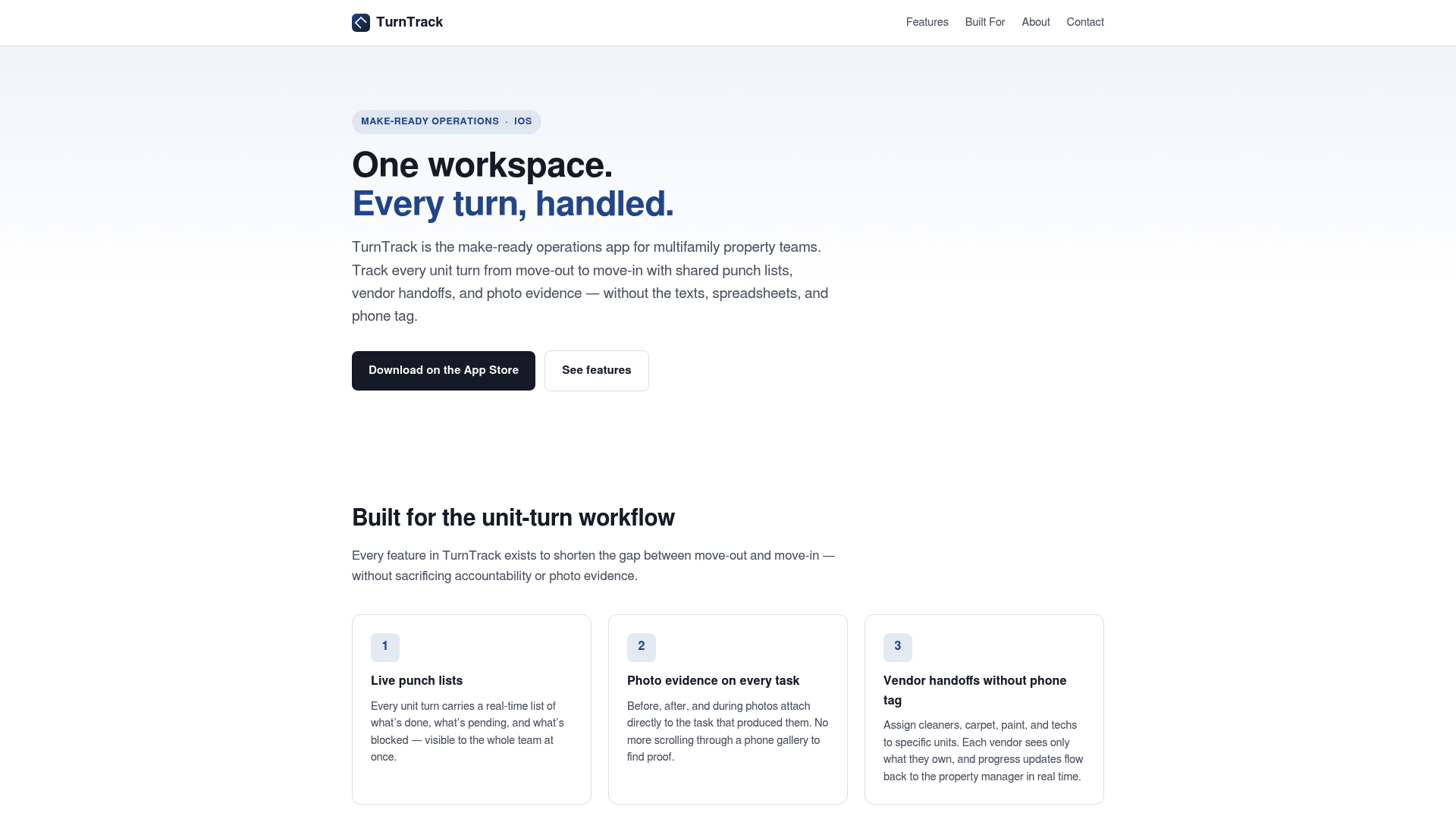
TurnTrack gives your team one shared workspace where the punch list, inspection record, vendor contacts, and property specs all live together. At $14.99/month for the whole team, it costs less than a single callback caused by a missed item. There is no PMS to replace and no long setup process. Start a free trial directly from the TurnTrack App Store page, load your existing punch list, and your team can be working from a shared record the same day.