
Make-ready priority is the systematic process of ranking and scheduling rental unit preparation tasks to move a vacant unit from move-out to lease-ready condition with the least downtime possible. Without a clear priority system, service managers running 5–15 active turns at once lose days to vendor gaps, missed inspections, and units that sit idle when they should be generating rent. The cost of that idle time compounds fast. A disciplined make-ready priority framework is the difference between a 7-day turn and a 3-week one.
What is make-ready priority and why does it matter?
Make-ready priority is the formal term for ranking and sequencing the preparation work required before a unit is ready for occupancy. The industry often calls this work the "make-ready process" or "unit turn," and it covers deep cleaning, paint touch-ups, minor repairs, lock rekeying, and safety checks. Standard make-ready scope is typically completed within a 24–72 hour window, though the full cycle from move-out to market-ready runs longer when vendor scheduling is loose.
The financial case for tight priority management is straightforward. Efficient property management targets a move-out to market-ready window of 7–10 days, compared to 3–4 weeks for self-managed turnovers without a structured plan. Every extra day a unit sits vacant is lost rent. Priority management closes that gap by sequencing tasks so no vendor is waiting on another and no unit stalls mid-turn.

Cost control is the second reason priority matters. Flat-rate bundled make-ready services in Los Angeles range from $225 for a studio to $950 for a 3-bedroom unit in 2026, saving roughly 55–62% compared to stacking individual vendors. That savings disappears when poor sequencing forces a second cleaning visit or a re-inspection because work was done out of order.
Priority also protects your team. When every task feels equally urgent, techs default to easier work first. That behavior leaves the critical-path tasks, the ones that block every subsequent stage, sitting untouched until the deadline is already slipping.
How to build a make-ready priority framework
Priority is a decision based on impact and dependency, not just urgency. A task that blocks three downstream vendors carries more weight than a task that only affects itself, even if both have the same deadline. Property managers who treat priority as a simple urgency label end up with teams that work hard but finish late.
A practical framework for unit turns uses four levels:
- P0 (Critical): Tasks that block all other work. Examples include restoring utilities, completing the move-out inspection, and confirming unit access. Nothing else starts until these are done.
- P1 (High): Tasks on the critical path that unlock vendor scheduling. Drywall repair, subfloor fixes, and any work that must cure or dry before the next trade arrives belong here.
- P2 (Standard): Work that runs in parallel once P1 is clear. Deep cleaning, paint, and appliance checks typically fall here.
- P3 (Elective): Cosmetic upgrades that improve marketability but do not affect rent-readiness. These get done only if time and budget allow.
Before any work begins, apply a Definition of Ready check. The Definition of Ready confirms that all entry conditions are met: keys are available, utilities are on, the move-out inspection is complete, and the scope is defined. Starting a turn without these conditions met is the single fastest way to burn a day on a unit that cannot actually be worked.
Pro Tip: Run your Definition of Ready check the moment a tenant gives notice, not the day they hand in keys. That gap is free scheduling time most managers waste.
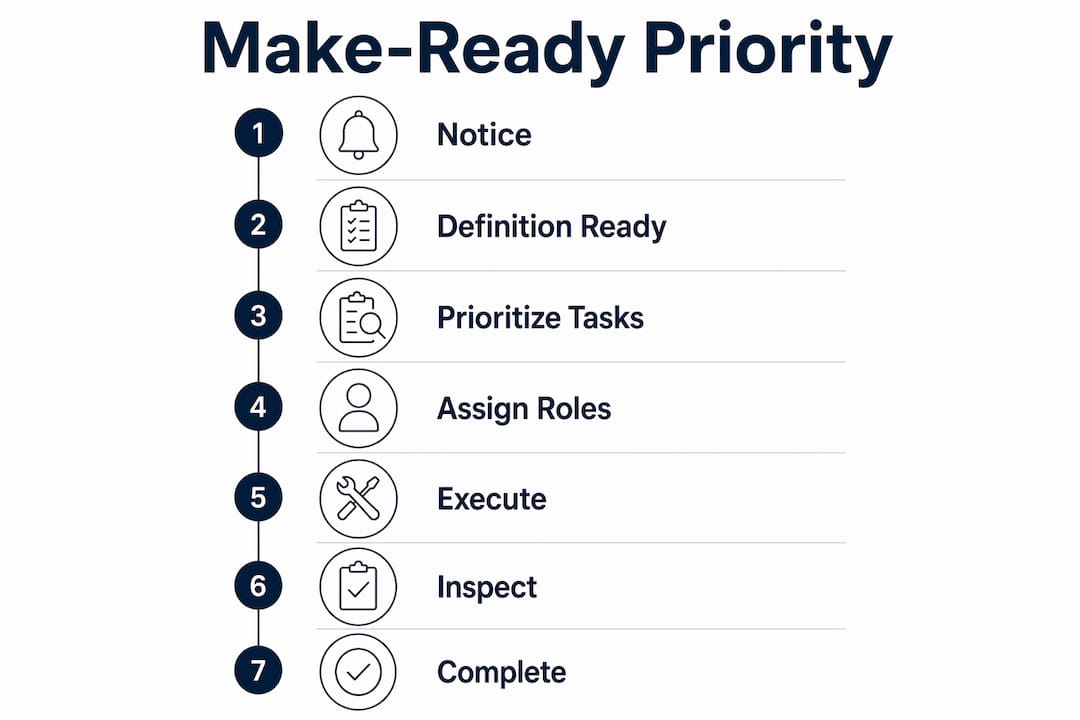
Priority inflation is the most common failure mode. It happens when every task gets labeled "urgent" because no one wants to be responsible for a delay. Enforce the framework by requiring written justification to escalate any task above P1. That one rule alone cuts priority inflation by forcing the conversation before the label gets applied.
Roles and responsibilities in make-ready priority management
Role clarity is what keeps priority decisions from collapsing under pressure. The make-ready process runs best when the people executing turns are not the same people handling occupied-unit maintenance. These are different jobs with different rhythms.
Make-ready specialists, often called "turn techs," focus exclusively on vacant units and typically earn in the high teens to low twenties per hour. General maintenance techs handle occupied-unit work orders. Mixing the two roles creates scheduling conflicts and pulls turn techs away from deadline-driven work to handle non-urgent occupied-unit calls.
The service manager or make-ready manager owns the priority list. That person sets the daily sequence, adjusts priorities when conditions change, confirms vendor arrival windows, and signs off on each stage before the next one begins. Without a single owner, priority decisions get made by whoever is loudest in the moment.
Vendor handoffs are where most priority breakdowns happen. The cleaner finishes and leaves, but no one tells the carpet crew the unit is ready. The carpet crew shows up a day late because they were not notified. That gap costs a full day of float time. Clear handoff protocols, with a named contact responsible for each notification, eliminate this pattern.
- Turn tech: Executes P0 and P1 tasks, flags scope changes to the service manager immediately.
- Vendors (cleaners, carpet, paint crews): Confirm arrival windows 24 hours in advance, report completion directly to the service manager.
- Service manager: Owns the priority list, approves scope changes, and re-ranks daily based on vacancy cost.
- Leasing team: Communicates move-in dates so the service manager can adjust priority when a unit gets a lease before it is finished.
What are the common bottlenecks in make-ready priority?
The biggest hidden bottleneck is the delayed move-out inspection. Most managers wait until the tenant physically vacates to walk the unit. Delaying the inspection until physical vacancy wastes 24–48 critical hours that could be used for vendor scheduling and supply procurement. Trigger the inspection at lease-end notice instead.
Scope creep is the second major drain. Without a documented standard, techs spend time on cosmetic work that does not affect rent-readiness. Scope creep during make-ready turns wastes time on non-essential repairs when no property-specific standards library exists. A written rent-ready standard separates mandatory fixes from elective upgrades and gives techs a clear stopping point.
| Challenge | Mitigation |
|---|---|
| Delayed move-out inspection | Inspect at lease-end notice, not physical vacancy |
| Scope creep | Maintain a documented minimal rent-ready standard |
| Priority inflation | Require written justification to escalate above P1 |
| Vendor communication gaps | Assign a named contact for each handoff notification |
| Resource starvation on low-priority units | Re-rank daily based on vacancy cost and move-in date |
Job priority manages constrained capacity by guiding resource allocation across multiple simultaneous turns. When a service manager runs 10 active turns, the priority list tells the team where to put effort first. Without it, resources flow to whichever unit has the loudest advocate, not the one with the highest vacancy cost.
Pro Tip: Re-rank your active turns every morning based on move-in date and daily vacancy cost. A unit with a signed lease and a 5-day deadline outranks an unleased unit with 10 days of float, even if the unleased unit started first.
Practical tips to sharpen your make-ready workflow
The best make-ready managers treat the priority list as a living document, not a plan set on day one and forgotten. Advanced managers re-rank priority daily based on earliest move-in dates and vacancy cost impact rather than fixed schedules. That daily discipline closes float time gaps before they become missed deadlines.
Here are the operational habits that separate tight turns from slow ones:
- Inspect at notice, not vacancy. Walk the unit or schedule the inspection the moment the tenant gives notice. Use that time to build the scope and line up vendors before the unit is even empty.
- Document your rent-ready standard. Write down exactly what "done" looks like for your property: the paint color (down to the Sherwin-Williams code), the HVAC filter size, the faucet model. Share that standard with every tech and vendor before work starts.
- Assign one person to own each turn. Shared responsibility means no responsibility. One named person tracks status, manages handoffs, and escalates problems.
- Eliminate vendor lookup friction. If a tech has to dig through their phone to find the carpet crew's number, that is a delay waiting to happen. Keep vendor contacts attached to the turn record itself.
- Use status labels that mean something. "Ready," "On Track," "At Risk," and "Overdue" give every person on the team an instant read on where a unit stands without a status meeting.
TurnTrack is built around exactly this workflow. Every turn in TurnTrack carries a shared record with a status label and a timeline that runs from Move-Out through Tech Start, Cleaners, Carpet, Inspection, and Make-Ready. Vendor contacts live inside the turn record, so a tech never has to leave the app to find who to call next. The Property Standards Library keeps your paint codes, filter sizes, and preferred vendors in one place and shares them to any tech or vendor without requiring them to have a TurnTrack account.
Key Takeaways
Make-ready priority is the core discipline that separates a 7-day turn from a 3-week one, and it requires daily re-ranking, clear role ownership, and a documented rent-ready standard to hold.
| Point | Details |
|---|---|
| Priority is impact-based, not urgency-based | Rank tasks by what they block, not by who is asking loudest. |
| Inspect at lease-end notice | Starting the scope before physical vacancy recovers 24–48 hours of lost prep time. |
| Document your rent-ready standard | A written standard prevents scope creep and gives techs a clear stopping point. |
| Assign one owner per turn | Shared responsibility produces missed handoffs; one named person prevents that. |
| Re-rank daily | Vacancy cost and move-in dates shift. Your priority list should shift with them. |
The discipline nobody talks about
The property management industry talks a lot about tools and checklists. It talks less about the discipline required to enforce priority when everyone is under pressure and every unit feels like the most urgent one.
The hardest part of make-ready priority is not building the framework. It is holding the line when a leasing agent calls at 9:00 AM saying a unit needs to be done by Friday and it is currently ranked P2. That pressure is real, and it is constant. The managers who handle it well are the ones who have already done the math: they know the daily vacancy cost on every active turn, and they use that number to make the call instead of reacting to whoever is loudest.
The other thing I have seen consistently is that role separation pays off faster than most operators expect. The first time you pull a turn tech off a vacant unit to fix a running toilet in an occupied unit, you lose more than an hour. You lose the sequencing on that turn, and the vendor who was scheduled for the afternoon now has a gap. That gap costs you a day. Keeping turn techs on turns is not a luxury. It is a scheduling decision with a direct dollar value.
Technology helps, but only if the underlying process is sound. A shared status board does not fix a team that has not agreed on what "At Risk" means. Get the definitions right first, then use a tool to make them visible to everyone at once.
— TurnTrack Team
TurnTrack keeps your priority visible across every active turn
Running 10 active turns across texts, emails, and memory is how units get shown before they are ready and vendors get missed entirely. TurnTrack gives every turn a shared record with a real-time status, a stage-by-stage timeline, and vendor contacts built right in.
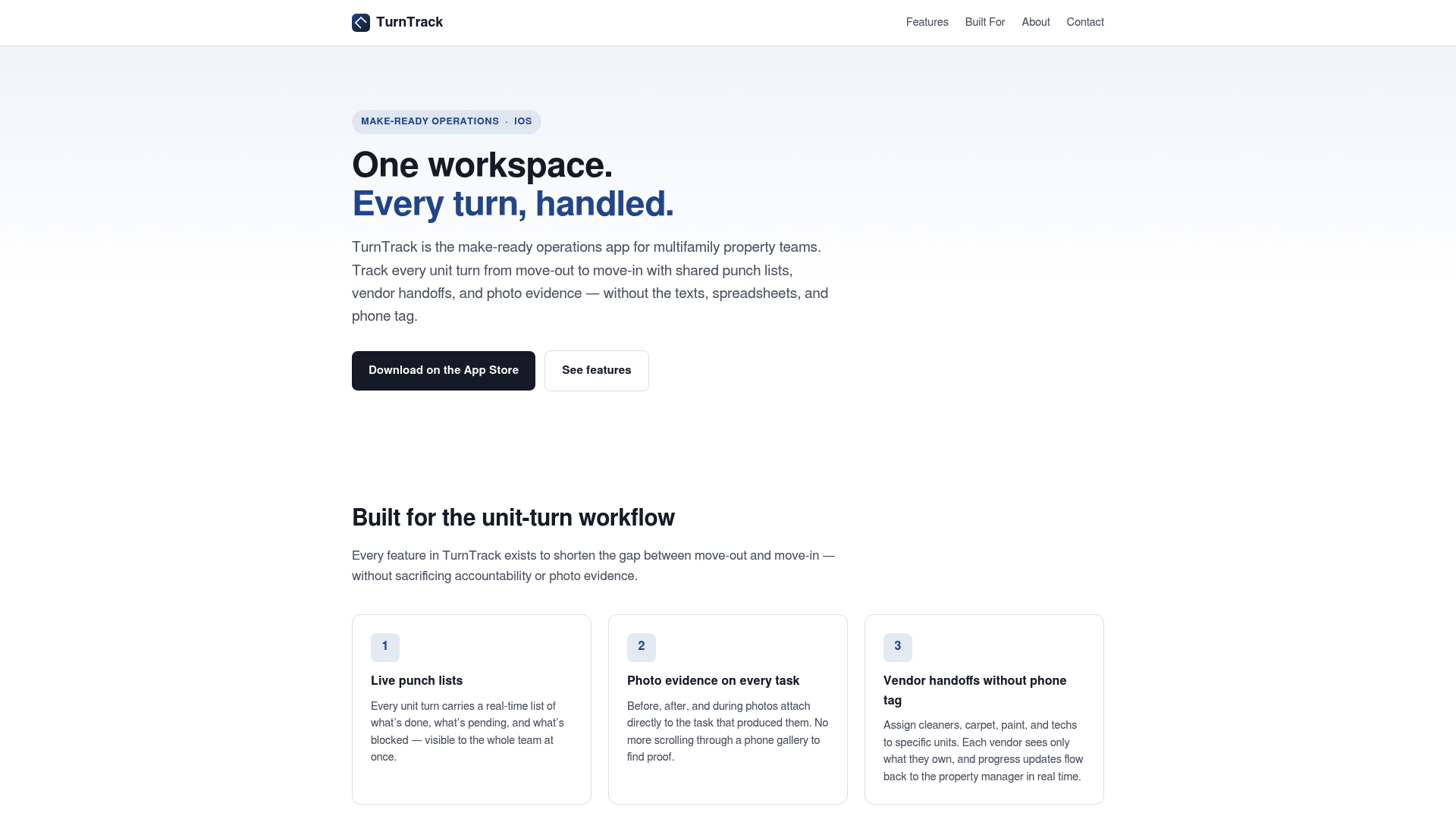
The Property Standards Library means a tech asking "what paint goes on these walls?" gets the answer from the app, not a phone call to you. Optional photo documentation attaches proof directly to inspection items where your property requires it. TurnTrack runs at $14.99 per month for your workspace, with a free trial available on iOS. It is built for the service manager still doing the work, not for enterprise teams with a full IT department.
FAQ
What does make-ready priority mean in property management?
Make-ready priority is the system of ranking and sequencing unit preparation tasks during a turnover to minimize vacancy time. Tasks are ordered by their impact on the critical path, not just by deadline.
How long does a standard make-ready take?
A standard make-ready covering cleaning, paint touch-ups, repairs, and safety checks is typically completed within 24–72 hours. The full move-out to market-ready cycle runs 7–10 days with a structured priority plan.
What is the Definition of Ready in a make-ready context?
The Definition of Ready is a checklist of conditions that must be met before work begins on a unit, including confirmed access, completed move-out inspection, and a defined scope. Meeting these conditions before the first tech arrives prevents mid-turn delays.
What is a make-ready technician?
A make-ready technician is a specialist focused exclusively on vacant unit preparation, separate from general maintenance staff who handle occupied-unit work orders. This role separation improves deadline adherence and turn quality.
How do you prevent scope creep during a make-ready?
Maintain a documented minimal rent-ready standard that defines exactly what "done" looks like for your property. That standard separates mandatory repairs from elective cosmetic upgrades and gives techs a clear stopping point.