
Before any contractor touches a unit, you need at minimum the following documents on file: a completed W-9, a signed Independent Contractor Agreement or SOW, a Certificate of Insurance with at least $1M per occurrence limit for on-site work, professional licenses where required, payment setup information, and an emergency contact. These six documents are the standard gate; nothing starts until they've been collected.
The short list:
- W-9 (or W-8BEN for foreign contractors)
- Signed SOW or Independent Contractor Agreement
- Certificate of Insurance (COI) with a minimum $1,000,000 per occurrence
- Professional license or certification when the trade requires it
- Payment info (invoice format or bank details)
- Emergency contact
TL;DR: Run a classification check first, collect docs second, schedule the first job third. In that order, every time.
Table of Contents
- Why a repeatable contractor onboarding workflow matters for unit turns
- What does your contractor onboarding checklist need to include?
- What does the step-by-step onboarding workflow look like?
- What compliance risks can you not afford to ignore?
- When should you automate, and what stays manual?
- How does TurnTrack fit into this workflow for unit turns?
- What templates should you copy into your onboarding packet?
- Key Takeaways
- What the field actually teaches you about onboarding contractors
- TurnTrack: a workspace built for this exact workflow
- Useful sources and references
Why a repeatable contractor onboarding workflow matters for unit turns
A repeatable onboarding process cuts two things simultaneously: time-to-productivity and audit exposure. Without it, you're chasing W-9s after the first invoice, discovering a vendor has no COI the day they show up, and scrambling to prove classification if a state agency comes knocking.
For multifamily operations, the stakes are tighter than most. A stalled make-ready costs real money in lost rent days. When a handoff between a cleaner and a carpet crew falls apart because nobody confirmed the vendor was cleared to be on-site, that idle day doesn't come back. Missing or scattered contractor documents cause most onboarding failures, and the fix is a centralized workflow with timestamps, not a better spreadsheet.
Pro Tip: Set a hard gate rule: no scheduling, no site access, no first assignment until classification is confirmed, W-9 is received, and COI is verified. Post it in your intake form so vendors see it before they submit.
Automation makes the biggest difference on timing. Automated onboarding workflows can compress the end-to-end process from weeks down to a few days when configured correctly. Manual processes, where someone emails a PDF and waits, routinely stretch to days or longer.

What does your contractor onboarding checklist need to include?
These documents and verifications must be on file before work begins. No exceptions for "they've worked here before."
- W-9 (or W-8BEN for international): Required before the first payment. Without it, you risk 24% backup withholding under IRS rules and can't file the year-end 1099-NEC.
- Independent Contractor Agreement / SOW: Defines scope, deliverables, IP ownership, payment terms, and termination. Have legal review the template once; reuse it per engagement.
- NDA / IP assignment: Required when the contractor accesses proprietary systems, tenant data, or property-specific specs.
- Certificate of Insurance: Require a COI with a minimum of $1M per occurrence for any on-site trade work. Request an additional insured endorsement naming your property or management company.
- Professional license or permit: Electricians, plumbers, HVAC techs — verify the license is current and matches the state where work is performed.
- Background check consent: Required before granting access to occupied buildings or sensitive systems.
- Payment setup: Invoice format, preferred payment method, and banking details if you pay by ACH.
- Emergency contact: Mandatory for any on-site worker.
- Equipment issuance record: If you provide keys, fobs, or equipment, log it.
- Access and key policy acknowledgment: Signed confirmation of your site rules, key return policy, and access expiration tied to the SOW end date.
State-specific note: California's ABC test applies a stricter three-part classification standard. If you operate in California or onboard across multiple states, get jurisdiction-specific legal review before finalizing your ICA template.
Pro Tip: Store all documents in a project-scoped folder, not email threads. Timestamped uploads in a central system are what an auditor actually wants to see. Email attachments are not an audit trail.
What does the step-by-step onboarding workflow look like?
Follow this six-step sequence for consistent starts and predictable timelines. Each step has a clear owner.
- Intake and classification check (Owner: requester / vendor coordinator) — Contractor submits intake form. You confirm independent contractor status under federal and applicable state frameworks before drafting any contract. Document the classification decision in writing.
- Contract and SOW execution (Owner: ops or legal) — Send the ICA and SOW for e-signature. No verbal agreements. The signed contract defines scope, payment, IP, and termination terms.
- Document collection and COI verification (Owner: vendor coordinator) — Collect W-9, COI, license copies, and background check consent. Verify COI limits and expiration date. Flag anything missing before moving forward.
- System access and scheduling (Owner: site lead / service manager) — Provision project-scoped access tied to the SOW end date. Schedule the first assignment. Share property-specific standards before the tech arrives.
- First assignment and on-site orientation (Owner: service manager) — Walk the contractor through site rules, safety expectations, and unit-specific conditions. Confirm they have everything they need to start.
- Post-job inspection and invoice approval (Owner: inspector / accounting) — Inspect the completed work against the SOW. Approve the invoice only after inspection sign-off.
Timing example: Intake submitted Friday afternoon. Documents received and verified by Monday. Tech starts Tuesday morning. That's a 72-hour window, achievable with e-signature and a clear intake form.
With automation handling handoffs, the end-to-end sequence runs in 24–72 hours. Manual routing typically takes days to weeks.
What compliance risks can you not afford to ignore?
Classification review and insurance verification are non-negotiable gates. Getting either wrong costs more than the job is worth.
Misclassification: The IRS and most state agencies use a multi-factor test covering behavioral control, financial control, and the nature of the relationship. Keep a written classification worksheet for every contractor. If you direct when, where, and how they work, that's an employee relationship regardless of what the contract says.
Backup withholding: Collect the W-9 before the first payment. Without a valid W-9, you're required to withhold 24% of payments and remit it to the IRS. File 1099-NEC by January 31 for any contractor paid above the IRS filing threshold during the year.
Insurance gaps: A contractor without a current COI on file is a liability you're absorbing. Require the additional insured endorsement for any on-site work.
Treat every document receipt as a timestamped event. The audit question is never "did you collect it?" — it's "can you prove when you collected it and what it said?" Timestamps and version-controlled storage answer both.
Pro Tip: Build a simple audit log: contractor name, document type, date received, expiration date if applicable. Review it monthly. Expired COIs and lapsed licenses are the most common gaps that surface during claims.
This article is general information, not legal or tax advice. Consult a qualified attorney or HR professional for guidance specific to your jurisdiction and contractor relationships.
When should you automate, and what stays manual?
Automate handoffs and document validation. Keep human judgment on classification decisions and high-risk insurance exceptions.
Scaling beyond ad-hoc spreadsheets becomes necessary around 20–50 active contractors, or sooner if you onboard across multiple states. At that threshold, manual tracking creates errors faster than staff can catch them.
Automate these:
- Intake form routing and acknowledgment
- E-signature requests and completion tracking
- COI expiration alerts (30 days and 7 days out)
- Access provisioning triggers tied to SOW dates
- Invoice routing to accounting after inspection approval
- Audit log entries for every document received
Keep these manual:
- Final classification sign-off
- On-site safety orientation and site walkthrough
- Unusual insurance exceptions or waiver decisions
Pro Tip: Build a template per contractor type: cleaners, electricians, carpet vendors, HVAC techs. Each template pre-populates the right document requirements and access levels. A cleaner doesn't need the same COI limits as an electrician, and your intake form shouldn't ask them for the same things.
How does TurnTrack fit into this workflow for unit turns?
A turn-focused operations workspace centralizes gates and reduces idle time between Move-Out and Make-Ready. TurnTrack maps directly to the onboarding sequence described above.
Here's how it works in practice. Each unit turn in TurnTrack has a shared record with a live status: Ready, On Track, At Risk, or Overdue. The schedule timeline runs Move-Out → Tech Start → Cleaners → Carpet → Inspection → Make-Ready. Every vendor contact lives inside the turn record, so the manager doesn't dig through a phone to find the carpet crew's number.
The Property Standards Library holds property-specific specs — the exact Sherwin-Williams paint color, HVAC filter size, preferred vendor for each trade — and shares them directly to a tech or vendor without requiring them to have a TurnTrack account. A tech asking "what white goes on these walls?" gets the answer from the spec sheet in the app.
The gate enforcement is the part that matters most. A manager can hold a tech start in the timeline until the COI and W-9 are uploaded to the vendor card. Once those are confirmed, the tech gets scheduled and the first task is assigned. The audit trail builds itself as the work moves forward.
For inspections, TurnTrack walks Move-Out, Mid-Turn, and Move-In area by area on a phone. Where the property requires it, optional photos attach directly to inspection items or activity updates. Not every task needs a photo. Smoke detector replacement with the date written on the detector? That's where a photo earns its place.
For make-ready operations running 5–15 active turns at once, this replaces the texts, emails, and spreadsheets that let vendors fall through the cracks.
What templates should you copy into your onboarding packet?
Copy these short templates into your intake and SOW to remove ambiguity and speed approvals.
- Intake form fields: Contractor legal name, business entity type, EIN or SSN, trade or service type, license number and expiration, COI carrier and policy number, preferred payment method, emergency contact name and phone.
- SOW checklist bullets: Scope of work description, unit address, start and completion dates, deliverables and acceptance criteria, payment amount and schedule, access requirements, and termination clause.
- COI request wording: "Please provide a Certificate of Insurance showing general liability coverage of no less than $1,000,000 per occurrence, with [Property Management Company Name] listed as additional insured. COI must be current and not expire before the project completion date."
- NDA blurb: "Contractor agrees to keep confidential all property-specific information, tenant data, and proprietary systems accessed during the engagement."
- Payment and invoice format: Invoice must include contractor name, EIN, service date, unit address, description of work, and total amount due.
- Site safety bullets: No smoking on property, PPE required for applicable trades, report any hazardous conditions immediately, no access to occupied units without prior notice to management.
- Access expiration language: "System access and physical keys are provisioned for the duration of this SOW only and must be returned or deactivated by [SOW end date]."
Store these in a turn-focused workspace or a project-scoped template library, not a shared HR drive. For larger or multi-state make-ready programs, a construction cost plan checklist can help frame procurement scope for bigger renovation jobs alongside your standard onboarding packet.
Key Takeaways
A classification-first, gate-first contractor onboarding checklist — with centralized documents and a turn-focused workspace — is the fastest path to compliant, productive vendor starts on multifamily unit turns.
| Point | Details |
|---|---|
| Classification comes first | Confirm independent contractor status in writing before drafting any contract or collecting forms. |
| Six documents are the gate | W-9, signed SOW/ICA, COI (minimum $1,000,000 per occurrence), license, payment info, and emergency contact must be on file before work starts. |
| Timing target with automation | A complete onboarding sequence runs in 24–72 hours when intake, e-signature, and document routing are automated. |
| Scale trigger for orchestration | Move beyond spreadsheets at roughly 20–50 active contractors or when onboarding spans multiple states. |
| TurnTrack for unit turns | TurnTrack's workspace enforces gates, centralizes vendor contacts and property specs, and builds an audit trail as work moves through the Make-Ready timeline. |
What the field actually teaches you about onboarding contractors
Most onboarding failures aren't document failures. They're gate failures. The W-9 exists, the COI exists, but nobody checked whether the COI was current before the tech showed up. Or the classification worksheet was never completed because "we've always used this vendor." Those are the gaps that create real exposure.
Three things worth enforcing from day one: make the gate explicit and visible to everyone on the team, not just the person who set it up; make the approval chain a named list, not a general expectation; and attach photo evidence to inspections where it matters, not everywhere. A photo of every painted wall adds noise. A photo of a replaced smoke detector with the date written on it adds proof.
On communication cadence: automate the handoffs, but run a weekly onboarding audit yourself. Five minutes reviewing who's in progress, what's missing, and what's expiring soon catches problems before they become disputes. Automation handles the volume. The weekly check catches what automation misses.
TurnTrack: a workspace built for this exact workflow
Running 5–15 active turns at once means your contractor onboarding process needs to live where the work lives, not in a separate folder nobody checks.
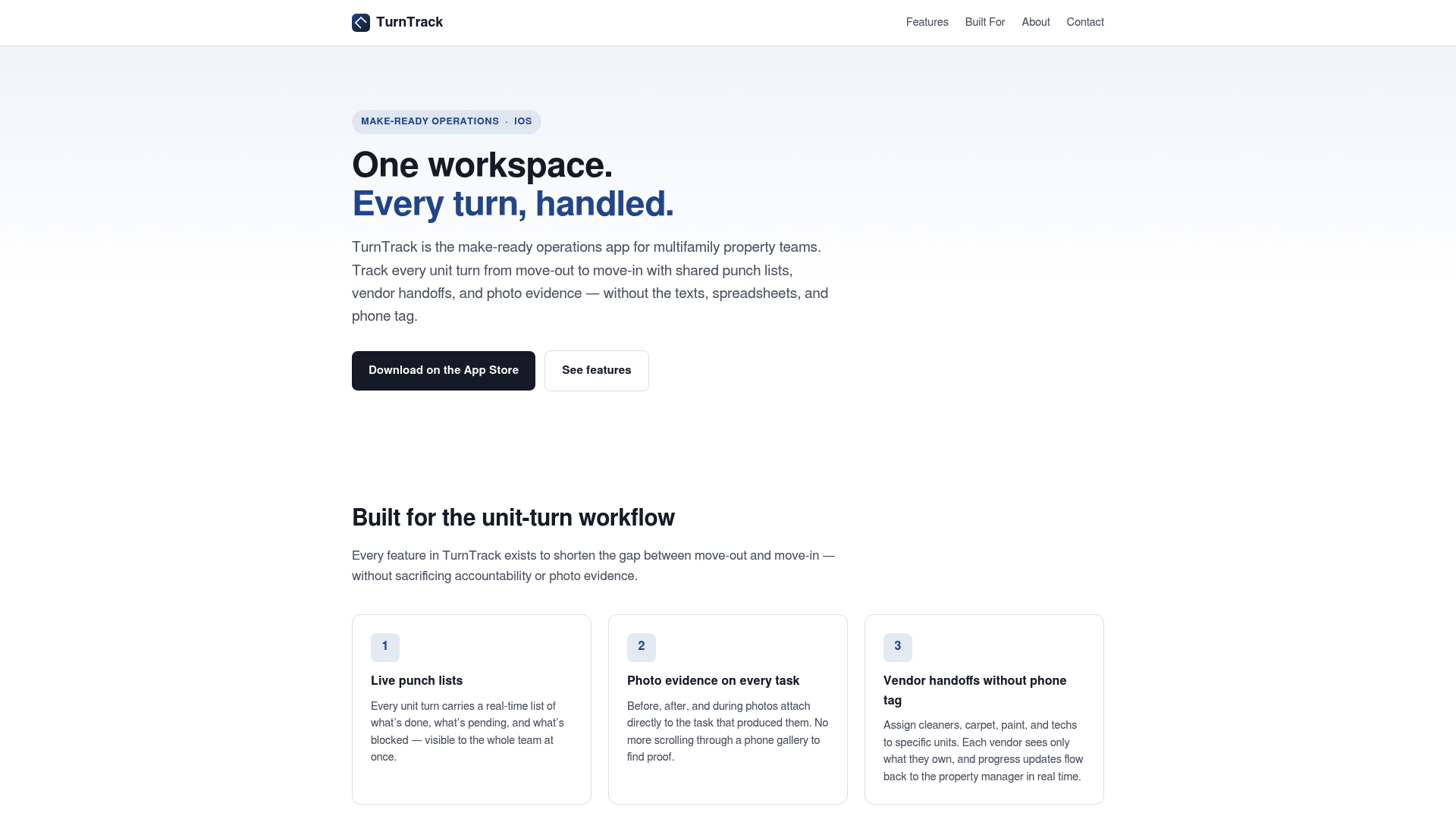
TurnTrack is an operations workspace for multifamily unit turns. It handles the Make-Ready timeline, vendor coordination, inspections, punch lists, and the Property Standards Library. At $14.99/month for a workspace subscription with a free trial and an iOS app, it's built for service managers and property teams who need real coordination without enterprise-level overhead. One subscription covers your invited team.
TurnTrack does not manage rent, leases, accounting, or tenant communications. It does one thing: keeps unit turns moving from Move-Out to Make-Ready with every vendor, task, and document in one place.
Start a free trial and run your next turn with the gates already built in.
Useful sources and references
- Moxo: Contractor Onboarding Workflow Guide — workflow sequencing, automation timing, and audit trail design
- FirstHR: Contractor Onboarding Checklist and Compliance — W-9 requirements, 24% backup withholding rule, 1099-NEC filing by January 31
- FileRequestPro: Contractor Onboarding Checklist — document checklist, COI minimums ($1M per occurrence), and SOW requirements
- Worksuite: Contractor Onboarding Checklist — classification-first practice and scaling thresholds (20–50 contractors)
- Papaya Global: Onboarding an Independent Contractor — legal and compliance framework, payment setup, and feedback loops
Consult a qualified attorney or HR professional for jurisdiction-specific questions, especially if you operate in California or across multiple states. The 1099-NEC filing deadline is January 31 for payments of $600 or more in the prior calendar year.