
A preferred vendor list (PVL) is a short, curated set of pre-vetted vendors you call first for unit turns. It is not the same as an approved vendor list (AVL): the AVL is compliance-focused, covering every vendor allowed on property; the PVL is a performance-curated subset you have already vetted, priced, and trust to show up. A preferred supplier list improves cycle times and supplier accountability when it is wired into your actual workflow, not sitting in a spreadsheet no one opens.
Your next 30 days: run a vendor audit across the four critical turn categories — cleaning, carpet, paint, and general maintenance techs. For each vendor, confirm you have:
- W-9 on file with a matching tax ID
- Current certificate of insurance (COI) with coverage limits and expiry date
- Active business license
- A primary contact and an emergency contact
That audit alone will surface expired insurance, missing W-9s, and vendors you have not used in over a year. Fix those before peak season hits.
Table of Contents
- What fields does every PVL entry need to store?
- How do you vet and approve a new vendor?
- How do you keep the PVL reliable over time?
- How does the PVL fit into an individual unit turn?
- How does TurnTrack operationalize your vendor list inside each turn?
- A ready-to-use PVL template and 7-step onboarding checklist
- What criteria matter most for multifamily unit turns?
- How do you negotiate contracts and pricing with preferred vendors?
- What are the most common PVL problems in multifamily operations?
- What legal and compliance issues go beyond the documentation checklist?
- How do you build vendor diversity into the PVL?
- Key Takeaways
- The list is only as good as what you do with it
- TurnTrack puts your vendor list inside every turn record
- Primary references and further reading
What fields does every PVL entry need to store?
A vendor record that staff can actually use during a turn needs more than a phone number. Standard vetting for U.S. businesses requires W-9 forms, proof of general liability insurance, business licenses, and tax IDs as a baseline. Build your records around these five groups:
| Field Group | Required Fields |
|---|---|
| Contact & business info | Legal name, DBA, primary contact, emergency contact, service area, hours |
| Compliance & payment docs | W-9, tax ID, COI (coverage limits, effective date, expiry), business license |
| Operational specs | Service categories, pricing band, SLA (response time), certifications |
| Performance metadata | Last job date, average turnaround time, inspection pass rate, photo evidence links |
| Administrative | Internal owner, preferred tier (1–3), last review date, contract expiry, probation status |
A few fields that teams routinely skip: the emergency contact (critical when a vendor goes dark mid-turn), the probation status flag, and the internal owner field. Without an owner, no one is accountable for keeping the record current.
How do you vet and approve a new vendor?
Vetting should be tailored by vendor type and risk, with procurement, finance, and legal holding defined approval gates to prevent bottlenecks. For a multifamily operation, that translates to a six-step workflow:
- Request and justification. A service manager or inspector submits the vendor for evaluation with a service gap reason (e.g., primary carpet vendor at capacity during peak season).
- Pre-screen. Check service fit, coverage area, basic references, and run a duplicate check against your existing vendor master.
- Document collection. Collect W-9, COI, business license, and payment/cancellation terms. Attach everything to the vendor record before moving forward.
- Verification. A staged check — TIN/W-9 match, sanctions screen, bank verification — reduces fraud and speeds activation. AP verifies financial details; operations verifies references and past performance.
- Trial job. Run one paid job under probationary status with defined acceptance criteria: on time, within scope, passes inspection. No trial, no preferred status.
- Approval and activation. The final approver (property manager or operations director) activates preferred status and documents the decision in the vendor record.
Pro Tip: Set a scorecard threshold before the trial job, not after. Deciding what "pass" looks like in advance removes subjectivity and gives you a defensible record if a vendor disputes their status.
Governance matters here. Document every non-approval reason. A vendor who fails the trial should know exactly why, and that reason should live in the record in case they reapply.
How do you keep the PVL reliable over time?
The real failure mode for PVLs is staleness: expired insurance, broken contact details, and no scheduled reviews. A list that was accurate 18 months ago is a liability today.
Build your maintenance cadence around these checkpoints:
- Annual full review: score every vendor, confirm all docs are current, remove or demote underperformers.
- 6-month check for high-spend categories: cleaning and carpet vendors typically need more frequent review.
- Automated reminders: set calendar alerts 60 days before each COI expiry. Chasing expired certificates during a turn is avoidable.
Track these KPIs per vendor:
| KPI | What it tells you |
|---|---|
| On-time completion rate | Reliability under your specific turn schedule |
| Rework/repair rate | Quality consistency across units |
| Inspection pass rate | Whether their work clears your QA standard |
| Average turnaround time | Speed relative to your make-ready deadline |
| Invoice accuracy | Admin burden and billing disputes |
For demotion, set clear thresholds: two failed inspections in a quarter triggers probation; a third moves the vendor to the AVL (still allowed, not preferred). When a vendor is demoted mid-turn, have a transition plan ready so active jobs are not disrupted.
Pro Tip: Attach audit trail documentation to the vendor profile, not just to the turn record. When a dispute comes up six months later, you want the score history, the reviewer's name, and the date in one place.
How does the PVL fit into an individual unit turn?
Vendor coordination belongs inside the turn timeline, not in a separate lookup. The sequence is Move-Out → Tech Start → Cleaners → Carpet → Inspection → Make-Ready. At each handoff, the coordinator should be pulling from the PVL, not texting around to find a number.
Practical steps that prevent bottlenecks:
- At Tech Start, confirm the preferred vendor for each trade is available for the unit's target date. If not, escalate to your backup vendor immediately.
- Attach property-specific specs to the vendor task: paint code, appliance model, HVAC filter size. A vendor who shows up without the right materials costs you a day.
- Require photo evidence for QA-critical tasks (smoke detector replacement, carpet seams, paint touch-ups) and attach it to the inspection item, not just the activity feed.
- For off-list needs, document the exception: record the one-off vendor in the AVL for future vetting and note why the PVL vendor was unavailable.
Keep a small pool of two or three backup vendors per category for peak seasons. Maintaining current insurance certificates and accurate contact details prevents emergency disruptions during busy make-ready seasons. A backup vendor with an expired COI is not actually a backup.
Pre-authorize work windows for your top-tier vendors. If when your preferred cleaner has standing weekly work windows at your property, scheduling friction drops significantly.
How does TurnTrack operationalize your vendor list inside each turn?
TurnTrack is a make-ready operations workspace, not a property management system. It does not handle rent, leases, or tenant communications. What it does is put vendor coordination inside the turn record itself, so staff are not hunting through phones and spreadsheets mid-job.
Inside each turn, TurnTrack stores the vendor contact, lets you attach COI photos and property standard specs directly to the task, and logs every update in an activity feed. The Property Standards Library holds property-specific details — the exact Sherwin-Williams color code, the HVAC filter size, the preferred vendor for each trade — and shares them to a tech or vendor without requiring them to have a TurnTrack account. A tech in the unit asking "what white goes on these walls?" gets the answer from the spec sheet in the app.
Photo evidence is optional and attached where the property requires it: smoke detector documentation, carpet condition before and after, paint touch-ups. Not forced on every task, but available where QA demands it.

TurnTrack runs at $14.99/month per workspace, covers the invited team, includes a free trial, and is available on iOS via the App Store. It fits operators who need vendor coordination and audit trails inside each turn record without paying for enterprise software that overserves a 200-unit community.
A ready-to-use PVL template and 7-step onboarding checklist
Export or build your PVL with these columns:
| Column | Notes |
|---|---|
| Vendor ID | Unique internal identifier |
| Category | Cleaning, carpet, paint, HVAC, etc. |
| Tier | 1 = preferred, 2 = approved, 3 = probation |
| Primary contact | Name, phone, email |
| COI expiry | Date; flag 60 days out |
| W-9 on file | Yes/No + date collected |
| Pricing band | Rate range or flat fee per unit type |
| SLA | Response time and completion window |
| Last review date | Quarter and year |
| Contract link | File path or URL |
| Internal owner | Name of accountable staff member |
7-step onboarding checklist:
- Map your current spend by category and identify gaps (no preferred vendor, single-vendor risk).
- Select two or three candidates per category. Keeping category lists to 1–3 vendors preserves negotiation leverage and service accountability.
- Request W-9, COI, business license, and pricing terms from each candidate.
- Verify documents and run a paid trial job with defined acceptance criteria.
- Sign a preferred vendor agreement covering SLAs, pricing, and demotion conditions.
- Import the vendor record into your PVL and into TurnTrack's vendor coordination module.
- Schedule the first 6-month checkpoint before you close the onboarding file.
Typical onboarding time per vendor involves a few days for document collection and additional time to schedule and complete the trial job. Budget for the trial job cost as a vetting expense.
What criteria matter most for multifamily unit turns?
Reliability and speed-to-complete outrank price for turn vendors. A cleaner who is $50 cheaper but books out two weeks in advance costs you more in vacancy days than you save on the invoice. Evaluate candidates on:
- Availability during peak seasons (August/September and May/June in most markets)
- Familiarity with multifamily unit standards — vendors who work single-family homes often underestimate the scope of a unit turn
- Licensing and certification specific to the trade (EPA 608 for HVAC, lead-safe certification for pre-1978 properties)
- References from other property managers, not homeowners
- Willingness to work within your inspection and photo-evidence requirements
Pricing benchmarks vary by market, but the more useful metric is cost per turn completed on time and passing inspection. A vendor with a higher per-unit rate who never requires a callback is cheaper in practice.
How do you negotiate contracts and pricing with preferred vendors?
Preferred status should be formalized in writing with agreed terms, SLAs, and demotion/removal conditions. That formalization is also your negotiating leverage. You are offering volume and priority scheduling in exchange for better rates and guaranteed availability.
Specific terms to negotiate:
- Volume pricing tiers: a lower per-unit rate above a monthly threshold (e.g., 10+ units/month).
- Response time guarantees: 24-hour response for standard turns, 4-hour for emergency calls.
- Rework policy: vendor returns at no charge for any item that fails your inspection within 48 hours.
- Rate lock period: fix pricing for 12 months to protect your budget.
- Cancellation notice: 48–72 hours minimum so you can activate a backup without scrambling.
Put the demotion clause in writing. A vendor who knows they can lose preferred status for two consecutive failed inspections has a concrete incentive to perform. Without it, the designation is just a title.
What are the most common PVL problems in multifamily operations?
Most PVL failures come down to three patterns:
The list grows uncurated. Every vendor who ever completed a job gets added, and no one removes anyone. Within a year, the list has 40 vendors across 8 categories, half with expired insurance, and staff ignore it because it is not trustworthy. Fix: cap each category at three preferred vendors and enforce the annual review.
The AVL and PVL are treated as the same thing. The AVL is a compliance record; the PVL is a performance record. Mixing them means your "preferred" list includes vendors who are merely allowed, not actually good. Keep them as separate records linked together.
Vendor data lives in email threads. A COI attached to an email from 18 months ago is not a vendor record. When the service manager who received that email leaves, the data is gone. Centralize everything in a system with an audit trail. A third-party vendor management checklist can help you structure what to collect and where to store it.
The fourth pattern, less discussed: over-reliance on a single vendor per category. When your only preferred cleaner goes on vacation during August turnover, you have no fallback. Two vendors per category is the minimum; three is better for high-volume properties.
What legal and compliance issues go beyond the documentation checklist?
Documentation is the floor, not the ceiling. Beyond W-9s and COIs, your vendor agreements should address:
- Indemnification clauses: the vendor agrees to hold your property harmless for claims arising from their work. Without this, a vendor's employee injury on your property can become your liability.
- Additional insured status: your property should be listed as an additional insured on the vendor's general liability policy, not just a certificate holder.
- Workers' compensation coverage: required in most states for vendors with employees. Verify it annually, not just at onboarding.
- Independent contractor classification: misclassifying an employee as an independent contractor carries IRS penalties and state labor law exposure. If you direct when, where, and how a vendor works, consult an employment attorney about classification.
- Lien waivers: for larger repair or renovation work, require a lien waiver upon payment to protect the property from mechanic's liens.
This is general information, not legal advice. Confirm current requirements with a licensed attorney in your state and review IRS guidance on contractor classification before finalizing vendor agreements.
How do you build vendor diversity into the PVL?
A PVL built entirely from word-of-mouth referrals tends to reflect whoever the last service manager knew. That limits your options and can create single points of failure. Practical steps to broaden the pool:
- Post open vendor solicitations through local trade associations, minority business enterprise (MBE) directories, and your state's small business development center network.
- Track vendor diversity metrics in your PVL (MBE/WBE/veteran-owned status) alongside performance data. Vanderbilt University's procurement model, for example, actively manages preferred supplier relationships and includes disadvantaged business enterprises as a category criterion.
- Evaluate diverse vendors on the same scorecard as any other candidate. Diversity is a sourcing criterion, not a performance exemption.
- Set a target: at least one diverse vendor per major service category. Review progress at the annual audit.
The business case is straightforward. A broader vendor pool gives you more negotiating leverage, reduces single-vendor dependency, and often surfaces vendors who are hungrier for the work and more responsive as a result.
Key Takeaways
A reliable preferred vendor list requires current documentation, a defined vetting process, and a scheduled review cadence — without all three, the list becomes a liability faster than it becomes an asset.
| Point | Details |
|---|---|
| Cap each category at 1–3 vendors | Keeping the list short preserves negotiation leverage and maintains vendor accountability. |
| Require W-9, COI, license, and a trial job | No vendor reaches preferred status without verified documents and a passed trial job. |
| Review on a set cadence | Run a full annual review; check high-spend categories every 6 months; automate COI expiry alerts. |
| Track on-time rate, rework rate, and inspection pass rate | These three KPIs tell you whether a vendor is earning their preferred status each quarter. |
| TurnTrack embeds the PVL inside each turn | TurnTrack puts vendor contacts, specs, and photo evidence inside the turn record so staff never hunt for details mid-job. |
The list is only as good as what you do with it
The most common mistake is treating the PVL as a one-time project. You build it, you feel organized, and then six months later someone is calling a vendor whose COI expired in March because no one checked. The list did not fail — the maintenance process did.
The second mistake is making it too long. Operators who add every vendor they have ever used end up with a list that staff ignore because it offers no real guidance. Keeping each category to 1–3 preferred vendors is not about limiting options; it is about creating accountability. A vendor who knows they are one of two preferred cleaners for a 150-unit property has a reason to answer the phone on a Saturday.
What actually saves time in the field: attaching property-specific specs to the vendor task so the tech or vendor shows up knowing exactly what is needed. The service manager who built TurnTrack spent 9+ years watching turns stall because a vendor showed up without the right paint color or the wrong filter size. Embedding that information in the turn record, not in someone's memory, is what closes that gap.
The PVL is infrastructure. Build it once, maintain it consistently, and wire it into the turn workflow so it gets used automatically rather than consulted occasionally.
TurnTrack puts your vendor list inside every turn record
Running 5–15 active turns at once means vendor details need to be where the work is, not in a separate spreadsheet or a text thread from three months ago. TurnTrack is a make-ready operations workspace built for exactly this: every turn has a shared record with a live timeline, and the vendor contact, COI, and property specs are attached to the task, not buried somewhere else.
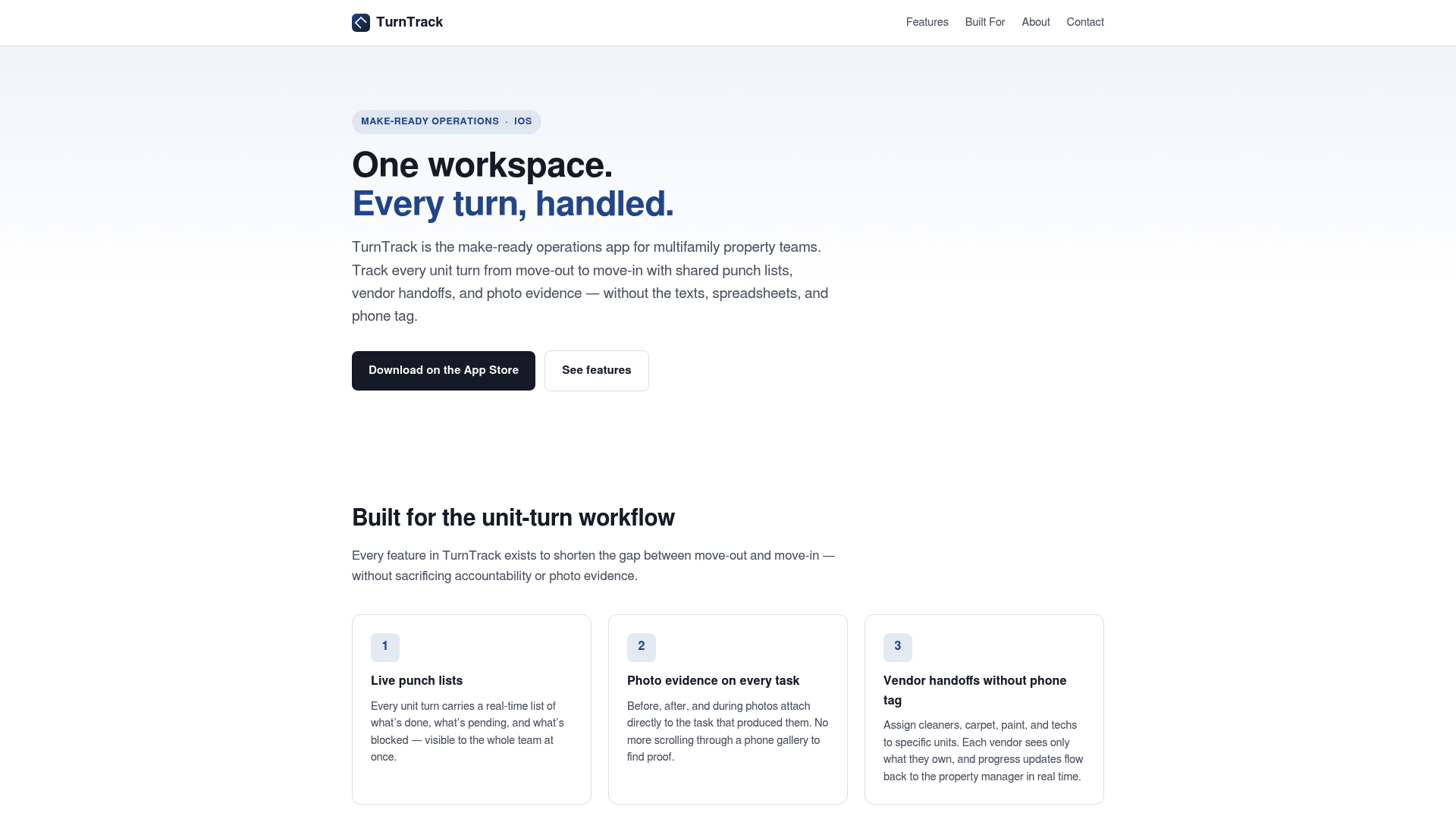
The Property Standards Library stores the paint code, the filter size, the preferred vendor per trade, and shares it directly to a tech or vendor without requiring them to have an account. Photo evidence attaches to inspection items where your property requires it. The activity feed creates an audit trail as a byproduct of the work.
TurnTrack costs $14.99/month per workspace, covers your invited team, and includes a free trial on iOS via the App Store. It is built for operators who need vendor coordination and documentation inside each turn, without paying for enterprise software that overserves a mid-size community.
Start with the free trial: run your first 10 turns in TurnTrack and measure the time you save on vendor lookups and inspection documentation. No long-term contract, no per-seat pricing for your crew.
Primary references and further reading
The sources below back the guidance in this guide and are worth bookmarking for your own vendor governance work.
- Vendor Approval Process: Key Steps & Best Practices — HighRadius
- Vendor Approval Process — Vendr
- Approved Vendor List Guidance — Bill.com
- Vendor Creation Approval Workflow — Stampli
- Third-Party Vendor Management Checklist for Property Managers — Postal Solutions
- Preferred Suppliers — Vanderbilt University Finance
- Reduce Vacancy Time Multifamily: A Manager's Playbook — TurnTrack Blog
- Audit Trail Property Management: A Practical Guide — TurnTrack Blog