
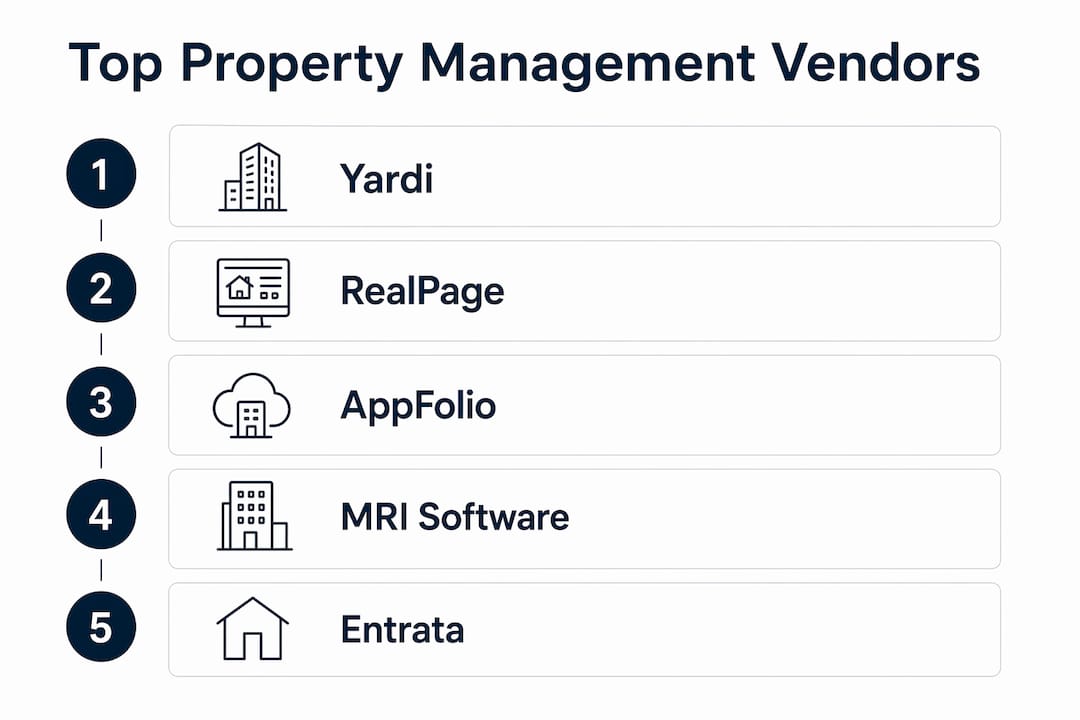
The largest U.S. property management software companies are Yardi, RealPage, AppFolio, MRI Software, Entrata, Buildium, ResMan, Propertyware, and Rent Manager. Most of them are built around accounting, leasing, and compliance first. For a service manager running 5–15 active turns, that architecture matters: these platforms are systems of record, not daily operations tools.
TL;DR for service teams:
- Enterprise PMS (Yardi, RealPage, MRI, Entrata) serve 500+ unit portfolios with deep accounting and compliance features.
- Mid-market cloud tools (AppFolio, Buildium, ResMan) target scaling operators with modern interfaces.
- SMB tools (Rent Manager, Propertyware) fit smaller or specialized portfolios.
- None of the above are purpose-built for punch lists, vendor coordination, and photo-documented turn workflows.
- Next step: run a 3–6 week pilot focused on turn adoption, not feature counts.
Table of Contents
- How the property management software market actually breaks down
- Profiles of the largest property management software vendors
- How these vendors compare on dimensions that matter for turn teams
- How to evaluate a PMS or operations workspace for turn work
- When a dedicated operations workspace beats extending your PMS
- Step-by-step pilot plan for evaluating a vendor or ops workspace
- Key Takeaways
- An operator's honest take on the enterprise PMS gap
- TurnTrack: a purpose-built operations workspace for make-ready teams
- Sources and further reading
How the property management software market actually breaks down
The market segments into three tiers, and mismatching your portfolio to the wrong tier is the most common implementation failure.
- Enterprise systems of record (500+ units): Yardi, RealPage, MRI Software, Entrata. Deep accounting, revenue management, compliance reporting. High implementation cost and long onboarding.
- Mid-market cloud platforms (100–500 units): AppFolio, Buildium, ResMan. Modern interfaces, faster setup, per-unit pricing.
- SMB and specialized tools (<100 units or niche asset classes): Rent Manager, Propertyware. Flexible but narrower.
A fourth category is growing quietly: lightweight operations workspaces focused exclusively on turn and make-ready coordination. These sit alongside a PMS rather than replacing it. The Fair Housing Act, 50 state landlord-tenant codes, and local rent-control regimes make audit-ready workflow documentation a real operational need, not a nice-to-have.
One vendor-trust note worth flagging: the DOJ filed an antitrust lawsuit against RealPage in August 2024, centered on its YieldStar revenue management algorithm. That event has pushed some buyers to diversify their tech stacks and re-examine ownership risk before signing multi-year contracts.
Profiles of the largest property management software vendors
Yardi and RealPage rank among the largest by revenue and installed base. Here is how each major vendor stacks up for a service manager evaluating turn operations.
Yardi serves portfolios of every size through two platforms: Voyager (enterprise) and Breeze (SMB). Accounting and compliance are its core strengths. Field tools exist but are secondary to the financial engine. Expect a long implementation for Voyager; Breeze is faster but lighter on operations features.
RealPage targets large multifamily operators with revenue management, leasing analytics, and OneSite as its property management core. Propertyware, a RealPage subsidiary, handles single-family portfolios. The DOJ lawsuit is an active procurement consideration. Field tools are available but not the platform's identity.
AppFolio is a NASDAQ-listed company (ticker: APPF) with over eight million units managed through its platform. It targets mid-to-large operators with a clean interface and strong leasing automation. Maintenance tracking exists; dedicated turn workflow tools are limited.

MRI Software, headquartered in Cleveland, serves over 45,000 clients across 170+ countries with a 400+ partner network. It started in 1971 and has evolved into a cloud platform covering commercial and residential. Strong on compliance and integrations; field operations require third-party add-ons.
Entrata is a full-suite enterprise platform for large multifamily. It covers leasing, accounting, resident services, and maintenance. Adoption complexity is high for field teams not already inside the platform.
Buildium targets mid-market managers with 150+ units. G2 rates it at 4.2 stars. Per-unit pricing starts around $1.40/unit. Maintenance tracking is included; turn-specific workflows are basic.
ResMan focuses on multifamily and affordable housing operators. It offers accounting, leasing, and maintenance modules. Field adoption is manageable for mid-size teams already using the platform daily.
Rent Manager, built by London Computer Systems (founded 1988, Cincinnati, Ohio), is Investopedia's pick for best overall rental property management software. It handles mixed portfolios well and has strong integration options. Minimum unit thresholds and onboarding costs apply.
Propertyware specializes in single-family rental portfolios of 250+ units. G2 rates it at 3.9 stars. It is a RealPage subsidiary, which carries the same vendor-trust considerations noted above.
How these vendors compare on dimensions that matter for turn teams
| Vendor | Best for | Core strengths | Mobile/field tools | Turn/make-ready support | Pricing model | Support/onboarding | Compliance & audit |
|---|---|---|---|---|---|---|---|
| Yardi | Enterprise 500+ units | Accounting, compliance, revenue mgmt | Available; not primary | Limited native turn tools | Enterprise contract | High onboarding complexity | Strong audit logs |
| RealPage | Large multifamily | Revenue mgmt, leasing analytics | Available | Limited; third-party needed | Enterprise contract | High complexity; DOJ risk factor | Strong |
| AppFolio | Mid-to-large operators | Leasing automation, clean UX | Good mobile app | Basic maintenance tracking | Per-unit (~$1.40+) | Moderate; onboarding fee | Solid |
| MRI Software | Commercial + residential enterprise | Compliance, integrations, partner ecosystem | Moderate | Add-ons required | Enterprise contract | High; 400+ partner network | Very strong |
| Entrata | Large multifamily | Full suite: leasing, accounting, resident services | Moderate | Basic maintenance | Enterprise contract | High complexity | Strong |
| Buildium | Mid-market 150+ units | Accounting, leasing, maintenance | Moderate | Basic | Per-unit (~$1.40+) | Moderate | Good |
| ResMan | Multifamily + affordable housing | Accounting, leasing | Moderate | Basic | Per-unit | Moderate | Good |
| Rent Manager | Mixed portfolios 100+ units | Flexibility, integrations | Good | Moderate | Per-unit starting around $1.40 | Moderate; onboarding fee | Good |
| Propertyware | Single-family 250+ units | SFR specialization | Moderate | Limited | — | Moderate | Moderate |
The pattern is consistent: enterprise platforms carry strong compliance and accounting but weak daily turn tooling. Mid-market cloud tools are more accessible but still treat maintenance as a module, not a workflow. None of them were designed around the punch-list-and-photo-evidence loop a service manager runs every day.
How to evaluate a PMS or operations workspace for turn work
Start with an honest assessment of portfolio complexity and your team's actual IT capability. Overbuying features is the fastest path to low adoption.
Evaluation checklist:
- Portfolio size and asset class (multifamily, SFR, mixed)
- Team IT capability and change tolerance
- Core turn workflows you need covered (punch lists, inspections, vendor access, photo evidence)
- Audit and compliance requirements (Fair Housing, state codes, local rent control)
- Support expectations (named rep, video training, response time)
Questions to ask in a vendor demo:
- Can a field tech access a punch list and vendor contact from a phone without a full PMS login?
- How does the system document inspection results with optional photo evidence?
- What does the audit trail show for a completed turn, and who can access it?
- What is the pilot scope, and how many live turns can we run before committing?
- What is average support response time, and do you assign a named onboarding rep?
User satisfaction correlates strongly with support quality and training responsiveness, not feature breadth. That finding should weight your scoring.
Pilot success metrics: adoption rate among field techs, average time-to-ready per unit, task completion accuracy, and number of vendor coordination errors.
Pro Tip: Keep your pilot to 5–10 live turns on one property. A scoped pilot surfaces adoption problems in two weeks; a broad one buries them in configuration noise.
When a dedicated operations workspace beats extending your PMS
Large PMS platforms lack the lightweight, real-time task tracking and vendor-scoped access that make-ready operations require. The signals that you need a separate ops workspace:
- Your field techs avoid the PMS because it requires full login credentials and is slow on mobile.
- Vendors need task visibility without a paid PMS seat.
- You need photo documentation tied to specific inspection items, not just a general notes field.
- Turn status (Ready/On Track/At Risk/Overdue) needs to be visible to the whole team in real time.
- Your PMS audit log captures financial events but not field-level task completions.
The trade-off is data duplication: a unit's lease lives in the PMS; its turn record lives in the ops workspace. That handoff is manageable. What is not manageable is forcing field techs to use a platform built for accountants. For more on software alternatives when the enterprise tool is the wrong fit, the pattern is consistent across portfolios of all sizes.
Step-by-step pilot plan for evaluating a vendor or ops workspace
Run a 3–6 week pilot before any contract. Scoped pilots focused on operator tasks validate fit faster than broad evaluations.
Week-by-week timeline:
| Week | Tasks | Success metrics |
|---|---|---|
| Week 1 | Discovery: map current turn workflow, identify gaps, configure one property | Workflow documented; property standards loaded |
| Week 2–3 | Run 5–10 live turns; field techs use mobile tools daily | Adoption rate >80%; zero missed vendor contacts |
| Week 4 | Collect time-to-ready data; solicit field feedback | Turn time vs. baseline; tech satisfaction score |
| Week 5–6 | Review audit trail completeness; decide go/no-go | Audit log covers all inspection stages; support response <24 hrs |
Red flags to stop the pilot early:
- Mobile UX requires more than 3 taps to log a task update.
- Support response exceeds 48 hours during the pilot.
- Audit trail does not capture individual task completions with timestamps.
- Field techs revert to texts and spreadsheets after week one.
For a detailed make-ready pilot checklist, the same framework applies whether you are evaluating a large PMS module or a standalone ops workspace.
Key Takeaways
The largest property management software companies are enterprise systems of record first; service managers running daily turns almost always need a separate, purpose-built operations workspace alongside them.
| Point | Details |
|---|---|
| Enterprise PMS = systems of record | Yardi, RealPage, MRI, and Entrata are built for accounting and compliance, not daily punch lists. |
| Mid-market tools are more accessible | AppFolio, Buildium, and ResMan offer modern interfaces but still treat turn workflows as a module. |
| Pilot on operator metrics | Measure adoption rate, time-to-ready, and audit trail completeness, not feature counts. |
| Support quality predicts satisfaction | Named reps and fast response times matter more than feature breadth in user reviews. |
| TurnTrack fills the ops gap | At $14.99/mo with a free trial, TurnTrack covers turn records, inspections, vendor coordination, and a Property Standards Library where large PMS leave off. |
An operator's honest take on the enterprise PMS gap
The enterprise PMS market is not broken. Yardi and RealPage do exactly what they were built to do: manage money, leases, and compliance at scale. The problem is that service managers are not accountants. When a tech is standing in a unit trying to figure out what paint goes on the walls or whether the carpet crew has been called, a platform optimized for revenue management is the wrong tool. The gap between what a large PMS promises and what a field team actually uses daily is where most turn coordination falls apart. Spreadsheets, group texts, and sticky notes fill that gap by default. That is not a technology failure; it is a scope mismatch. The right answer is not to force the PMS to do field work. It is to give the field team a tool built for field work, and let the PMS do what it does well.
TurnTrack: a purpose-built operations workspace for make-ready teams
If the vendors above are your system of record, TurnTrack is what your service team actually uses on the floor.
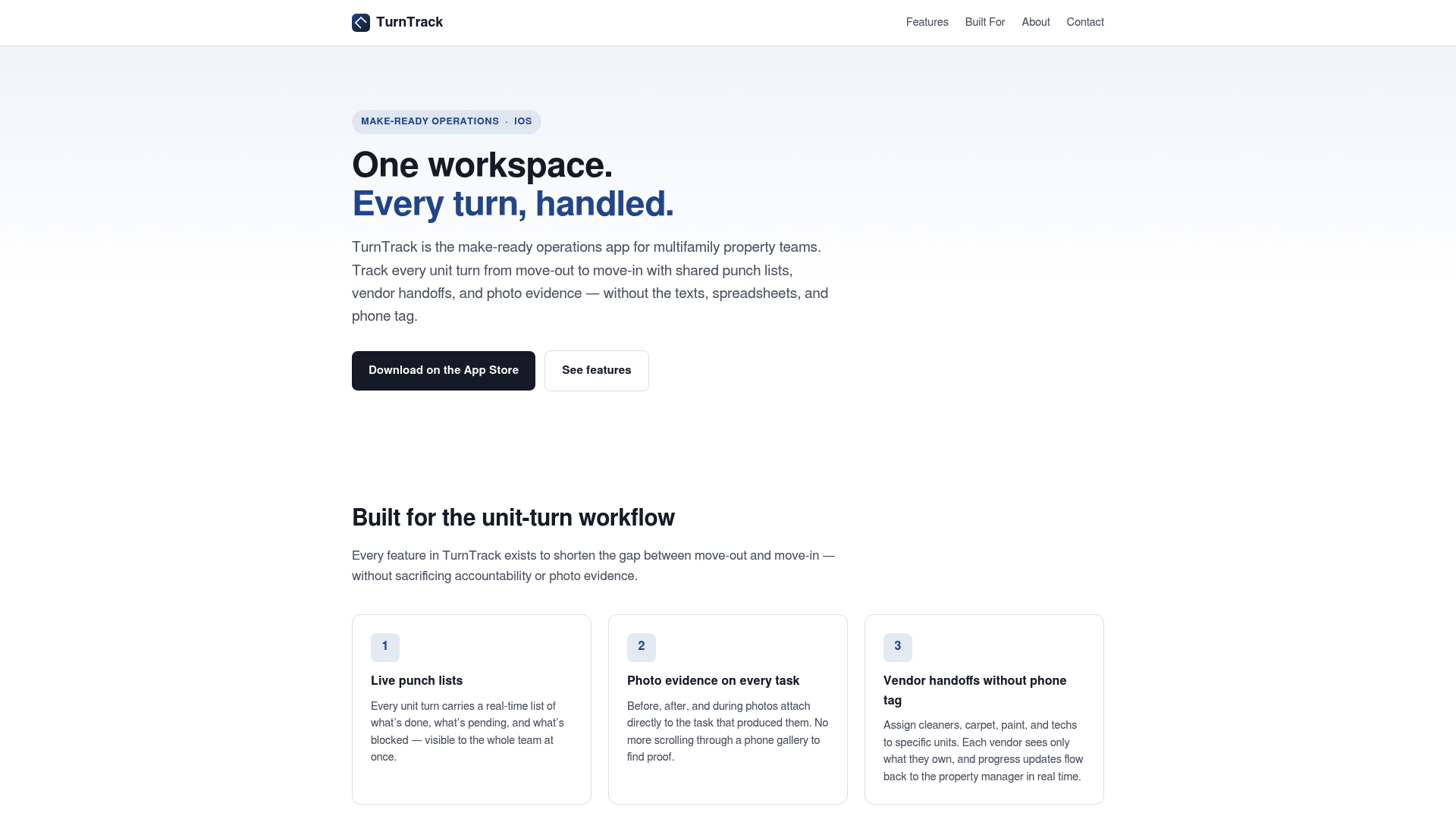
Every turn gets a shared record with a live status (Ready, On Track, At Risk, Overdue) and a timeline the whole team can see: Move-Out → Tech Start → Cleaners → Carpet → Inspection → Make-Ready. Vendor contacts live inside the turn record, so a tech never has to dig through a phone to find the carpet crew. The Property Standards Library keeps property-specific specs in one place: the exact paint color, HVAC filter size, faucet model, and preferred vendor, shareable to any tech or vendor without requiring them to have a TurnTrack account. Inspections (Move-Out, Mid-Turn, Move-In) are walked area by area on a phone. Photos are optional and attached where the property requires documentation, not forced on every task.
TurnTrack is not a PMS. It does not handle rent, leases, accounting, or tenant communications. It manages the unit-turn workflow only. Workspace subscription: $14.99/mo, free trial available, iOS. One subscription covers the invited team.
Start your free trial, import one property's standards, and run 5 live turns. That is enough to know whether it fits.
Sources and further reading
- Property Management Software: 10 platforms ranked — Zendikt: market segmentation, vendor-trust context, and DOJ antitrust background.
- Best property management software of 2026 — TechRadar: portfolio-fit guidance and pilot approach.
- Best Property Management Software Reviews — Gartner Peer Insights: peer reviews for Yardi, AppFolio, Entrata, Buildium, Rent Manager, MRI, and Propertyware.
- What Property Management Software Gets the Highest Reviews? — Rentec Direct: user sentiment and support quality analysis.
- Best Property Management Software — Software Advice: aggregated comparison for shortlisting and pricing validation.
- 11 Largest Property Management Software Companies — ReadyContacts: revenue and market-share context.
- Audit Trail Property Management Guide — TurnTrack: building audit-ready documentation for compliance.
- Workflow management software alternatives — Dexcore Technologies: comparative evaluation of workflow approaches for field operations.