
Normal wear and tear is predictable, gradual deterioration the landlord pays for. Tenant-caused damage is harm from negligence or misuse that you can deduct from the security deposit, prorated by the item's remaining useful life. That single distinction determines who writes the check at move-out.
At move-out, three actions protect your deposit rights immediately:
- Run a standardized move-out inspection, area by area, using the same form you used at move-in.
- Collect time-stamped before/after photos that match the same angles from the move-in walkthrough.
- Calculate any deduction using HUD useful-life guidance to prorate the remaining value, not the full replacement cost.
Collect this evidence before the tenant leaves:
- Signed move-in inspection report (tenant-acknowledged condition at start of tenancy)
- Dated, time-stamped photos of every room and fixture at both move-in and move-out
- Itemized repair invoices and receipts for every deduction you plan to make
- Work orders showing what was repaired, by whom, and when
Table of Contents
- What landlords mean by "normal wear and tear" in the U.S.
- What counts as tenant-caused damage
- Side-by-side examples by property area
- How to calculate fair security-deposit deductions
- Documentation that makes deductions defensible
- Security deposit rules and dispute basics in the United States
- Practical move-out assessment workflow
- Lease clauses, move-in orientation, and preventive measures
- How an operator uses TurnTrack to build an audit-ready move-out record
- Key Takeaways
- The mistake most operators make at move-out
- TurnTrack keeps your unit-turn documentation in one place
- Useful sources and templates
What landlords mean by "normal wear and tear" in the U.S.
Normal wear and tear is the expected, gradual deterioration that results from ordinary, intended use of a property over time. It is not the tenant's fault. It is the cost of renting. Under U.S. landlord-tenant law, landlords generally cannot deduct these costs from a tenant's security deposit.
HUD guidance lists the following as classic examples: faded or lightly scuffed paint, small nail holes from hanging pictures, worn carpet traffic lanes, loose grout around tiles, minor door scuffs, and slightly sticking doors caused by seasonal humidity. These conditions arise because someone lived in the unit, not because they abused it.
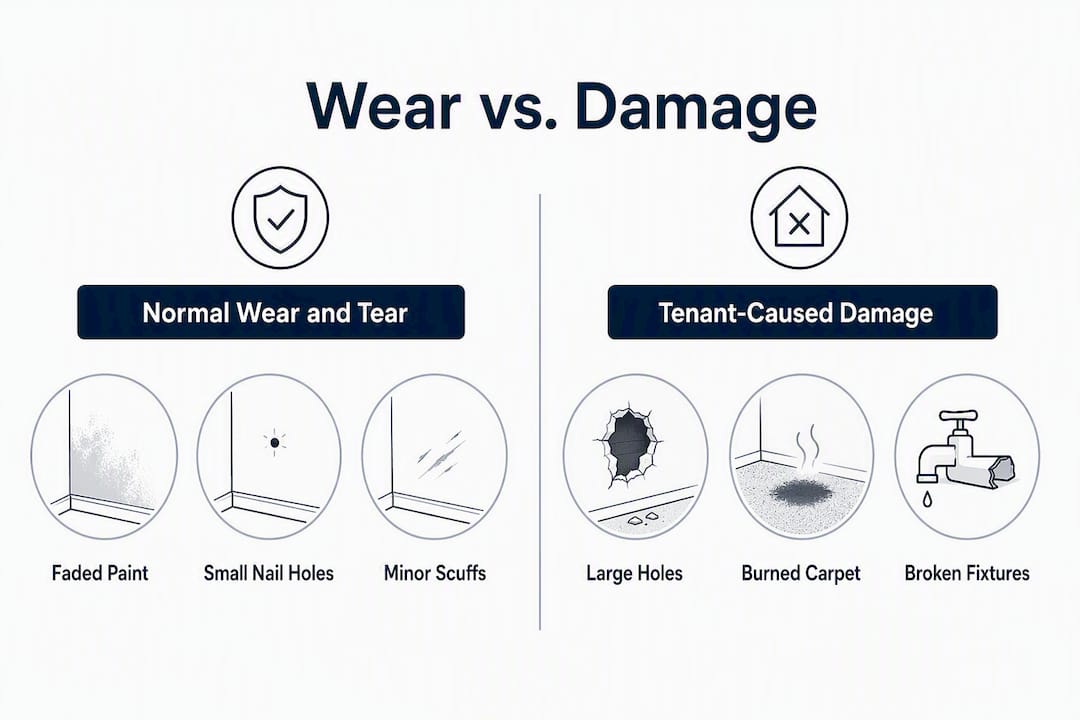
The underlying principle is simple: if the deterioration would have happened to any reasonable tenant living normally in the space, it is wear. A carpet that shows a worn path from the bedroom to the bathroom after three years of tenancy is not damage. A carpet soaked with pet urine is.
Two quick scenarios make this concrete. A tenant lives in a unit for four years. The interior paint looks dull and shows a few minor scuffs near light switches. That is wear — paint has a useful life of roughly 2–3 years under HUD baselines, so the landlord was already past due for repainting. Now picture a tenant who punches a fist-sized hole in the drywall. That is damage, regardless of tenancy length.
What counts as tenant-caused damage
Damage is harm that goes beyond ordinary use. It results from negligence, misuse, or deliberate action, and it is the tenant's financial responsibility when properly documented and prorated.
HUD examples of chargeable damage include:
- Gaping holes in drywall (beyond a standard picture nail)
- Broken windows or cracked glass from impact
- Burns on countertops, floors, or carpets
- Pet urine soaked through carpet into the subfloor
- Unauthorized paint colors or wallpaper that require extra prep work to reverse
- Missing or broken fixtures (towel bars ripped from walls, broken cabinet doors)
- Mold caused by tenant failure to report a leak or ventilate a bathroom
The tenant's responsibility is not automatic. You must document the condition, connect it to the tenant's tenancy (not a pre-existing issue), and prorate the charge based on the item's remaining useful life. A broken window is chargeable at full replacement if it was intact at move-in. A carpet replacement is chargeable only for the remaining life of the carpet, not the full cost of new flooring.
Here is a scenario that shows the line clearly. A tenant moves out after two years. The carpet has a 5-year useful life and was new at move-in. There is a large burn mark near the couch. You can charge for 3/5 of the replacement cost (three years of remaining life). If that same carpet had been installed seven years ago, its useful life is exhausted and the charge is $0, even for the burn.

Side-by-side examples by property area
The fastest way to classify a condition is to ask four questions: How severe is it? How many instances are there? How long was the tenancy? What caused it? Severity and cause separate wear from damage more reliably than any single rule.
| Area | Normal Wear and Tear | Tenant-Caused Damage |
|---|---|---|
| Walls | Small nail holes (1–2 per room), minor scuffs, faded paint | Large holes, crayon or marker stains, unauthorized paint colors |
| Floors (hardwood) | Light surface scratches from normal foot traffic | Deep gouges, water damage from unreported leaks, burns |
| Carpet | Worn traffic lanes, minor matting, light fading | Stains, burns, pet urine soaked to subfloor, torn sections |
| Appliances | Light grease buildup, minor surface scratches | Broken knobs, cracked glass, missing parts, burn damage |
| Blinds | Slight fading or dust accumulation | Bent or broken slats, missing blinds, broken cords |
| Plumbing/fixtures | Mineral deposits, slow drain from normal use | Cracked toilet tank from impact, broken faucet handles |
| Doors | Slightly sticking from humidity, minor edge wear | Holes, broken locks, damaged hinges from forced entry |
| Windows | Condensation staining on frames, minor screen wear | Cracked or broken glass, torn screens from misuse |
A note on grey areas. Clustered nail holes — say, 15–20 in a single wall from a gallery arrangement — often cross into damage territory in small claims court, even though a single nail hole does not. Judges look at the cumulative effect and the cost to restore the surface to a rentable condition.
Pet-related conditions deserve their own note. Mild pet odor that clears with standard cleaning is generally wear, especially in a long tenancy. Pet urine that has penetrated the carpet pad and subfloor is damage. The test is whether standard turnover cleaning resolves it or whether remediation or replacement is required.
How to calculate fair security-deposit deductions
Charge the tenant for the remaining useful life of the damaged item, not the full cost of a brand-new replacement. That is the proration principle, and courts widely accept HUD-style schedules as the baseline for this math.
Sample useful-life baselines (HUD-style guidance):
| Item | Typical Useful Life |
|---|---|
| Interior paint | 2–3 years |
| Carpet | 5–7 years |
| Vinyl/linoleum flooring | 5–7 years |
| Hardwood floor refinishing | 10+ years |
| Water heater | ~10 years |
| HVAC system | ~10 years |
| Refrigerator | 10–12 years |
| Dishwasher | 8–10 years |
| Blinds | 3–5 years |
The proration formula:
Worked example. A tenant moves out after 18 months. The carpet was installed new at move-in and has a 6-year useful life. There is a large burn mark that requires full carpet replacement. The replacement cost is a market price example.
- Remaining useful life is calculated by subtracting tenancy length from total useful life.
- The charge is the replacement cost multiplied by the fraction of remaining useful life.
The tenant owes a prorated amount representing damage beyond normal wear, not the full replacement cost.
Pro Tip: When to claim full replacement: only when the item was new at move-in AND the damage makes it completely unusable AND the tenancy was very short (under 6 months). In nearly every other case, proration is the defensible path. If you cannot document the installation date, your proration claim weakens significantly — keep invoices and work orders for every major replacement.
One more scenario worth knowing: if the carpet was already 7 years old at move-in and the tenant burns it, the proration math yields $0. The item had no remaining value to the landlord. Charging for it anyway is the definition of unjust enrichment, and judges treat it that way.
Documentation that makes deductions defensible
Documentation wins disputes. Without a signed move-in report and dated photos, a landlord asking a judge to approve a $1,200 carpet deduction is essentially asking the court to take their word for it. That rarely works.
Inspection checklist — collect and preserve all of the following:
- Signed move-in inspection report, acknowledged by the tenant before or on the day they take possession
- Time-stamped move-in photos covering every room, wall, floor, appliance, and fixture
- Matching move-out photos taken from the same angles, with timestamps
- Itemized invoices for every repair or replacement you intend to charge
- Work orders showing the scope of work, vendor name, and completion date
- Receipts for materials purchased for repairs
- Certified itemized disposition notice delivered to the tenant within the state-required deadline
Photo guidelines. Take wide-angle room shots first, then close-ups of any condition worth noting. Capture the same framing at move-out that you used at move-in — a photo of a wall stain means nothing if you have no "before" shot of that wall. Use a phone with automatic date/time metadata, or a camera app that embeds timestamps visibly in the image. For damage claims, photograph the item from two distances: context (where in the room) and detail (the damage itself).
Evidence handling. Store photos and inspection reports in a system that preserves the original file metadata. An itemized deduction letter should list each item, the charge, the proration math, and the supporting invoice. Send it via a method that creates a delivery record. Keep copies of everything for at least as long as your state's statute of limitations for small claims actions, which is typically 2–6 years depending on the state.
A move-in inspection form that both parties sign is the single most valuable document in a deposit dispute. If you do not have one, you are starting from zero at move-out.
Security deposit rules and dispute basics in the United States
Landlords must follow state-specific timelines and provide itemized written notices. Failure to do so can result in penalties that exceed the deposit itself — in some states, a landlord who misses the return deadline forfeits the right to make any deductions at all.
Common legal requirements to verify for your state:
- Return deadline: Most states require returning the deposit (or itemized deductions) within 14–30 days of move-out. California requires 21 days; Texas requires 30 days.
- Itemized written notice: Nearly every state requires a written, itemized list of deductions. A vague "cleaning and repairs" line item will not hold up.
- Allowable withholdings: Deductions are generally limited to unpaid rent, damage beyond normal wear and tear, and specific lease violations. Routine cleaning and normal wear are not deductible in most jurisdictions.
- Burden of proof: The landlord bears the burden of proving that a deduction was for damage, not wear. Time-stamped before/after documentation and signed reports are the evidence courts expect.
- Unjust enrichment: Small-claims judges routinely reduce or dismiss full replacement charges when the item had remaining useful life. Proration is not optional — it is the standard.
State law governs the specifics. HUD guidance provides the federal framework, but California, Texas, Maryland, and every other state layer their own statutes on top. Check your state's landlord-tenant statute directly — the Legal Information Institute at Cornell is a reliable starting point for definitions, and your state legislature's website carries the deposit statutes.
Routine cleaning and standard make-ready work are generally a cost of doing business and cannot be billed to tenants unless the tenant left the unit in a condition that goes well beyond ordinary vacating. Charging a tenant for a standard carpet cleaning after a two-year tenancy is the kind of deduction that gets thrown out in small claims court and damages your credibility on the legitimate charges.
This article provides general information about U.S. landlord-tenant practices, not legal advice. Deposit rules vary by state and locality — confirm current requirements with your state's landlord-tenant statute or a licensed attorney.
Practical move-out assessment workflow
A repeatable move-out process protects your deposit rights and speeds re-occupancy. The goal is a documented, timestamped record that connects the tenant's tenancy to every condition you intend to charge for.
Step-by-step workflow:
- Schedule the inspection within 24–48 hours of move-out. Do not wait. Conditions change, and a gap in the timeline weakens your chain of custody.
- Use the same inspection form you used at move-in. Walk every area in the same order. Note conditions room by room, not as a general summary.
- Photograph before you touch anything. Capture the unit in the condition the tenant left it, before any cleaning or repairs begin.
- Classify each item as wear or damage using the useful-life baselines above. Flag items that need vendor quotes before you can calculate the deduction.
- Get itemized invoices before finalizing deductions. Do not estimate. A court will want the actual invoice, not a round number.
- Calculate prorated charges for each damage item using the formula above.
- Prepare the itemized deduction notice with each charge, the proration math, and the supporting invoice attached.
- Deliver the notice within your state's deadline via a method that creates a delivery record (certified mail, email with read receipt, or a tenant portal with delivery confirmation).
- Return the remaining deposit balance at the same time as the notice.
Sample timeline:
| Stage | Target Timing |
|---|---|
| Move-Out | Day 0 |
| Inspection | Day 1–2 |
| Vendor quotes / invoices | Day 3–7 |
| Itemized notice prepared | Day 8–10 |
| Notice delivered + deposit returned | Before state deadline (typically Day 14–30) |
Pro Tip: Assign specific tasks to specific people and document who did what. If a vendor patches drywall, their invoice names the unit and the work. If your maintenance tech does the work, a work order with their name and date serves the same purpose. Mixed, undocumented labor is the audit-trail gap that turns a legitimate charge into a disputed one.

For a ready-to-adapt checklist, the tenant move-out inspection checklist covers the full workflow with photo guidance and common documentation pitfalls.
Lease clauses, move-in orientation, and preventive measures
Prevention lowers dispute volume. A tenant who understands what "damage" means, how to report a leak, and what the lease requires is far less likely to cause a dispute at move-out — or to contest one if it arises.
Sample lease language worth including:
- "Tenant is responsible for damage to the premises caused by negligence, misuse, or failure to report maintenance issues in a timely manner. Normal wear and tear is excluded."
- "Tenant shall not make alterations, including painting, without prior written consent from Landlord."
- "Pets are permitted under the following conditions: [terms]. Tenant is responsible for all damage caused by pets, including but not limited to staining, odor remediation, and subfloor damage."
- "Tenant shall promptly report any water leaks, plumbing failures, or HVAC issues to Landlord. Failure to report may result in tenant liability for resulting damage."
Move-in orientation checklist:
- Walk the unit with the tenant and sign the inspection report together
- Explain how to submit maintenance requests and the expected response time
- Clarify what constitutes damage versus normal use (a brief verbal explanation goes a long way)
- Provide contact information for emergency maintenance
- Document any pre-existing conditions on the inspection form before the tenant signs
Tenant education at move-in materially reduces the incidence of damage claims. A tenant who knows to report a slow leak immediately is less likely to hand you a mold remediation bill at move-out.
Operational prevention. Schedule routine inspections at 6-month intervals for longer tenancies. Catching a slow leak, a broken window seal, or a pest entry point early costs far less than discovering it at move-out. Consistent make-ready standards — the same paint color, the same carpet grade, the same fixture spec — also make proration math cleaner because you have documented replacement costs on file. Pest prevention is part of this picture too; clear lease language on pest responsibility reduces ambiguity about who pays when an infestation is discovered at move-out.
How an operator uses TurnTrack to build an audit-ready move-out record
TurnTrack's unit-turn record and optional photo attachments create the chronology and condition evidence that judges and mediators accept. The documentation is a byproduct of running the turn, not a separate task.
Here is how the workflow maps in practice:
Move-in. Walk the unit on a phone using TurnTrack's Move-In inspection. Go area by area — walls, floors, appliances, fixtures. Attach photos to specific inspection items where the condition warrants it. The tenant-acknowledged condition is now tied to a timestamped record inside the turn.
During tenancy. Mid-Turn inspections can be run at 6-month intervals. Any condition noted gets attached to the turn record, building a timeline of the unit's condition across the tenancy.
Move-out. Run the Move-Out inspection using the same area-by-area structure. TurnTrack's activity feed logs every update with a timestamp. Photos attached to inspection items carry the date and context of the condition — not a folder of unnamed JPEGs, but a record tied to a specific area and stage of the turn.
Make-ready. The schedule timeline (Move-Out → Tech Start → Cleaners → Carpet → Inspection → Make-Ready) shows who did what and when. Vendor coordination lives inside the turn — the carpet crew's contact is right there, and their work is logged against the same record. The Property Standards Library keeps specs like the exact paint color and HVAC filter size in one place, so techs get the right materials without a phone call.
TurnTrack features that support each step:
- Unit turn record with status (Ready, On Track, At Risk, Overdue)
- Move-In, Mid-Turn, and Move-Out inspections walked area by area
- Optional photo attachments on inspection items and activity updates
- Schedule timeline from Move-Out through Make-Ready
- Vendor coordination inside the turn record
- Property Standards Library for unit-specific specs
- Activity feed with timestamps for every update
Pro Tip: Attach invoices and receipts directly to the turn record as activity updates. When a dispute arises, you have a single file: inspection photos, timeline of work, vendor invoices, and make-ready completion — all tied to one unit and one tenancy. That is the audit trail that holds up.
Key Takeaways
Normal wear and tear is the landlord's cost of doing business; tenant-caused damage is chargeable only when documented, prorated by useful life, and delivered within your state's deposit return deadline.
| Point | Details |
|---|---|
| Wear vs. damage distinction | Wear is gradual deterioration from ordinary use; damage is harm from negligence or misuse — landlord pays for wear, tenant pays for damage. |
| Proration is required | Use HUD-style useful-life schedules to calculate charges; full replacement costs are rarely defensible and invite unjust enrichment claims. |
| Documentation wins disputes | A signed move-in report and time-stamped before/after photos are the evidence courts expect — without them, deductions are hard to defend. |
| State law governs timelines | Most states require itemized notice and deposit return within 14–30 days; missing the deadline can void your right to deductions entirely. |
| TurnTrack for audit trails | TurnTrack's unit-turn record, area-by-area inspections, and optional photo attachments create a timestamped, audit-ready file as a byproduct of running the turn. |
The mistake most operators make at move-out
Treat turnover costs as an operating expense. That is the mindset that keeps you out of small claims court and keeps your credibility intact with tenants, mediators, and judges.
The most common mistake is charging full replacement cost for an item that was already partially depreciated. A landlord who charges $1,800 for new carpet on a unit where the carpet was four years into a six-year life is not just legally exposed — they are also signaling to a judge that they did not do the math. Courts notice. And once a judge decides you overreached on one line item, every other deduction on the list gets scrutinized harder.
The second most common mistake is weak photo evidence. A single photo of a stain, taken at move-out, with no corresponding move-in photo of the same area, is not evidence of tenant damage. It is evidence that the stain existed when you photographed it. The "before" shot is what makes the "after" shot meaningful.
The third mistake is inconsistent inspection forms. If your move-in checklist covers 12 items and your move-out checklist covers 30, a tenant's attorney will point out every item that appears only at move-out. Standardize the form and use it every time, for every unit.
The operators who rarely lose deposit disputes are not the ones with the most aggressive deduction policies. They are the ones with the cleanest paper trails. A signed inspection report, matching photos, and an itemized invoice with proration math is a package that is genuinely hard to contest.
TurnTrack keeps your unit-turn documentation in one place
Running 5, 10, or 15 turns at once means documentation gaps are almost inevitable when the process lives across texts, emails, and spreadsheets. TurnTrack gives every turn a shared record that the whole team can see, with a timeline from Move-Out to Make-Ready and optional photo attachments tied to specific inspection items.
The result is an audit-ready file built as a byproduct of the work itself, not a separate documentation task at the end. Vendor contacts live inside the turn. The Property Standards Library keeps unit-specific specs — paint color, filter size, fixture model — accessible to any tech without requiring them to have a TurnTrack account. When a deposit dispute comes up, the record is already there: inspection photos, timeline of work, invoices attached to the activity feed.
TurnTrack is not a property management system. It does not handle rent, leases, or tenant communications. It manages unit-turn and make-ready operations only — which is exactly what matters when you are defending a security deposit deduction.
Workspace subscription is $14.99/month, covers your invited team, and includes a free trial. iOS only via the App Store. Start your free trial at TurnTrack and run your next turn with a complete audit trail from day one.
Useful sources and templates
These are the primary references and templates worth bookmarking for deposit documentation and useful-life guidance.
- HUD Guidance on Normal Wear and Tear — The federal baseline for wear-and-tear definitions and useful-life schedules. Use this as your proration reference and adapt it to your state's requirements.
- NLIHC Reproduction of HUD Useful-Life Appendix — A clean, accessible version of HUD's useful-life schedule for paint, carpet, appliances, and more.
- Legal Information Institute — Reasonable Wear and Tear (Cornell) — Plain-language legal definition with case law examples from multiple states.
- iPropertyManagement — Normal Wear and Tear vs Damage — Practical examples and documentation guidance for landlords.
- California Courts — California Tenants Guide — State-specific deposit rules for California landlords and tenants.
- TurnTrack — Move-In Inspection Form Guide — Template and field guidance for building a signed, area-by-area move-in record.
- TurnTrack — Move-Out Inspection Checklist — Ready-to-adapt checklist with photo guidance for move-out documentation.
- TurnTrack — Audit Trail in Property Management — Practical guide to building defensible records for deposit disputes and make-ready operations.
A note on state law: every state layers its own deposit statutes on top of federal guidance. The return deadline, penalty structure, and allowable deductions vary. Always verify the current statute for your state directly from your state legislature's website before making deductions or sending a disposition notice.