
A tenant move-in inspection form is a standardized document that records the exact condition of a rental unit before a tenant takes possession. It is the single most important piece of documentation you will create for any tenancy, and here is why: without a signed baseline, judges generally assume any damage was pre-existing, which guts your ability to make security deposit deductions.
The form works because it creates a mutually agreed record. Both parties walk the unit, note conditions room by room, attach photos, and sign off. That signature is what separates a legally binding document from a piece of paper you printed. HUD's inspection guidance is explicit: both the manager and the tenant must sign for the form to be admissible as evidence.
Key reasons every multifamily operator needs this process locked down:
- Prevents "he said, she said" disputes at move-out by establishing a clear, agreed baseline
- Protects security deposit deductions with documented, timestamped evidence
- Satisfies state-specific legal requirements (Arizona, Georgia, Washington, Wisconsin, Virginia, Maryland, and others mandate written condition reports)
- Serves as a final orientation, walking tenants through how systems operate and reducing future maintenance calls
- Creates an audit trail that holds up in court or mediation
Table of Contents
- When and How to Conduct the Tenant Move-In Inspection
- What your move-in inspection form needs to cover
- Legal standards that make or break your inspection record
- How digital tools sharpen your inspection workflow
- TurnTrack keeps your inspections and your turns in one place
- Key Takeaways
When and How to Conduct the Tenant Move-In Inspection
Timing is not a minor detail. The inspection should happen shortly before the tenant receives keys, ideally on move-in day before furniture comes through the door. Once a couch is in front of the wall, that wall is no longer documented.
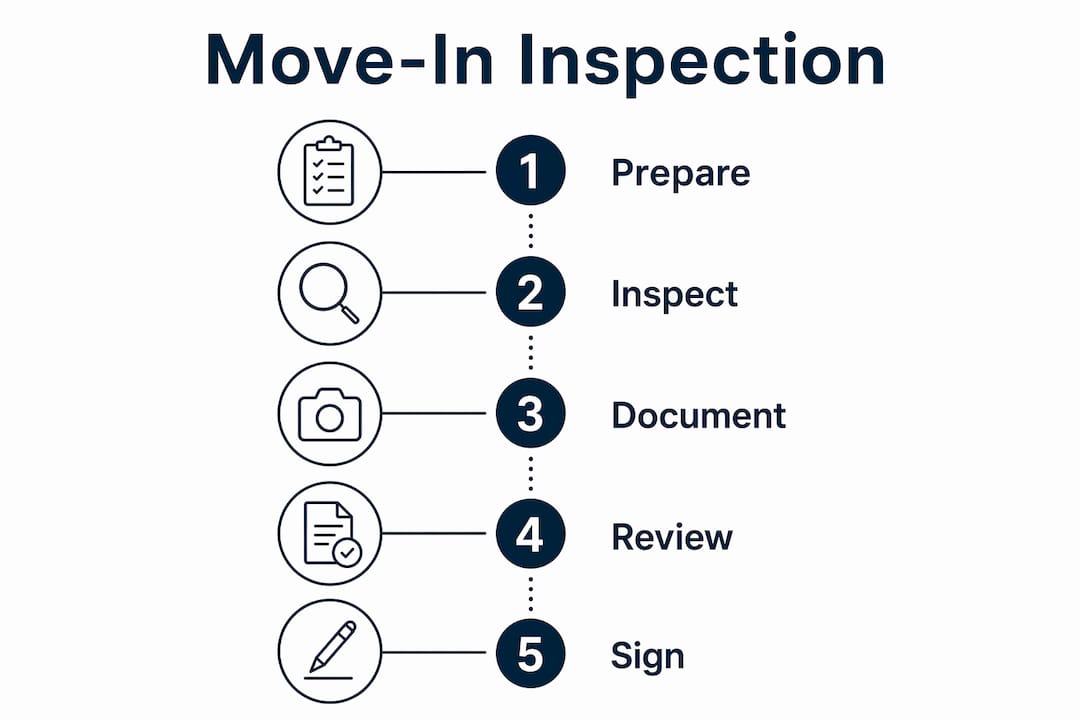
A step-by-step process that holds up:
- Schedule jointly. Walk the unit with the tenant present. Joint inspections produce stronger legal documentation than solo manager walkthroughs because the tenant cannot later claim they were unaware of conditions.
- Budget enough time. For a single-family home or large apartment, a thorough inspection usually takes enough time to cover all details carefully. Rushing creates gaps.
- Follow a consistent sequence. Entry and exterior, living area, kitchen, bathrooms, bedrooms, closets, utility areas. Same order every time, every unit.
- Test, don't just look. Run faucets, flush toilets, cycle the dishwasher, test every outlet, check smoke and CO detectors. A visual pass misses half the problems.
- Communicate as you go. Narrate what you are noting. Tenants who understand the process are less likely to dispute findings later.
- Give tenants a return window. Allow 24–48 hours to add notes after the walkthrough. Put the deadline in writing, in the lease.
Pro Tip: If a tenant does not return their signed copy by the deadline, your completed form with photos becomes the record of file. Document that you provided the form and send a written reminder on day two. An unreturned form is not a blank slate for the tenant.
What your move-in inspection form needs to cover
A vague form is nearly useless. "Good condition" means nothing in a dispute. Every item needs a specific, descriptive note.
Room-by-room, the form should capture:
- Floors, walls, ceilings: note paint condition, scuffs, nail holes, stains, cracks, and flooring scratches or tears by exact location
- Doors and windows: confirm locks function, screens are intact, and hardware operates correctly
- Kitchen appliances: run each one. Note the oven interior, stovetop burners, refrigerator temperature, dishwasher cycle, and disposal
- Bathrooms: check caulking and grout for mold, test water pressure, inspect under-sink areas for moisture
- Fixtures and lighting: every switch, outlet, and fixture confirmed working
- Smoke and CO detectors: tested and documented, with battery status noted
- Keys, fobs, and access devices: log exactly what was issued and how many
- Utility meter readings: record at time of possession or note account transfer status
- Access codes: document what was issued, separately from the main form for security
Pro Tip: Wide-angle room shots establish context; close-ups document specific damage. Take both. A photo of a scratch without a room-establishing shot is harder to place in a dispute.
Organized photo and document storage linked directly to the lease file is the difference between finding what you need in two minutes and scrambling through folders during a mediation.

Legal standards that make or break your inspection record
The form's legal weight depends entirely on how it is executed. A few non-negotiables:
- Signatures from both parties. Per HUD guidance, an unsigned form is not binding. Both the manager and tenant sign; both get a copy.
- Electronic signatures are fully valid. UETA is adopted across all US states, meaning a digitally signed move-in form carries the same legal weight as ink on paper.
- Timestamped photos must match written notes. Photo evidence strengthens your position; photos that contradict the written record create confusion and weaken it.
- California AB 2801, effective January 1, 2026, mandates timestamped move-in photos for new leases. If you operate in California, this is now a compliance requirement, not a best practice.
- Retain records for 3–5 years. Disputes can surface long after move-out. Store signed forms, photos, and video in a location you can access quickly.
- Avoid vague language. "Normal wear" is a legal term; "good" is not. Descriptions like "2-inch scuff on south wall of bedroom, approximately 4 feet from floor" are defensible. "Walls: fine" is not.
How digital tools sharpen your inspection workflow
Paper forms get lost. Photos taken on a personal phone end up in a camera roll with no context. Digital inspection tools solve both problems by requiring fields to be completed before submission and attaching photos directly to the items they document.
The practical advantages:
- Required fields prevent incomplete submissions
- Photos attach to specific line items, not a separate folder
- Electronic signatures are captured instantly, with a timestamp
- Cloud storage means the record is accessible from any device, not just the filing cabinet in the office
- Tenants can review their copy without a printer
TurnTrack's inspection workflow is built for exactly this. Move-In inspections are walked area by area on a phone, with optional photo attachments tied to each item. The activity feed logs every update, so the record builds itself as the work happens. The Property Standards Library keeps unit-specific specs, preferred vendors, and paint codes in one place, accessible to any tech or vendor without requiring them to have an account. When a smoke detector gets swapped, the photo with the date written on it attaches right to that task.
Pro Tip: A digital audit trail does not just protect you in disputes. It also speeds up turnover by keeping every stage of the Make-Ready visible to the whole team, reducing the back-and-forth that stalls units.
TurnTrack keeps your inspections and your turns in one place
Running 5–15 active turns at once means inspection records, vendor contacts, and unit specs are constantly at risk of living in someone's phone or a spreadsheet no one else can see. TurnTrack puts the Move-In inspection inside the turn record, alongside the full Make-Ready timeline, vendor coordination, and the Property Standards Library.
At $14.99/month for a workspace subscription with a free trial, it is built for operators who need a real field tool, not an enterprise platform that takes months to configure. iOS, available now. Start your free trial at TurnTrack and run your next move-in inspection the way it should be documented.
Key Takeaways
A signed, photo-documented tenant move-in inspection form is your primary legal defense against security deposit disputes and the foundation of every defensible unit turnover.
| Point | Details |
|---|---|
| Signatures are non-negotiable | Both manager and tenant must sign; an unsigned form has no legal weight in a dispute. |
| Timing matters | Inspect jointly before keys are handed over, ideally on move-in day before furniture arrives. |
| Specificity beats brevity | Vague notes like "walls: good" will not hold up; describe location, size, and type of every condition. |
| Digital tools close the gaps | Electronic signatures under UETA are legally binding, and photo-linked digital forms prevent lost records. |
| TurnTrack for multifamily turns | TurnTrack's Move-In inspection, activity feed, and Property Standards Library keep the whole turn documented in one place for $14.99/month. |