The typical cost of unit turns runs $1,000–$5,000 per apartment, with a 2026 national average near $3,872 based on Zego's industry reporting. The single largest line item is not paint or cleaning — it's vacancy. Every day a unit sits empty is lost rent you cannot recover. Plug your monthly rent into this formula right now: (monthly rent ÷ 30) × days vacant = lost rent. On a $1,500/month unit, that's $50 per day. At 14 days vacant, you've already spent $700 before a vendor sets foot in the door.
Three changes produce the fastest first-dollar savings: shorten your make-ready timeline by pre-inspecting at move-out, swap full-service junk removal for curbside pickup where local ordinance allows, and lock in a single approved paint color per unit type so painters never wait on a spec call.
| Metric | Value |
|---|---|
| Typical per-turn range | $1,000–$5,000 |
| 2026 national benchmark | ~$3,872 |
| Optimized target (standard make-ready) | $1,200 |
Pro Tip: Pre-market the unit before final cleaning is complete.
Key Takeaways
The 2026 national benchmark for per-turn cost sits near $3,872, with vacancy/lost rent as the largest single driver — cutting days vacant is the highest-leverage action any property manager can take.
| Point | Details |
|---|---|
| 2026 benchmark per turn | Industry average is ~$3,872; typical range is $1,000–$5,000 depending on scope and market. |
| Vacancy is the top cost | Lost rent at 35–50% of total turn cost makes make-ready speed the primary budget lever. |
| Turn type changes the budget | Soft make-readies run $800–$2,500; eviction-driven hard turns can reach $10,000 or more. |
| Hidden costs compound fast | Coordination overhead, rework, and invoice errors add 15–20%+ to direct vendor costs. |
| TurnTrack reduces the coordination tax | A $14.99/mo workspace tracks every turn's status, vendors, specs, and inspections in one place. |
Table of Contents
- What does a unit turn actually cost, line by line?
- How do vacancy days translate directly into dollars?
- Soft turns, hard turns, and eviction-driven turns: what each costs
- What are the hidden costs that inflate your real per-turn spend?
- How do you calculate your own unit turn cost?
- What operational levers actually cut unit turn costs?
- How does make-ready software reduce the coordination tax?
- The coordination problem no one budgets for
- TurnTrack: a make-ready workspace for the whole turn team
- Sources
What does a unit turn actually cost, line by line?
Industry reporting confirms that vacancy/lost rent is the dominant expense, typically accounting for 35–50% of total per-turn cost. Everything else is a distant second.
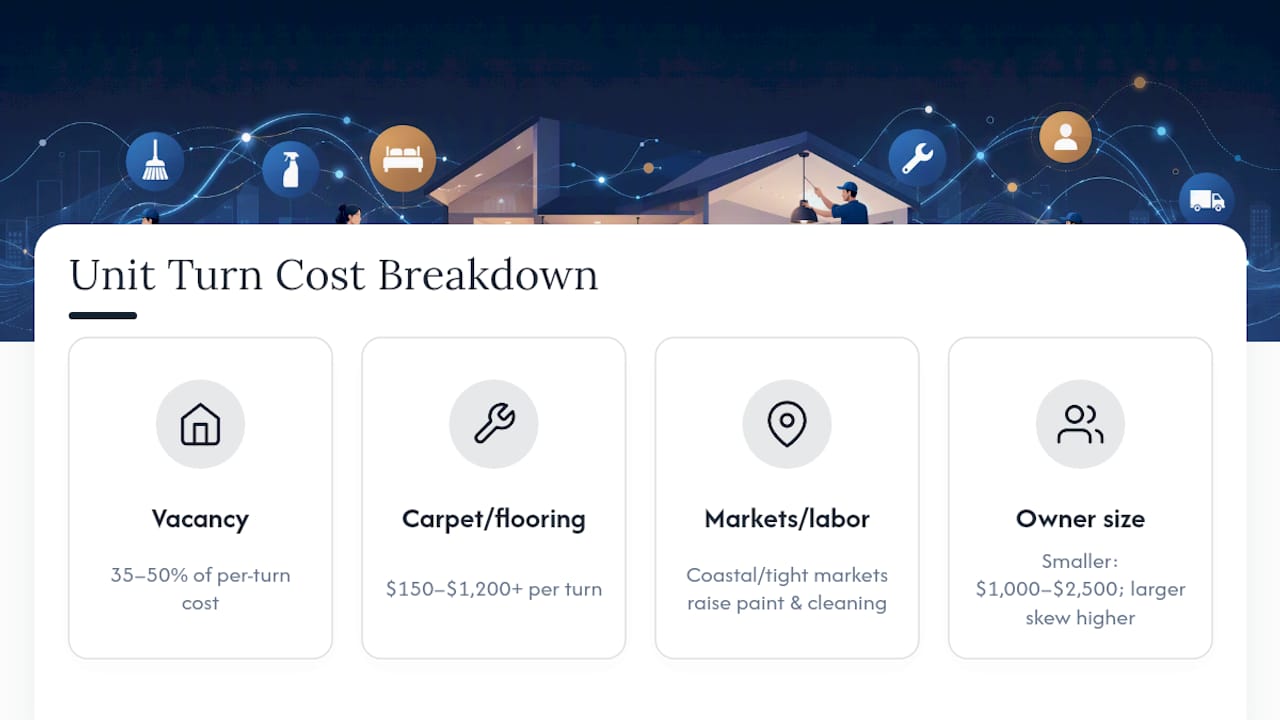
Carpet and flooring are the categories with the widest variance. A carpet clean on a short-tenancy unit might cost $150; replacing worn carpet in a 3BR after a long-tenancy resident can hit $1,200 or more. Markets with higher labor costs — coastal metros, tight contractor markets — push painting and cleaning toward the top of their ranges. Smaller landlords tend to land in the $1,000–$2,500 band; larger communities skew higher as scope and coordination complexity grow.
How do vacancy days translate directly into dollars?
The math is simple and the stakes are high. Divide monthly rent by 30 to get your per-day cost, then multiply by days vacant.
Formula: (monthly rent ÷ 30) × days vacant = vacancy loss
Three scenarios show how quickly this compounds:
At $1,500/month, the difference between a 7-day and a 21-day make-ready is $700. That's before a single vendor invoice. At $2,200/month, a two-week delay costs over $1,000 in lost rent alone.
The NAA's resident journey research reinforces that pre-marketing during the make-ready window is one of the most effective ways to compress vacancy days. Units listed before final cleaning is complete consistently attract earlier lease signings.
Four timeline levers that cut days vacant:
- Pre-inspect at move-out. Walk the unit the day the resident leaves. Scope is locked, vendors are called the same afternoon.
- Stagger vendors, don't stack them. Schedule painters to finish 24 hours before cleaners arrive, not the same day.
- Run parallel trades where possible. Appliance repair and carpet assessment can happen while painters are in adjacent rooms.
- Pre-market at the 80% mark. Post photos of comparable ready units or the unit itself before final punch-out.
Industry benchmarks put average make-ready timelines at 7–14 days for standard turns, with poorly coordinated turns stretching to 21 days or more. Each extra week at median rent costs roughly $350–$500 in pure vacancy loss.
Soft turns, hard turns, and eviction-driven turns: what each costs
Not every turn is the same scope, and routing the wrong budget to the wrong turn type is one of the fastest ways to blow your annual forecast.
A soft turn (also called a standard make-ready) covers paint touch-ups, cleaning, minor patching, and a rekey. Scope is limited because the unit is in acceptable condition. Cost typically falls in the $800–$2,500 range, and most of that is labor.
A hard turn (classic refresh) involves flooring replacement, appliance swaps, countertop resurfacing, or full paint. This is a unit that needs a genuine upgrade to compete at market rent. Budget $3,500–$7,500 for a classic refresh; a full renovation with cabinet replacement and fixture upgrades can reach $10,000–$25,000.
An eviction-driven turn is its own category. Expect all the costs of a hard turn, plus: trash-out and junk removal (often $300–$800 above normal), potential board-up or security costs, accelerated vendor timelines that carry rush premiums, and possible legal fees. The unit condition is unpredictable, which means scope creep is almost guaranteed.
Same 1BR, three scenarios:
The eviction premium is real. Rush scheduling, uncertain scope, and the emotional weight of the situation all push costs up. Operators who track turn type separately in their budget models catch this variance early; those who average all turns together consistently under-budget eviction units.
What are the hidden costs that inflate your real per-turn spend?
Direct vendor invoices are only part of the story. The coordination overhead — the hours a service manager spends chasing vendor status, re-scheduling no-shows, reconciling invoices, and resolving deposit disputes — adds real dollars to every turn. Industry analysis suggests that 40–45% of true per-turn costs often go untracked because they live in staff time and process friction rather than vendor invoices.
Common hidden cost drivers:
- PM coordination hours. Status calls, follow-up texts, and scheduling re-dos at $25–$40/hour add up fast across 10 active turns.
- Emergency and rush fees. A vendor no-show that pushes a unit's ready date by two days costs the rush premium plus the additional vacancy loss.
- Rework. A painter who uses the wrong color because no one confirmed the spec means a second visit. That's a full day of vacancy and a second invoice.
- Invoice reconciliation errors. Overbilling, duplicate line items, and NTE overruns that go unchallenged because no one has time to audit them.
- Deposit dispute labor. Without documented before/after condition records, disputes take hours to resolve and often end in concessions.
The Chicago Housing Authority OIG audit of 1,468 units (2023–2024) found total costs of $52,173,041 with average per-unit costs rising from roughly $29,000 in 2023 to roughly $49,000 in 2024 in audited samples, with multiple instances where costs far exceeded Not-To-Exceed thresholds. The audit recommended stricter procurement controls, written justifications for scope changes, and invoice verification. While public housing operates at a different scale, the procurement failure pattern — NTEs exceeded without documentation, invoices approved without walk-through verification — appears in private multifamily portfolios too, just at smaller dollar amounts.
Portfolio-level compounding: hidden costs that add $300 per turn look manageable on one unit. At 500 units with the same turnover rate, it's $45,000 per year — enough to fund a part-time coordinator or a full software stack.
For a practical framework on vendor invoice auditing and NTE compliance, a structured audit checklist helps catch overruns before they become budget surprises.
How do you calculate your own unit turn cost?
A repeatable five-step process produces a number you can defend in a budget meeting and track quarter over quarter.
- Capture baseline rent and days vacant. Pull the move-out date and the lease-start date for the incoming resident. Calculate days vacant. Multiply by your per-day rent figure.
- List and estimate line-item vendor costs. Use the category table above as your template. Get actual quotes for your market — contractor rates in Phoenix differ from rates in Boston.
- Add an indirect/coordination uplift. A conservative estimate is 15–20% of direct vendor costs to account for PM time, rework risk, and invoice errors. Higher if your process is manual.
- Include contingency and capital thresholds. Add 10% contingency for scope surprises. Flag any item over $500 as a capital decision requiring separate approval.
- Produce per-turn and annualized portfolio totals. Multiply per-turn cost by expected annual turns (units × turnover rate) for your budget exposure.
Sample calculation — 2BR at $1,600/month:
At the standard scenario ($2,635/turn), annual budget exposure is $131,750. At the slow scenario, it's $162,200. That $30,450 gap is entirely recoverable through faster make-ready coordination.
Tag every turn by tier (make-ready / refresh / renovation) when you log it. Operators who separate these in their tracking produce forecasts that are meaningfully more accurate than those who average all turns together.
What operational levers actually cut unit turn costs?
The highest-impact changes are process changes, not capital investments. Here's where experienced operators start.
Shorten make-ready days first
Every day you cut from the vacancy window is a direct dollar saved. Pre-inspect at move-out, call vendors the same day, and build a vendor schedule before the resident is gone. Properties that run a structured make-ready process with pre-scheduled vendor slots consistently hit 7-day turns on standard units.
Standardize paint and flooring specs
A service manager who has to call the office to confirm the paint color before a painter starts has already cost you half a day. Pick one Sherwin-Williams color per unit type, document the exact SKU, and put it somewhere every vendor can access without asking. Do the same for flooring: one LVP SKU per property, stocked on-site. Operator trade press consistently identifies material standardization as one of the fastest ways to cut rework and re-scheduling.
Fix your vendor procurement controls
Negotiate flat-rate scopes per unit type rather than time-and-materials. A painter who charges by the hour has no incentive to finish fast; a painter on a fixed $450 scope for a 1BR does. Set written NTE limits for every vendor category, require a written justification for any overage, and audit invoices against the scope before payment. The CHA OIG findings are an extreme example, but the underlying failure — approving invoices without verifying the work — happens at private communities every week.
Switch junk removal methods
Full-service junk removal at $300–$500 per unit is often unnecessary for standard turns. Curbside pickup, where local ordinance allows, costs a fraction of that. For eviction trash-outs, get competitive quotes rather than defaulting to a single vendor.
Retain residents longer
The cheapest turn is the one you don't run. A resident who renews costs nothing in make-ready, vacancy, or marketing. Retention strategies — proactive maintenance, responsive communication, renewal incentives — pay back in avoided turn costs. Ancillary income programs and move-in package services also improve the resident experience at move-in, which correlates with longer tenancy.
Pro Tip: Pilot one change at a time and measure it. Run your new vendor scheduling approach on 10 turns before rolling it out property-wide. Track days vacant and total cost per turn for both groups. A documented pilot gives you the data to justify the change to ownership — and to catch problems before they scale.
How does make-ready software reduce the coordination tax?
The coordination overhead described above — status chasing, rework, missed vendor calls, invoice disputes — is largely a documentation and communication problem. A shared workspace that every team member and vendor can see eliminates most of it.
TurnTrack is make-ready and unit turn software built specifically for multifamily property management teams. Every turn gets a shared record with a live status (Ready, On Track, At Risk, Overdue) and a timeline that tracks the full sequence: Move-Out → Tech Start → Cleaners → Carpet → Inspection → Make-Ready. When a vendor is scheduled, their contact lives inside the turn record. No digging through a phone or a separate spreadsheet.
The Property Standards Library is the feature that cuts rework most directly. It stores property-specific specs — the exact Sherwin-Williams color, the HVAC filter size, the preferred flooring SKU — and makes them accessible to any tech or vendor without requiring them to have a TurnTrack account. A painter who knows the spec before arriving doesn't need a call, doesn't wait, and doesn't use the wrong color.
Inspections (Move-Out, Mid-Turn, Move-In) are walked area by area on a phone, building a before/after condition record that resolves deposit disputes without a two-hour email chain. Optional photo documentation attaches directly to inspection items and activity updates where the property requires it — smoke detector replacement with the date written on it, for example — without forcing photos on every routine task.
Workflow automation analysis shows the automation-addressable portion of per-turn costs falling from roughly $1,878 to $360 in portfolio examples, with payback periods measured in weeks for larger communities. The coordination tax is real and it's measurable.
Pro Tip: Use the Property Standards Library to build a spec sheet for each floor plan before turn season starts. Share it with every vendor at the start of the relationship. You'll field fewer "what color goes here?" calls and fewer re-dos — both of which show up directly in your days-vacant number.
The coordination problem no one budgets for
Running 10 active turns at once across texts, emails, and memory is not a workflow — it's a liability. The service managers who consistently hit 7-day make-readies are not working harder than everyone else. They have a shared record that tells them, at a glance, which units are On Track and which are At Risk. They catch a stalled turn on day 3, not day 9.
TurnTrack was built by a service manager with 9+ years in the field, specifically for the operators who are still doing the work. The coordination problems it solves — missed vendor calls, units shown before they're ready, disputes with no documentation, property standards that live in one person's head — are not edge cases. They're Tuesday.
The workspace subscription model ($14.99/month, free trial) is designed for teams that heavy enterprise platforms overserve and overprice. It is not a property management system and does not handle rent, leases, or accounting. It manages the unit-turn workflow only, and it does that one thing well.
TurnTrack: a make-ready workspace for the whole turn team
Running a tighter make-ready process is the fastest path to cutting your per-turn cost. TurnTrack gives your team a shared workspace where every active turn has a live status, a vendor contact, a timeline, and a condition record — all in one place on iOS.
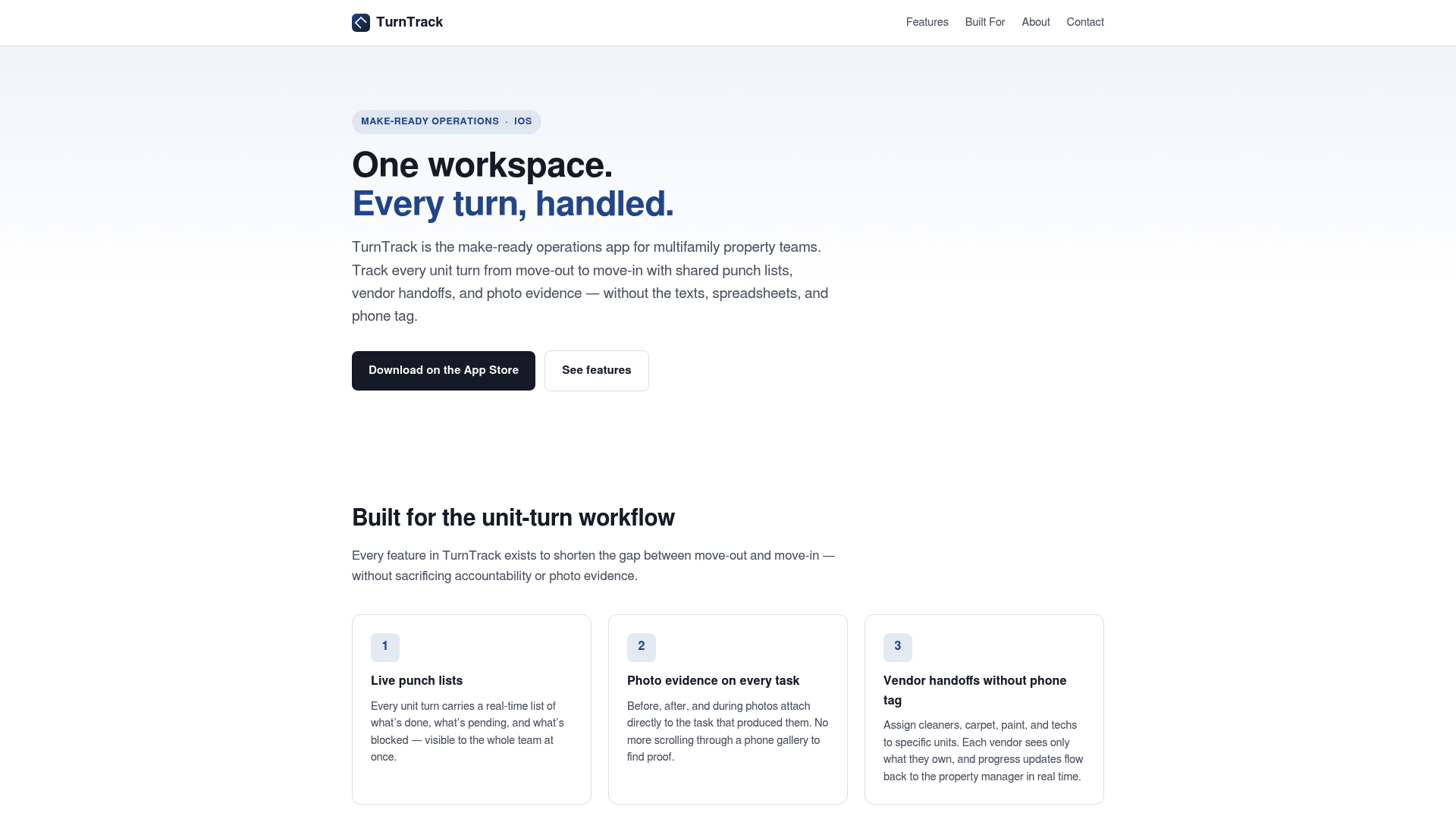
At $14.99/month with a free trial, one workspace subscription covers your invited team. There's no per-seat pricing for the techs and vendors you coordinate. The Property Standards Library keeps your paint specs, filter sizes, and flooring SKUs accessible to every vendor without a separate account. Optional photo documentation attaches to inspection items where you need it, building an audit-ready record as a byproduct of the work.
TurnTrack is not a PMS. It does not manage rent, leases, or accounting. It manages the unit-turn workflow from Move-Out to Make-Ready, and it does it for less than the cost of one extra vacancy day. Start your free trial at TurnTrack.
Sources
The benchmarks and operational guidance in this article draw from the following reports and audits. Each is worth reading in full if you're building a formal budget model or presenting turn costs to ownership.
- Apartment Turnover Cost: $1,000–$5,000 Breakdown 2026 | Dropcurb
- Turnover costs hold steady at nearly $4,000 per resident
- AI Unit Turn Cost Modeling for Multifamily 2026
This article is general information, not a substitute for advice from a qualified financial advisor. Consult a qualified financial professional about your own circumstances before acting on anything here.