
A multifamily property manager is the professional responsible for overseeing the daily operations, financial performance, tenant relations, and regulatory compliance of residential properties with multiple rental units. The multifamily property manager job description covers a wide range of duties, from leasing and maintenance coordination to budget reporting and Fair Housing Act compliance. This role carries a fiduciary obligation to the property owner while maintaining livable conditions and fair treatment for residents. The National Apartment Association (NAA) and HUD both set standards that define how this role operates across market-rate, affordable, and mixed-use communities.
What are the primary duties of a multifamily property manager?
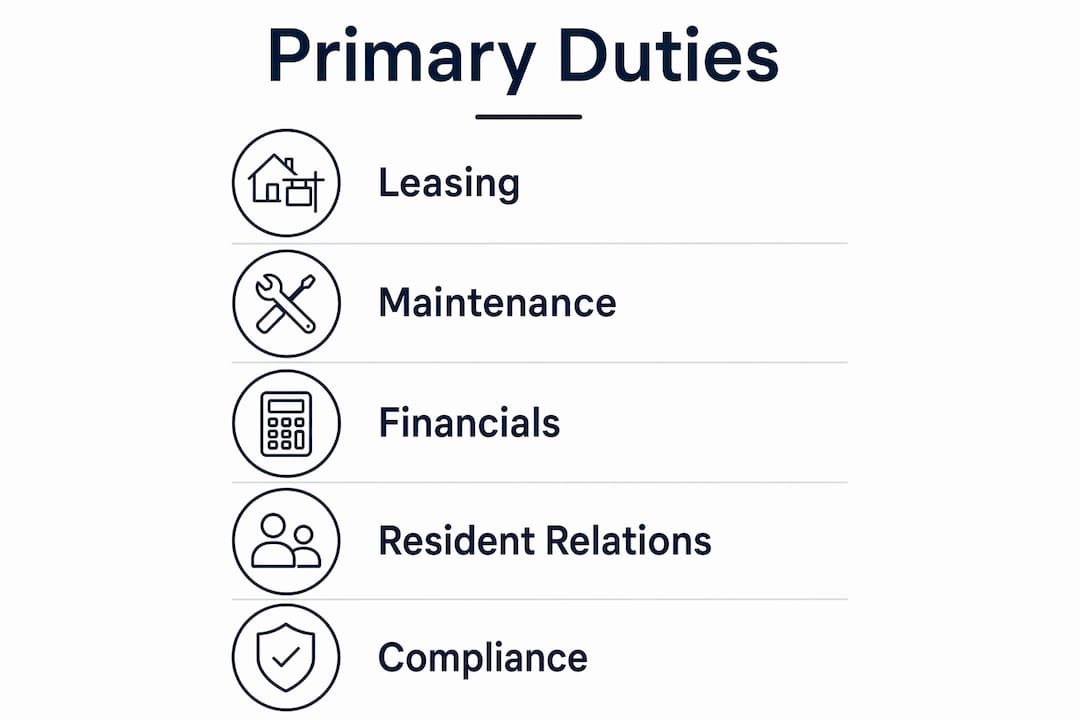
A multifamily property manager's core responsibilities span leasing, maintenance, financial management, resident relations, and regulatory compliance. Each function connects directly to the property's profitability and legal standing. Missing any one of them creates risk for the owner.
Leasing and occupancy management
The manager markets vacant units, screens applicants, executes leases, and enforces lease terms throughout the tenancy. Occupancy rate is the most visible performance metric an owner tracks, so leasing accuracy matters from day one. A manager who mishandles applicant screening exposes the owner to Fair Housing liability under 42 U.S.C. § 3601.

Maintenance coordination
Preventive maintenance programs, work order tracking, and vendor scheduling all fall under the manager's authority. Capital improvement projects, such as roof replacements or HVAC upgrades, require the manager to gather bids, present options to the owner, and oversee execution. Deferred maintenance is one of the fastest ways to erode asset value.
Financial management
Rent collection, trust account handling, budget preparation, and owner reporting are core financial duties. Property managers must strictly segregate trust accounts from operating funds to meet fiduciary and regulatory standards. Financial reporting typically follows GAAP or fund-specific accounting standards depending on the ownership structure.
Resident relations and compliance
Conflict resolution, community programming, and lease enforcement all require consistent communication with residents. Fair Housing Act compliance is mandatory, and HUD enforces violations with civil fines up to $21,663 per incident. That figure reflects how seriously regulators treat discriminatory practices, even unintentional ones.
Pro Tip: Build a written response protocol for resident complaints. A documented process protects the owner legally and gives your team a consistent standard to follow, regardless of who handles the call.
What qualifications and certifications does this role require?
The qualifications for a multifamily property manager role vary by state and property type, but several benchmarks apply broadly across the industry.
Licensing requirements
Licensing requirements vary by state. States like Texas, Florida, and California require a real estate broker or property manager license to manage residential properties for compensation. ARELLO tracks these mandates across all jurisdictions. Candidates should verify their state's requirements before applying or hiring.
Professional certifications
Two credentials carry the most weight in multifamily hiring:
- Certified Property Manager (CPM): Issued by IREM, this designation requires verified management experience, financial coursework, and an ethics component.
- Certified Apartment Manager (CAM): Issued by the National Apartment Association, CAM benchmarks competency specifically in multifamily operations.
Both CPM and CAM certifications are voluntary but widely recognized. Owners and regional managers treat them as a signal of professional commitment and operational knowledge.
Core skills for the role
Beyond credentials, the job demands a specific set of competencies:
- Financial literacy: Reading a budget variance report, understanding NOI, and explaining owner distributions.
- Communication: Written and verbal clarity with residents, vendors, owners, and regulators.
- Problem-solving: Diagnosing maintenance issues, resolving lease disputes, and managing emergency situations under pressure.
- Knowledge of leasing law: Fair Housing, local landlord-tenant statutes, and habitability standards.
- Vendor management: Sourcing, vetting, and coordinating contractors without losing track of scope or cost.
Experience in hospitality or retail management transfers well to this role. Both industries build the customer-facing communication and operational discipline that multifamily management demands.
How is multifamily property management structured within a portfolio?
The multifamily portfolio manager role sits within a clear hierarchy that connects site-level operations to regional oversight and ownership.
A site-level manager handles the day-to-day work: leasing, maintenance, financials, and resident contact. A regional manager typically oversees 8–15 properties to maintain operational consistency across the portfolio. That ratio means a regional manager cannot be on-site every day. Site managers must operate independently within defined authority limits.
Management agreements define those limits. Typical contracts set decision thresholds between $200 and $500 for routine maintenance authorizations. Anything above that threshold requires owner approval before the work proceeds. This structure protects the owner's capital while giving the manager enough authority to handle daily operations without constant escalation.
| Management level | Typical scope | Key authority |
|---|---|---|
| Site manager | Single property, all daily operations | Maintenance up to contract threshold |
| Regional manager | 8–15 properties | Budget approval, vendor contracts |
| Asset manager | Portfolio performance and investment strategy | Capital allocation, disposition decisions |
Property management and asset management are distinct functions. Property management focuses on operations and occupancy. Asset management focuses on investment performance, refinancing, and long-term value. At smaller operators, one person may wear both hats. At institutional owners, they are separate departments.
Institutional owners of 100+ units primarily contract with professional management firms. Fees typically run 4%–10% of gross revenue depending on service scope. Owners of 1–4 units often self-manage, which means the professional management market concentrates in the mid-size to large property segment.
Pro Tip: If you manage across multiple property types, such as market-rate and affordable housing, keep separate operating procedures for each. Affordable housing carries HUD compliance requirements that do not apply to market-rate assets, and mixing the two creates audit risk.
What are the biggest challenges multifamily property managers face?
The fiduciary duties of a property manager require balancing the owner's financial goals with fair treatment of residents. That tension is real and ongoing. An owner may push for faster evictions or higher rent increases, while residents push back on both. The manager sits in the middle, legally obligated to act in the owner's interest while complying with tenant protection laws.
Compliance is the most consequential challenge. Fair Housing violations, habitability failures, and improper trust account handling each carry legal and financial penalties. A single HUD complaint can trigger a full audit of the property's leasing records. Managers who lack documented procedures are the most exposed.
Maintenance emergencies test operational readiness. A burst pipe at 2:00 AM, a heating failure in january, or a mold complaint requires an immediate response with a documented paper trail. Managers who rely on memory and text messages to coordinate vendors routinely miss steps, which creates liability and delays the unit's return to rentable condition.
Vacancy management adds financial pressure. Every day a unit sits empty costs the owner revenue. Coordinating the make-ready process, including cleaning, repairs, carpet, and inspection, across multiple vendors and techs requires a shared system. Without one, units get shown before they are ready, or sit longer than necessary because no one tracked the sequence. Tools built for make-ready operations address this directly by giving every stakeholder a shared view of each unit's status.
Financial reporting accuracy rounds out the major challenges. Owners expect monthly reports that reconcile income, expenses, and reserves. Errors in trust account reconciliation or budget variance reporting damage the manager's credibility and can trigger contract termination.
Key Takeaways
A multifamily property manager's effectiveness depends on fiduciary discipline, compliance knowledge, and the operational systems that keep maintenance and leasing running without gaps.
| Point | Details |
|---|---|
| Fiduciary duty is the foundation | Managers must prioritize owner interests while complying with Fair Housing and local tenant laws. |
| Certifications signal competency | CPM and CAM credentials are voluntary but widely recognized by owners and regional managers. |
| Portfolio structure defines authority | Site managers operate within contract thresholds; regional managers cover 8–15 properties each. |
| Compliance carries real penalties | HUD civil fines reach $21,663 per Fair Housing violation, making documented procedures non-negotiable. |
| Make-ready coordination is a revenue issue | Every extra day a unit sits vacant costs the owner money; a shared tracking system closes that gap. |
What I've learned about this role after 9+ years in the field
The job description on paper looks manageable. The job in practice is a coordination problem that never fully stops. The hardest part is not any single task. It is running 10 things at once, across vendors and techs who each have their own schedules, while an owner is asking why unit 204 is not leased yet.
New managers consistently underestimate documentation. They handle the situation, close the work order, and move on. Then a resident disputes a charge six months later, and there is no record of what was done, when, or by whom. That gap costs money and credibility. The managers who last in this role build documentation habits early, not because someone told them to, but because they got burned once and decided not to repeat it.
Technology adoption in this industry has been slow, and the tools that do exist often overserve smaller operators. A 50-unit community does not need an enterprise platform with a six-month onboarding process. It needs something a service manager can open on a phone and use on the first day. The right property management tools are the ones your team actually uses, not the ones that look impressive in a demo.
The regulatory environment keeps tightening. Fair Housing enforcement, local rent control ordinances, and habitability standards all add compliance layers that did not exist a decade ago. Managers who treat compliance as a checklist will eventually miss something. The ones who build it into their daily workflow treat it as part of the job, not a separate burden.
— TurnTrack Team
How TurnTrack supports multifamily property managers
Managing a unit turn across cleaners, carpet crews, techs, and inspections without a shared system means something always falls through. TurnTrack is a make-ready workflow tool built specifically for property and service managers running multiple active turns at once.
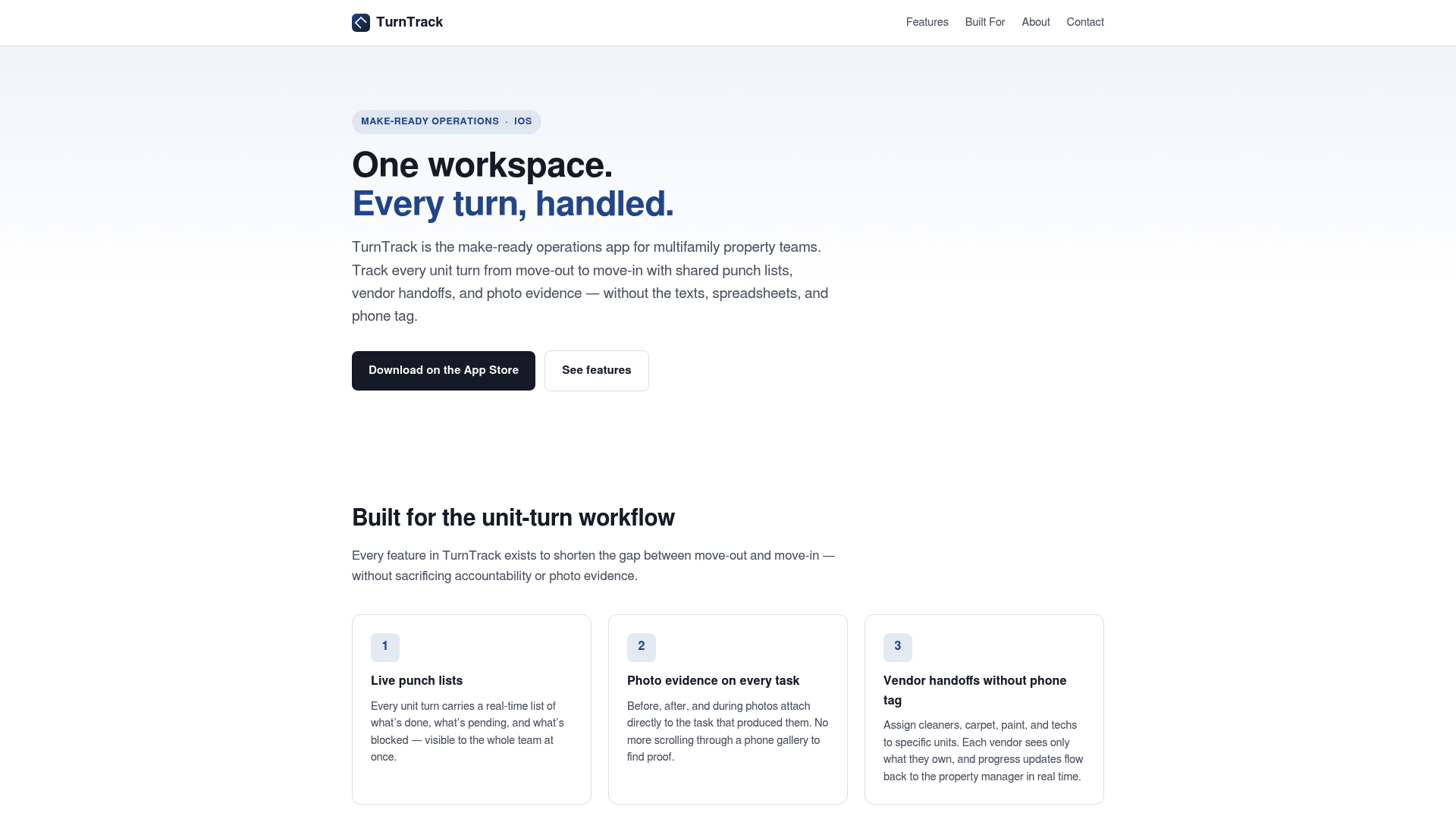
Every turn in TurnTrack carries a live status, Ready, On Track, At Risk, or Overdue, with a timeline that runs from Move-Out through Make-Ready. Vendor contacts live inside the turn record, so there is no digging through a phone to find the carpet crew. The Property Standards Library stores property-specific specs, the exact paint color, filter size, and preferred vendor, and shares them to a tech without requiring a TurnTrack account. Inspections are walked on a phone, area by area, building a before-and-after condition record as a byproduct of the work. TurnTrack runs at $14.99 per month with a free trial, on iOS.
FAQ
What does a multifamily property manager do every day?
A multifamily property manager handles leasing inquiries, maintenance coordination, rent collection, vendor scheduling, and resident communication on a daily basis. Financial reporting and compliance documentation are recurring weekly and monthly tasks.
Is a license required to be a multifamily property manager?
Licensing requirements vary by state. States like Texas, Florida, and California require a real estate or property manager license to manage residential properties for compensation.
What certifications help a property manager advance?
The Certified Property Manager (CPM) from IREM and the Certified Apartment Manager (CAM) from the National Apartment Association are the two most recognized credentials in multifamily property management.
How many properties does a regional property manager oversee?
A regional manager typically oversees 8–15 properties in a multifamily portfolio to maintain operational consistency across sites.
What is the difference between property management and asset management?
Property management focuses on daily operations, leasing, and maintenance. Asset management focuses on investment performance, capital strategy, and long-term portfolio value.