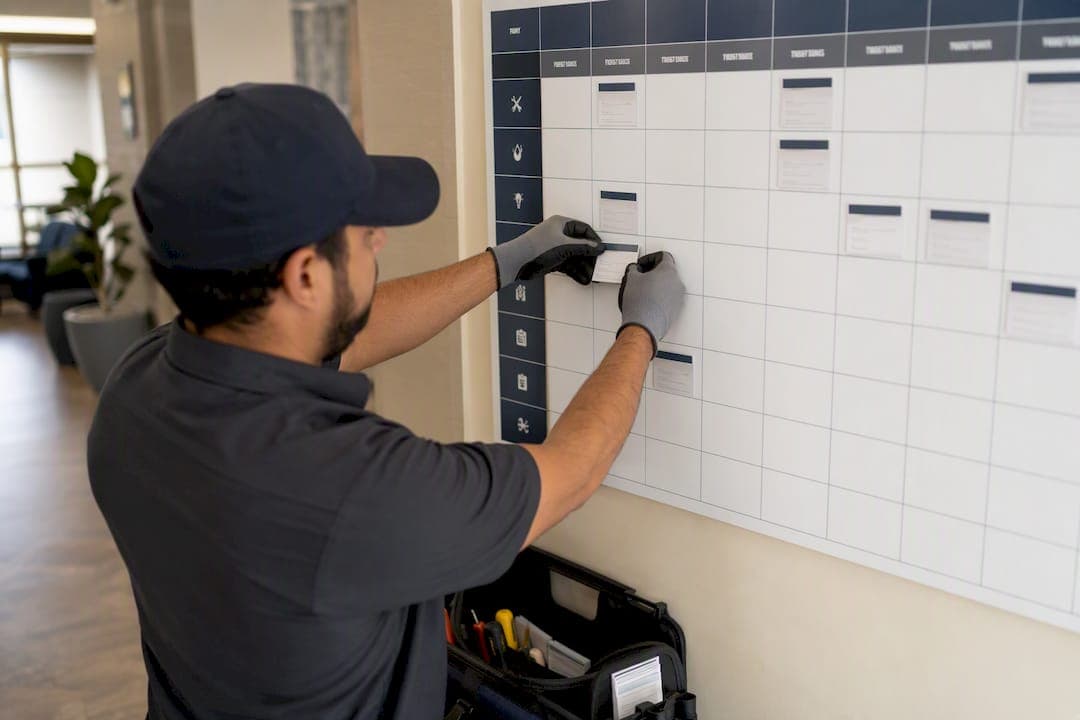
Start your turn calendar now, and run every unit through the same rigid sequence: trash-out, repairs, cleaning, carpet, inspection, final sign-off. That single decision, more than any staffing fix or budget increase, determines whether your units hit their lease-up date. Success means units signed off and released to leasing on schedule, with vacancy days trending down year over year. Two habits make that possible.
- Timestamped photo records at each phase, so disputes over damage or delays settle in minutes, not weeks
- A centralized workspace (a tool like TurnTrack) so status, vendor contacts, and property standards live in one place instead of five people's phones
Key Takeaways
A rigid per-unit sequence paired with a calendar that starts months ahead is what actually prevents student housing turns from sliding into missed move-ins.
| Point | Details |
|---|---|
| Start the calendar early | Begin planning 4 to 6 months ahead and lock vendor pricing 60 days before turn season starts. |
| Separate work orders from sign-off | A supervisor confirms readiness independently; closed tasks alone don't mean a unit is move-in ready. |
| Insert the mid-turn inspection | Schedule it after repairs and before cleaning to catch problems while there's time to fix them. |
| Build in a buffer | Reserve slack days per block of units to absorb vendor delays without cascading the schedule. |
| Centralize the record | A tool like TurnTrack keeps unit status, vendor contacts, and property standards in one shared workspace. |
Table of Contents
- What Should a Student Housing Turn Planning Timeline Look Like?
- How Do You Standardize Turn Inspections and Checklists?
- How Do You Lock Vendors and Avoid Delivery Delays?
- What's the Right Sequence to Turn Each Unit?
- What Tools Actually Help You Run Student Housing Turn Planning?
- What Should Happen Before You Release a Unit to Leasing?
- How Do You Handle Delays and Damage You Didn't Plan For?
- How Should You Communicate With Residents During Turnover?
- How Do You Train and Monitor Staff During Turn Season?
- Sources
What Should a Student Housing Turn Planning Timeline Look Like?
Student turns compress months of prep into a few weeks of execution, so the timeline has to start early or it never catches up.
- 4 to 6 months out: Pull last year's turn list and convert it into this year's baseline order. What you bought last August is a solid predictor of what you'll need again, minus the guesswork.
- 60 days out: Lock vendor pricing and reserve delivery windows. Waiting past this point means competing with every other property manager scrambling for the same carpet crews and paint contractors.
- 2 to 3 weeks out: Finalize delivery windows down to specific dates, not just a week range.
- Final 4 weeks: Run daily or weekly checkpoints. Assign one person to confirm vendor arrivals, one to track unit status changes, and one to flag anything slipping toward "At Risk."
The mistake most teams make isn't skipping planning. It's starting it two months too late and calling it a sprint instead of the fire drill it actually is.
How Do You Standardize Turn Inspections and Checklists?
Every unit needs three checkpoints: move-out, mid-turn, and move-in. Each should be walked area by area, not treated as one blanket pass.
- Move-out: Bedrooms, bathrooms, kitchen, common areas, and life-safety devices (smoke detectors, carbon monoxide alarms) get their own line items
- Mid-turn: Confirm repairs are actually done before cleaners and carpet crews show up behind them
- Move-in: Final walk that mirrors move-out, area for area, so you can compare condition directly
Photo guidance is simple: shoot before-and-after photos wherever damage is identified, timestamp them, and attach them directly to the work order. Skip the photo step on undamaged, unremarkable areas. Building programs with large inventories that run these checklists sequentially, unit after unit, typically need 6 to 8 weeks for full turnover completion when done at scale.
Pro Tip: Structure your punch list items with enough detail that they route automatically to the right vendor category. "Bathroom faucet leaking, unit 214B" becomes a plumbing work order the moment it's logged, no manual sorting required.
How Do You Lock Vendors and Avoid Delivery Delays?
Vendor problems rarely announce themselves early. They show up as a missed Tuesday delivery that pushes your whole week sideways.
- Require pack-by-unit fulfillment on high-volume items like appliances, blinds, and light fixtures, so nothing gets sorted on-site
- Negotiate simple SLAs that spell out response times and make-ready completion windows, not vague "best effort" language
- Order long-lead items (HVAC parts, specialty flooring, custom cabinet hardware) months ahead, and keep a buffer list of critical parts on hand
Unit-level kitting and scannable labels cut on-site sorting time dramatically, which matters most when crews are flipping multiple units in a single day rather than working through one unit slowly.
Pro Tip: Ask vendors for their delivery calendar before you finalize yours. A crew that's booked solid the same week your carpet needs installing is a delay you can see coming three months out.
What's the Right Sequence to Turn Each Unit?
The sequence matters more than the speed of any individual step. Get the order wrong and you create rework that costs more time than doing it right the first time.
- Trash-out: Clear the unit completely before anyone else starts
- Repairs: Fix what's broken, patch what's damaged
- Cleaning: Deep clean once repairs are finished, not before
- Carpet or flooring: Install last among the physical work, so foot traffic from other crews doesn't undo it
- Inspection: Walk the unit against your checklist
- Final make-ready: Staging, final touch-ups, keys prepped
Insert your mid-turn inspection after repairs and before cleaning. That single checkpoint catches problems while there's still time to fix them without pushing back the whole schedule, and it lets cleaning and carpet crews work without stepping on each other's timelines.
Turn-season risk almost always traces back to sequence management, not repair quality. A unit stuck for three days usually got stuck because two crews needed the same room at the same time.
Pro Tip: Set a hard rule: any unit that misses a checkpoint by more than 24 hours moves to "At Risk" status automatically, no manual flagging required. That gets eyes on it before it becomes a crisis.
What Tools Actually Help You Run Student Housing Turn Planning?
Tool categories map cleanly to specific problems. Scheduling software handles the calendar. CMMS platforms track work orders. Inspection apps document condition. Procurement tools manage ordering. The gap most mid-size teams hit is that none of these talk to each other, so someone spends hours each week manually reconciling five systems.
Centralized status labels solve a real, specific problem: missed vendors and units shown before they're ready. When a unit sits at "Ready," "On Track," "At Risk," or "Overdue" in a shared view, nobody on the leasing team has to guess or call the service manager to check.
- Status board visible to everyone coordinating the turn
- Property Standards Library holding the exact paint shade, filter size, and vendor for each fixture type
- Photo-linked inspections attached directly to work orders
- Vendor contact information stored inside the unit record itself, not a separate spreadsheet
TurnTrack, built by Alder Meridian LLC, is built specifically for this gap. It's a workspace-level subscription at $14.99 per month with a free trial, available on iOS, with Android arriving soon. It is not a property management system. It doesn't touch rent, leases, or accounting. It manages one thing: the unit-turn workflow, which fits teams running 5 to 15 active turns at once particularly well.
A service manager juggling 12 units across three vendors doesn't need enterprise software with modules for leasing and accounting. They need one shared record per unit, a status everyone can see, and a place to find the carpet crew's phone number without digging through three months of text threads.
What Should Happen Before You Release a Unit to Leasing?
Closing the last work order and confirming a unit is move-in ready are two different things, and treating them as the same step is where preventable problems slip through.
- Final QA sign-off is separate from closed work orders, and it belongs to a supervisor, not the tech who did the work
- The supervisor walks the unit against the original checklist, area by area, confirming nothing was missed
- Document the sign-off with timestamped photos and a release record tied to that specific unit
- Supervisor sign-off gates are consistently the most effective control point for stopping incomplete units from reaching move-in
If a unit fails sign-off, pull it from the allocation pool immediately. Don't let leasing show it or promise it to an incoming resident. Communicate a realistic ETA to leasing the same day, not after someone asks where the unit is. That single habit prevents the worst version of this problem: a resident standing in a hallway with boxes and no keys.
How Do You Handle Delays and Damage You Didn't Plan For?
Every turn season has surprises. A carpet crew cancels, a water heater fails during trash-out, a unit reveals damage nobody caught at move-out. Planning for the predictable schedule isn't the whole job. Planning for what breaks that schedule is the other half.

Build a buffer into your calendar rather than scheduling every unit back-to-back with zero slack. A single day of float per five or six units gives you room to absorb a vendor no-show without cascading delays into the next block.
Keep a short list of backup vendors for your highest-risk categories, usually flooring and appliances, since those are where lead times run longest and substitutions are hardest to make on short notice. If your primary carpet installer cancels with a week's notice, you want a second name to call, not a scramble through old invoices.
When damage exceeds what a standard turn budget covers, unexpected structural issues, extensive water damage, pest problems that need professional treatment, escalate it the same day it's found. Waiting to see if it's "not that bad" costs you the days you needed to fix it before move-in.
Track which units slip and why. A unit that moves to "At Risk" status because of a vendor delay tells you something different than one that slips because of an undiscovered repair. Patterns across a season point you toward where next year's buffer needs to be bigger.
How Should You Communicate With Residents During Turnover?
Move-out and move-in expectations need to reach residents well before the actual dates, not as a reminder email sent the week of.
Tell outgoing residents exactly what "move-out ready" means: all belongings removed, keys returned by a specific time, and what happens if the unit isn't empty by the deadline. Vague language here creates the disputes that timestamped photos exist to resolve.
Incoming residents need a realistic move-in date, and "realistic" matters more than "early." A property that consistently under-promises and delivers on time builds more trust than one that promises the first of the month and delivers three days late every single year. If a specific unit is trending toward a delay, tell that resident directly and early, with a real date, not a placeholder.
Give both groups a single point of contact for turn-related questions. Residents pinging five different staff members for the same answer wastes time and creates inconsistent responses. One contact, one consistent message, cuts that friction out entirely.
How Do You Train and Monitor Staff During Turn Season?
Turn season is where new hires either sink or figure it out fast, usually because the volume and pace expose gaps that slower seasons hide.
Walk every new tech through the sequence before the season starts, not during the first week of turns. Show them what "done" actually looks like for a repair versus what looks done but fails inspection. The gap between those two is where most rework originates.

Assign a single lead per unit with real accountability for hitting timeline milestones and getting that unit through sign-off. Diffuse ownership across a rotating crew is how units quietly stall without anyone noticing until leasing calls asking where it is.
Monitor performance through the same status data you're already tracking. A tech whose units consistently land in "At Risk" territory needs a different conversation than one whose units are always on time. That's not about blame. It's about catching a training gap or a workload imbalance before it costs you three more units next week.
Operator-to-operator lessons from the field
One property recovered four stalled move-ins in a single season just by moving the mid-turn inspection earlier, catching repair gaps before cleaners arrived instead of after. Try this on your next turn: require a 48-hour buffer between carpet installation and final inspection. Give it one season, track what changes, and adjust from there.
TurnTrack as a practical tool to implement the plan
Everything in this playbook, the calendar, the sequence, the sign-off gate, works better with one shared record instead of five scattered ones. That's the specific gap TurnTrack fills for teams running student housing turns.
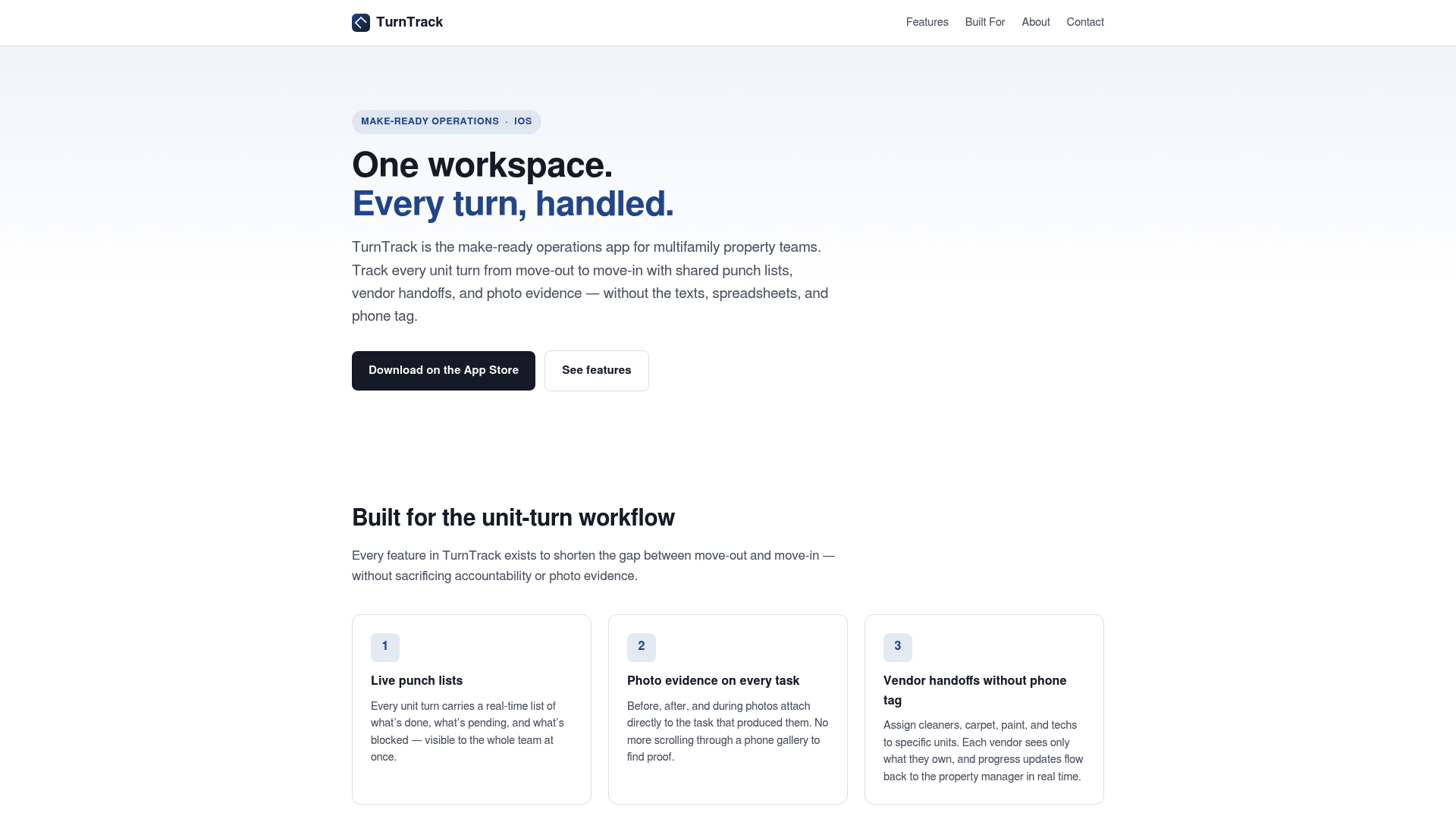
Each unit gets a shared record with a status label (Ready, On Track, At Risk, Overdue) and a visible timeline running Move-Out through Tech Start, Cleaners, Carpet, Inspection, and Make-Ready. Inspections get walked area by area on a phone, building a photo-backed before-and-after record as you go, and vendor contact information lives inside the unit itself instead of a separate list you have to dig for. The Property Standards Library holds your specific paint shade, filter size, and preferred vendor, and you can share that spec sheet with a tech or vendor without them needing an account.
The subscription runs $14.99 a month per workspace, with a free trial, and one subscription covers your whole invited team. It's built for iOS now, with Android coming soon, and it's not a property management system. It won't touch rent or leases. It's built for exactly the unit-turn workflow this article covers.
If you're running 5 to 15 active turns at once and coordinating them across texts, spreadsheets, and memory, check out TurnTrack's product page and start the free trial before your next turn season begins.
Sources
- Student housing facility management playbook (Matterport)
- Student Housing Turn Guide: Fast, Predictable, Done Right (Chadwell Supply)
- University residence hall annual turnover maintenance checklist (OxMaint)