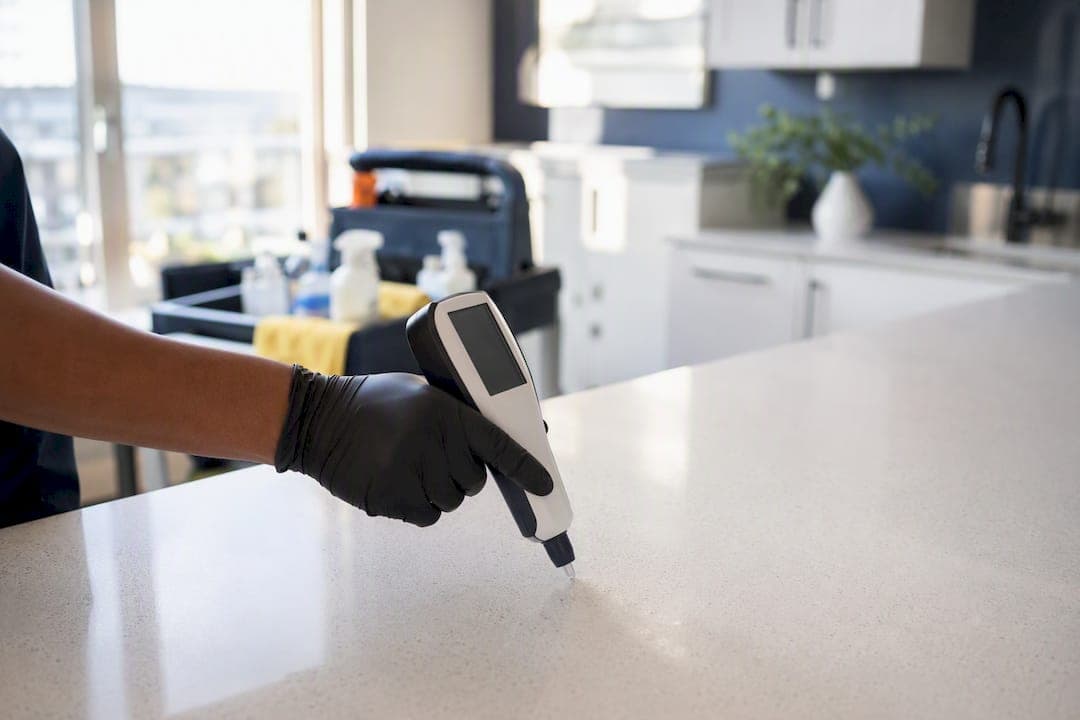
Cleaning quality standards are the measurable frameworks that define what "clean" means, how you check it, and what happens when it falls short. The industry shorthand for this is Clean, Measure, Monitor: clean to a defined level, verify with tools that go beyond eyeballing a surface, and track results over time so problems get caught before a tenant, inspector, or resident does.
If you take one action from this article, make it this: draft a Quality Control Plan (QCP) and get your inspection form agreed upon by everyone involved, from the crew to the client, before the next cleaning cycle starts. Federal contracts already require this. The GSA's National Custodial Specification mandates that contractors submit a written cleaning schedule and a QCP detailing inspection methods, frequency, and corrective-action steps. That's not bureaucratic overhead. It's the difference between a program you can defend and one you're guessing at.
- Define your desired cleanliness levels in writing, not in someone's head.
- Pair visual inspection with at least one objective verification method, such as ATP testing.
- Build a corrective-action loop so failed inspections trigger real fixes, not just notes.
Quick benchmark: Labor typically consumes 45% to 55% of a cleaning operation's revenue. If your standards program doesn't account for that reality, it won't survive contact with a tight budget.
Key Takeaways
A defensible cleaning quality program requires a written QCP, objective verification like ATP testing alongside visual audits, and documented handover records that prevent disputes before they start.
| Point | Details |
|---|---|
| Start with a QCP | Draft a Quality Control Plan defining inspection methods, frequency, and correction steps before work begins. |
| Reference established frameworks | Use ISSA for measurement, GSA for contract language, and APPA for institutional settings. |
| Combine measurement methods | Pair visual inspection with ATP testing on high-risk surfaces for defensible results. |
| Staff to the standard | Labor typically runs 45% to 55% of revenue; underfunded staffing breaks even a good QCP. |
| TurnTrack documents the process | Its inspection workflow and Property Standards Library turn documentation into a byproduct of the turn itself. |
Table of Contents
- What Are Cleaning Quality Standards and Why They Matter
- Which Industry Standards and Frameworks Should You Reference?
- How Do You Establish Cleaning Quality Standards Step by Step?
- How Do You Measure and Audit Cleaning Effectiveness?
- How Should Standards Differ by Facility Type?
- What Staffing and Training Sustain Cleaning Quality Over Time?
- What Belongs in a Cleaning Documentation and Handover Package?
- How Does TurnTrack Support Cleaning Quality Standards in Practice?
- Operator Notes: Common Traps and Simple Corrections
- Build Your First Inspection Packet With TurnTrack
- Frequently Asked Questions
- Sources
What Are Cleaning Quality Standards and Why They Matter
A cleaning quality standard is a written definition of three things: the result you expect, how you'll verify it happened, and what corrects it when it didn't. Miss any one of those three and you don't have a standard. You have a preference.
The Clean, Measure, Monitor philosophy exists because visual inspection alone lies to you. A countertop can look spotless and still carry a bacterial load high enough to fail an ATP swab test. Dust is visible; pathogens and residue usually aren't. That gap is exactly why modern frameworks pair a walk-through with an objective reading, rather than trusting a supervisor's eyes alone.
This matters beyond hygiene. In contract cleaning, your standards document is also your risk-management tool. The GSA's specification ties inspection language directly to a Quality Assurance Surveillance Plan, meaning a documented QCP is what protects you (or your vendor) when a client disputes performance. Without it, you're arguing opinion against opinion.
Standards support three concrete outcomes:
- Contract defensibility — a written QCP gives you evidence in a dispute, not just a memory of who said what.
- Risk reduction — objective checks catch what visual sweeps miss, especially in healthcare and food service.
- Reputation protection — consistent results, not lucky ones, are what keep contracts renewed.
Which Industry Standards and Frameworks Should You Reference?
Three sources anchor most commercial cleaning programs, and each solves a different problem.
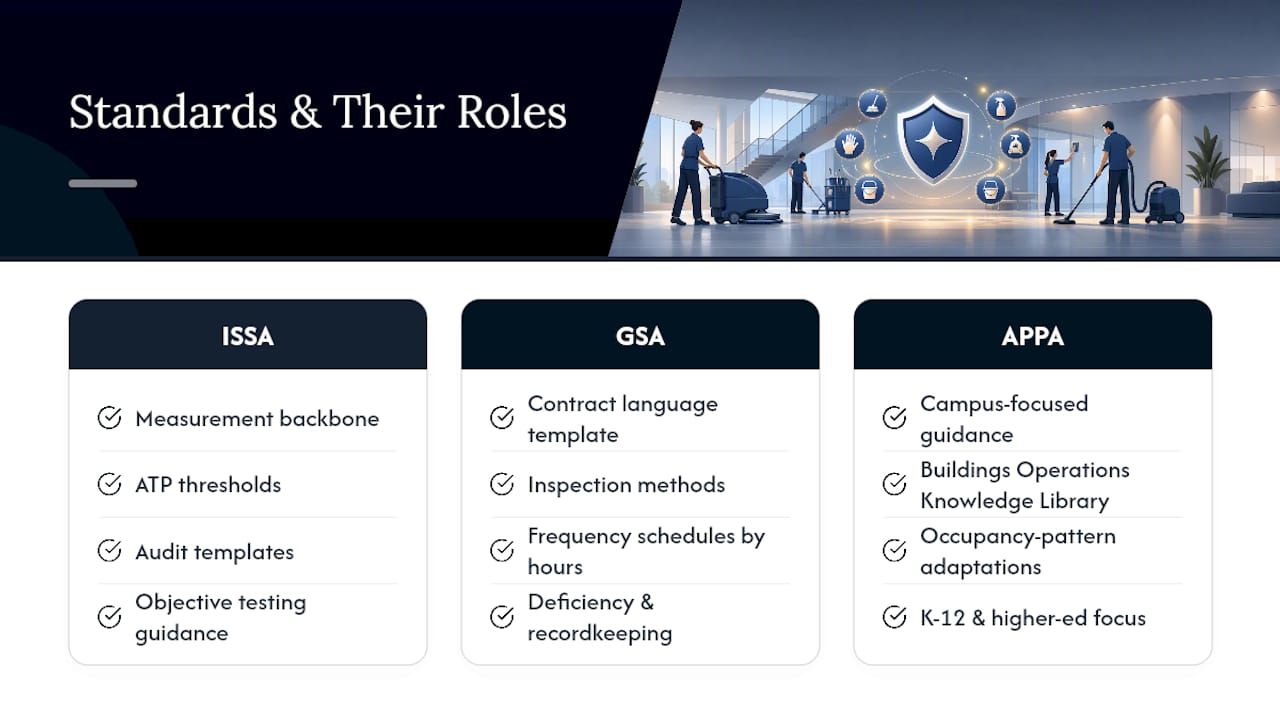
ISSA Clean Standards give you the measurement backbone. ISSA built its framework around the idea that cleanliness needs a number, not just a nod. Its guidance covers ATP thresholds, audit templates, and how to blend subjective walk-throughs with objective testing so you're not relying on gut feel alone. If you need a starting point for what "pass" actually means numerically, ISSA's framework is the reference most operators default to.
The GSA National Custodial Specification gives you the contract language. It spells out what a compliant QCP must contain: inspection methods, frequency schedules tied to facility operating hours, deficiency-correction procedures, and recordkeeping requirements. Even if you never touch a federal contract, this document is a usable template for writing your own QCP from scratch.
APPA guidance fills the gap for campuses and institutional facilities. Its Buildings Operations Knowledge Library translates general cleaning standards into the realities of higher-education and K-12 environments, where occupancy patterns and parental scrutiny differ from a typical office tower.
Layer in operational benchmarks for context. Supervisor-to-cleaner ratios and labor cost percentages tell you whether a program is staffed to actually hit the standards it claims to follow. A standard nobody can afford to execute isn't a standard. It's a wish list.
How Do You Establish Cleaning Quality Standards Step by Step?
Most facilities teams skip straight to inspection and wonder why results are inconsistent. The sequence below builds the foundation first.
-
Define desired cleanliness outcomes by area. Identify high-touch surfaces (door handles, elevator buttons, shared kitchen equipment) and set a distinct standard for each zone. A restroom and a conference room don't need the same frequency or verification method.
-
Write SOPs tied to specific tasks and equipment. Include dilution ratios for chemicals, dwell times for disinfectants, and required PPE. Vague instructions ("wipe down surfaces") produce inconsistent results because every cleaner interprets them differently.
-
Build the cleaning schedule around operating hours. Disruptive tasks like carpet extraction or floor stripping need to be scheduled when occupancy is lowest, and the schedule itself should be a document, not tribal knowledge passed between shift leads.
-
Draft the Quality Control Plan. This is where inspection frequency, deficiency correction timelines, and recordkeeping requirements live. The GSA specification is a solid template even outside federal work: it forces you to answer "who checks, how often, and what happens when it fails" in writing.
-
Pre-agree the inspection form and acceptance criteria with the client or stakeholder before work starts. This single step prevents more disputes than any other item on this list, because both sides know exactly what "pass" looks like before the first inspection happens.
Pro Tip: Draft your inspection form and walk it with the client once, on a sample area, before the contract officially starts. A five-minute joint walk-through catches mismatched expectations that would otherwise surface as a dispute three weeks in.
Skipping step five is the single most common failure point operators report, because it turns every inspection into a negotiation instead of a checklist.
How Do You Measure and Audit Cleaning Effectiveness?
Visual audits are fast, cheap, and necessary. They're also blind to what actually causes illness and complaints. A surface can look immaculate and still carry residue, biofilm, or bacterial load invisible to the naked eye. That's the core limitation you need to design around, not ignore.
Visual inspection should still anchor your program. Walk a representative sample of areas, not every square foot, on a fixed schedule, and score against a defined checklist rather than a gut impression.
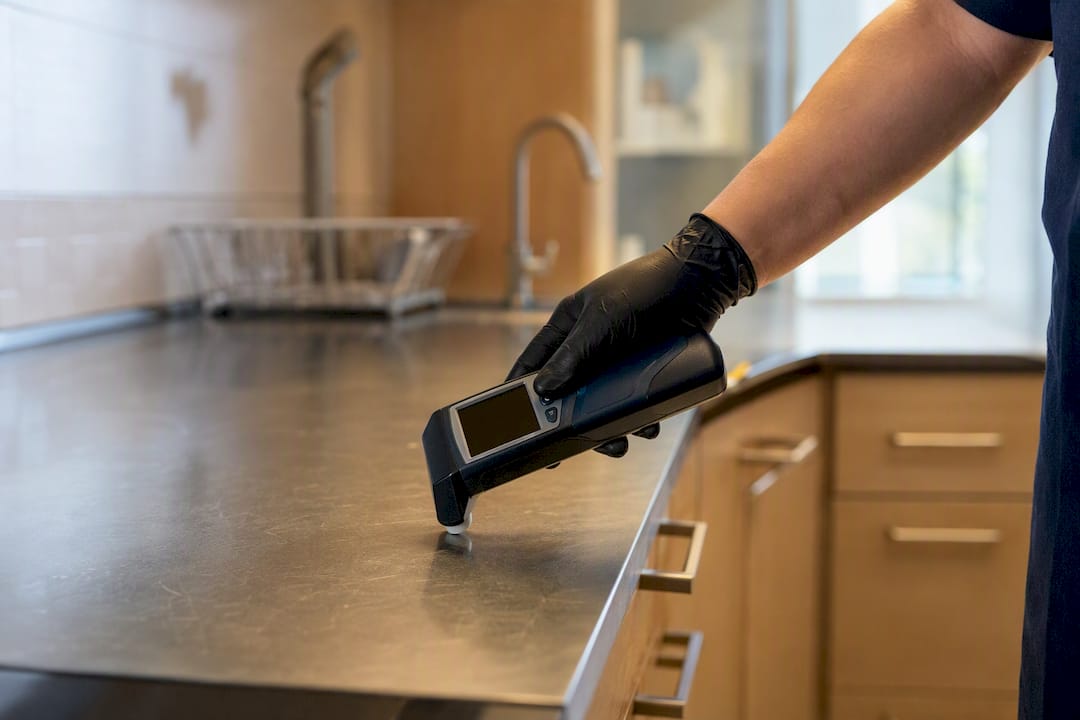
ATP testing closes the gap visual inspection leaves open. An ATP meter measures residual organic material on a surface and returns a numeric reading in Relative Light Units (RLU). Lower RLU readings generally track with lower microbial presence: ISSA cites research showing ATP reduction correlates with reduced culturable bacteria, though ATP isn't a direct pathogen count and shouldn't be treated as one. It's a proxy, not a microbiology lab result. Use it where risk is highest, such as healthcare touchpoints or food-prep surfaces, and treat a single failed reading as a signal to retest rather than a definitive verdict.
Fluorescent markers and RODAC plates serve a narrower but useful purpose. Markers applied before cleaning and checked under UV light after confirm whether a surface was physically touched during the process, which is a training and compliance check more than a hygiene measurement. RODAC plates give you a cultured bacterial count, slower to return results but more precise when you need to settle a dispute or investigate an outbreak.
Design your sampling plan around risk, not convenience. High-touch, high-occupancy, and high-vulnerability areas (patient rooms, cafeteria surfaces) deserve more frequent and more objective checks than a rarely used storage closet. Set numeric pass/fail thresholds in advance and write the remediation workflow into your QCP so a failed reading automatically triggers rework instead of a debate.
How Should Standards Differ by Facility Type?
A hospital and an office tower cannot run the same cleaning program, even if both call it "commercial cleaning."
Offices typically run daily cleaning for high-touch zones (restrooms, break rooms, entryways) with less frequent deep cleaning for carpets and windows. Priority goes to visible common areas since occupant complaints, not health risk, drive most disputes here.
K-12 schools and college campuses benefit from APPA's operational guidance, which accounts for high occupant turnover and parental scrutiny that a typical office never faces. Restrooms and cafeterias need higher-frequency verification, and documentation matters more because parents and administrators ask questions offices never do.
Healthcare facilities need to go further than either. Regulatory overlap with infection-control requirements means visual inspection alone is inadequate in patient-contact zones. This is where ATP testing or cultured sampling stops being optional and becomes the baseline expectation for critical surfaces.
Multifamily unit turns present a different challenge entirely: the standard has to survive a handoff between move-out and move-in, often within days. That means:
- Documented move-out inspection before cleaning begins, establishing baseline condition.
- Mid-turn inspection checkpoints so problems surface before the unit is "done."
- Photo evidence attached to the final move-in inspection, timestamped, so there's no ambiguity about what condition the unit was in at handover.
What Staffing and Training Sustain Cleaning Quality Over Time?
Standards written on paper mean nothing without people trained and staffed to execute them. This is where most programs quietly fail, not because the standard was wrong, but because nobody funded the labor to hit it.
Build training around competency checks, not just onboarding. New hires should demonstrate correct dilution ratios, dwell times, and equipment use before working unsupervised, and refresher checks should recur on a set cadence, not only after a complaint.
Supervisor-to-cleaner ratios directly affect whether inspections actually happen on schedule. A supervisor stretched across too many sites cannot run the audit cadence your QCP promises, and that gap shows up in inconsistent quality long before a client notices.
- Track cleaner hours against bid hours; a growing gap signals understaffing, not laziness.
- Watch workloading (square feet per cleaner-hour) against industry norms, since an unrealistic workload guarantees shortcuts.
- Remember labor typically runs 45% to 55% of revenue in commercial cleaning; a bid priced below that range usually can't sustain the staffing your standards require.
Pro Tip: If your inspection pass rate is dropping and nothing about the SOPs changed, check the staffing ratio before you blame the crew. A standard that worked at one supervisor per eight cleaners often breaks quietly when that ratio slips to one per fourteen.
What Belongs in a Cleaning Documentation and Handover Package?
Disputes rarely happen because cleaning quality actually failed. They happen because nobody can prove what condition a space was in before, during, or after the work. Documentation is what turns "he said, she said" into a settled fact.
- An area-by-area inspection checklist, matched to the specs agreed upon before work began, not written after the fact.
- Photos tied to specific tasks or areas, timestamped, especially for items that are hard to re-verify later (a replaced filter, a treated stain).
- Client sign-off at each inspection milestone, not just at final handover. Joint walk-throughs at move-out and move-in prevent the single biggest source of unit-turn disputes.
- A defined retention policy for inspection records and photos, long enough to cover contract compliance windows or lease-turnover disputes.
Photographic evidence with a timestamp shortens resolution time dramatically when a dispute does arise, because it replaces competing memories with a dated record. A pre-agreed inspection form makes that record consistent from one turn to the next, instead of reinventing the checklist every time.
How Does TurnTrack Support Cleaning Quality Standards in Practice?
Most of what breaks a QCP in the field isn't the standard itself. It's the gap between the paper document and what actually happens on the ground: missed handoffs, no proof of work, and specs that live in someone's memory instead of in writing.
TurnTrack was built for that exact gap in multifamily unit-turn workflows. Each unit turn has a shared record with a live status (Ready, On Track, At Risk, Overdue) and a timeline running from Move-Out through Tech Start, Cleaners, Carpet, Inspection, and Make-Ready. That timeline is your schedule made visible to everyone involved, not just the person managing the spreadsheet.
- Inspections (Move-Out, Mid-Turn, Move-In) are walked area by area on a phone, building the before-and-after condition record your QCP calls for.
- The Property Standards Library holds property-specific specs (the exact paint shade, filter size, faucet model) so a tech asking "what goes here?" gets an answer without a phone call.
- The activity feed logs updates and optional photos tied to each stage, creating documentation as a byproduct of doing the work, not an extra chore afterward.
- Vendor coordination lives inside the turn itself, so contact info for the carpet crew or paint vendor is right there when you need it.
TurnTrack runs on a workspace-level subscription at $14.99 a month with a free trial, available on iOS through the App Store. One subscription covers your invited team; photos are optional and attached where the property actually requires proof, not forced onto every single task.
A useful first test: create one Property Standards entry, run a sample inspection against it, attach a couple of photos, and see what the exported inspection packet looks like before you commit further.
| Point | Details |
|---|---|
| QCP is the starting point | A written Quality Control Plan defines inspection methods, frequency, and correction steps. |
| Pair visual with objective testing | ATP readings catch what visual inspection misses, especially on high-risk surfaces. |
| Staffing determines outcomes | Supervisor:cleaner ratios and labor budgets decide whether a standard is actually achievable. |
| Documentation prevents disputes | Timestamped photos and pre-agreed inspection forms resolve disagreements faster. |
| TurnTrack documents the turn | Its inspection workflow and Property Standards Library capture proof of work as it happens. |
Operator Notes: Common Traps and Simple Corrections
Standards fail most often because nobody owns them. A QCP written once and never revisited becomes shelf-ware within a year, so assign an owner and a review cadence (quarterly works for most facilities) or watch it drift silently out of date.
Handover is the single most common failure point we hear about from service managers. Not staffing, not chemicals. It's a mismatch between what one shift documented and what the next one expected. Fix it with a pre-agreed inspection form, used consistently, every time.
If you're only tracking three numbers, make them these: inspection pass rate, rework hours, and time-to-close deficiencies. Everything else is secondary.
Build Your First Inspection Packet With TurnTrack
Most cleaning-standard failures aren't a training problem or a chemical problem. They're a documentation problem: nobody can prove what happened, so every inspection turns into an argument. TurnTrack fixes that gap for teams running unit turns and make-ready workflows, where a missed handover between move-out and move-in creates the exact dispute this whole article is about avoiding.
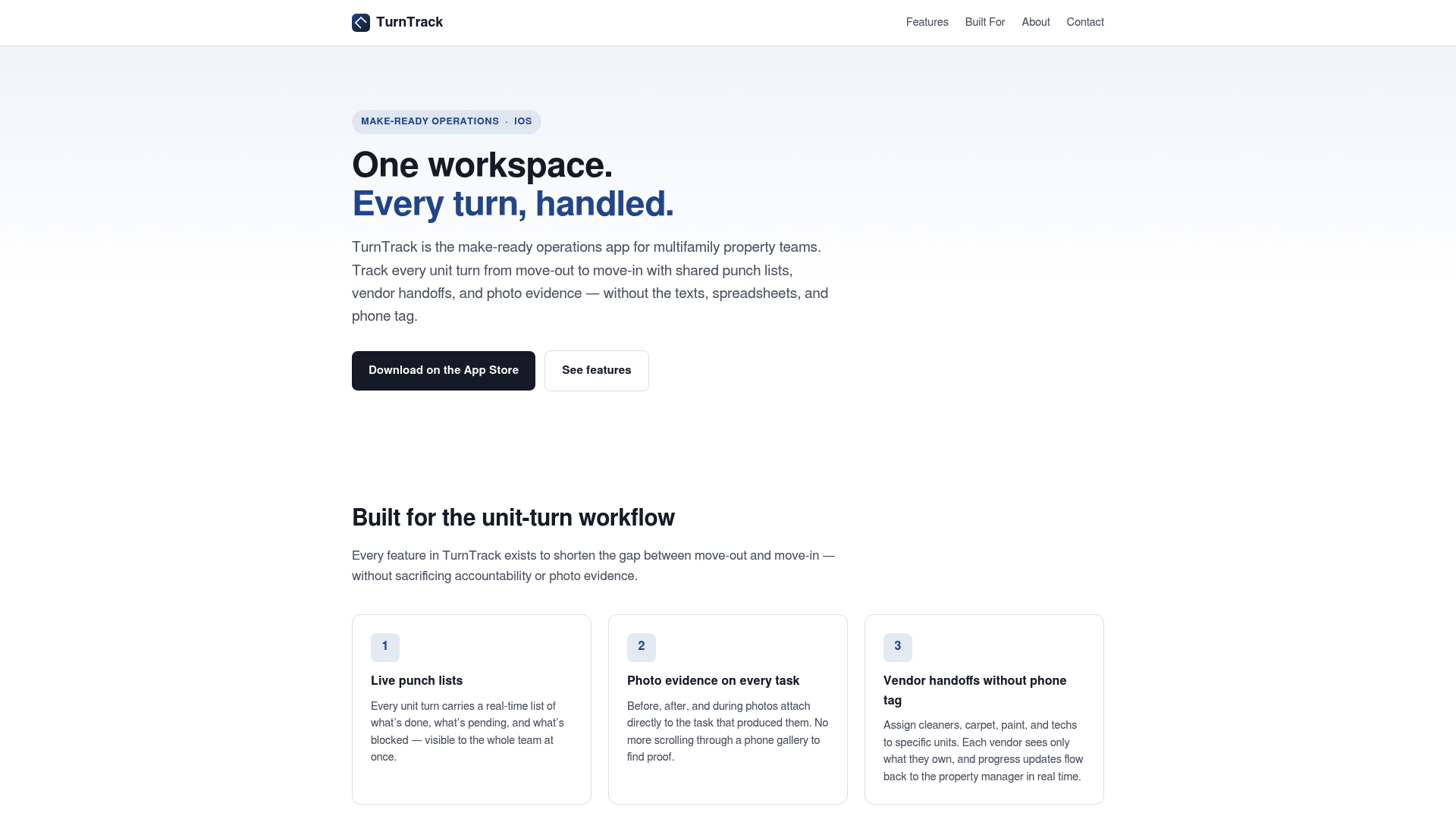
The workspace runs $14.99 a month with a free trial on iOS, and one subscription covers your invited team, techs, and vendors. Every inspection (Move-Out, Mid-Turn, Move-In) gets walked area by area on a phone, and the Property Standards Library keeps your specs in one place instead of scattered across texts and memory. Vendor contacts live inside the turn itself, so coordinating the carpet crew or cleaning vendor doesn't mean digging through a separate list.
Start with one property: create a Property Standards entry for your most-turned unit type, run a sample inspection, and build your first exportable inspection packet at Turntrack.
Frequently Asked Questions
What is the difference between a cleaning schedule and a Quality Control Plan? A cleaning schedule tells you when tasks happen. A QCP tells you how you verify they happened correctly, how often you inspect, and what corrects a failure. The GSA specification requires both as separate documents.
How often should a facility run ATP testing versus visual inspection? Visual inspection should happen on every cleaning cycle. ATP testing works best targeted at high-risk, high-touch surfaces on a defined sampling schedule rather than every surface, every time, since it's a verification tool, not a replacement for routine checks.
What's a reasonable supervisor-to-cleaner ratio? It varies by facility complexity, but industry benchmarks tie ratio directly to inspection consistency: stretch supervisors too thin and audit cadence slips, which shows up later as declining inspection pass rates.
Do cleaning quality standards apply to multifamily unit turns the same way they apply to office cleaning? The core principles (define, measure, monitor) apply the same way, but unit turns add a handover element offices don't face: a documented condition record has to survive the transition from move-out cleaning to move-in inspection, usually within days.
What single document reduces cleaning disputes the most? A pre-agreed inspection form with defined acceptance criteria, signed off by both parties before work starts. It removes ambiguity about what "pass" means before an inspection ever happens.