
ATR in property management is defined as an Activity Tracking Report, a digital or manual log that documents and coordinates maintenance tasks, vendor scheduling, and unit turnover activities from move-out to make-ready. Property managers searching for this term sometimes land on mortgage content about the federal Ability to Repay rule, which shares the same acronym but has nothing to do with daily operations. This guide covers the operational meaning of ATR, how it functions on a service team, and why it directly affects how fast and consistently your units turn. TurnTrack is built around this exact workflow, designed by a service manager with 9+ years in the field.
What is ATR in property management and how does it work?
An Activity Tracking Report is a shared record that captures every task, status update, and condition note tied to a specific unit turn. It replaces the scattered mix of texts, emails, and memory that most service teams rely on when running multiple turns at once. A service manager running 5–15 active turns simultaneously needs more than a mental checklist. Each unit has its own move-out date, assigned techs, vendor contacts, and unit-specific conditions that change daily.
A functional ATR tracks each unit through a defined sequence of stages. The most common structure runs from Move-Out through Tech Start, Cleaners, Carpet, Inspection, and Make-Ready. At each stage, the team logs what was completed, who did it, and when. That timestamp trail becomes the record of the turn.

Digital ATRs add real-time status visibility. Instead of calling the service manager to ask if unit 204 is ready, a leasing agent checks the status directly. That single change eliminates a category of miscommunication that routinely causes units to get shown before they are ready.
ATRs also capture unit-specific details that would otherwise live in one person's head. Paint codes, filter sizes, preferred vendors, and faucet models belong in the record, not in a notebook that leaves when a tech does. Operational activity tracking standardizes these details so any tech or vendor can work the unit without a briefing call.
Pro Tip: Attach a photo to the smoke detector task with the date written on the new battery. That single image closes disputes before they start and takes less than 10 seconds.
Key elements a well-built ATR captures:
- Unit status (Ready, On Track, At Risk, Overdue)
- Stage-by-stage timeline with completion timestamps
- Assigned tech and vendor contacts per task
- Unit-specific specs like paint color, filter size, and fixture model
- Optional photo documentation tied to specific tasks or inspection items
- Move-Out, Mid-Turn, and Move-In inspection records by area
How does ATR affect unit turnover efficiency?
ATR reduces turnover delays by making the current state of every unit visible to everyone who needs to know. Without a shared record, a vendor shows up to clean a unit the carpet crew has not finished yet. The cleaner leaves. The carpet crew arrives. The cleaner has to come back. That sequence adds days to a turn that should take hours.
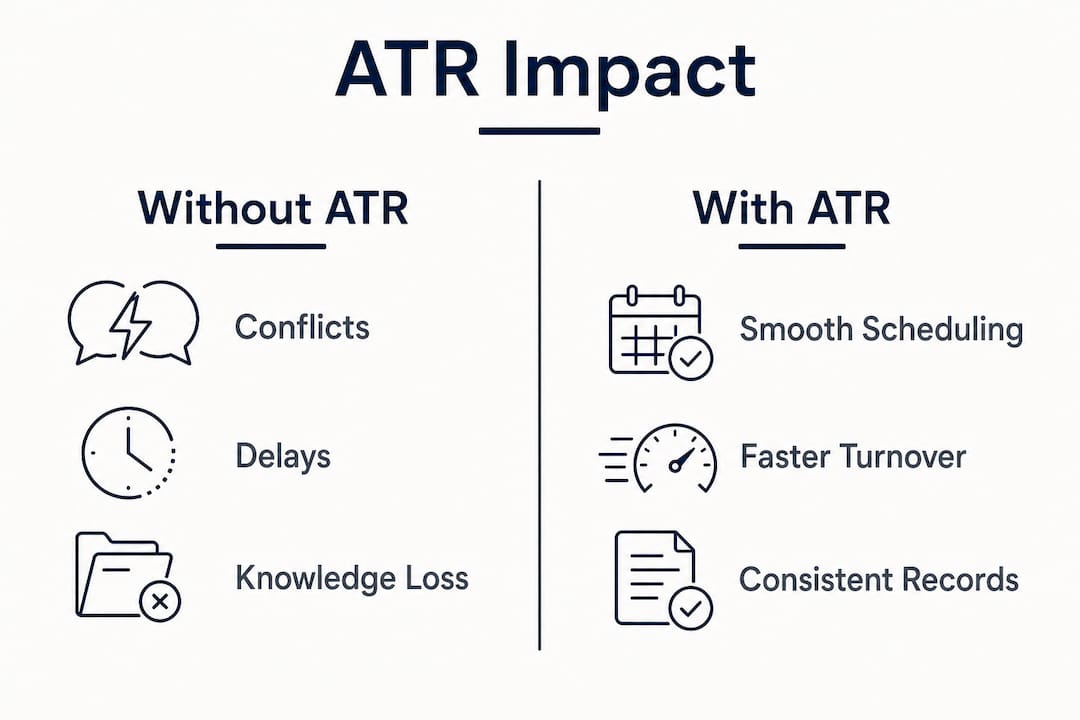
Activity tracking also protects against the knowledge loss that happens when a tech or service manager leaves. A new hire walking into a community with a populated ATR knows the Sherwin-Williams color on every wall, the HVAC filter size in every unit type, and which vendor handles carpet. Without that record, the new hire spends the first two weeks asking questions that slow every turn down.
The table below shows how ATR adoption changes common operational outcomes for a mid-size multifamily community.
| Operational area | Without ATR | With ATR |
|---|---|---|
| Vendor scheduling conflicts | Frequent, resolved by phone | Visible in the turn record before they happen |
| Unit-specific specs (paint, filters) | Stored in one person's memory | Logged in a shared Property Standards Library |
| Inspection documentation | Paper forms, often lost | Area-by-area digital record with optional photos |
| Unit readiness visibility | Requires a call to the service manager | Real-time status visible to the whole team |
| Staff transition impact | High. New hires start from zero | Low. Record carries all specs and history |
Consistent ATR use also supports on-site team performance during staff changes. The record does not quit when a person does. That continuity is the most underrated benefit of a well-maintained ATR.
Pro Tip: Build your Property Standards Library before your next turn cycle, not during one. Entering the Sherwin-Williams color, filter size, and preferred vendor for each unit type takes an hour once and saves that hour every time a new tech asks.
What is the difference between ATR as activity tracking and the mortgage ATR rule?
The federal Ability to Repay rule is a separate regulation with no connection to property operations. It requires mortgage lenders to verify eight underwriting factors before approving a residential loan, including income, debts, employment, credit history, and monthly payment obligations. The rule was codified under the Dodd-Frank Act and is enforced through CFPB regulations. Failure to comply can result in statutory damages up to $4,000 per claim.
Property managers encounter this rule only in one specific context: financing. If you are applying for a residential mortgage on a one-to-four unit property, the lender must document your ability to repay. That assessment has nothing to do with how you run maintenance or turn units.
The distinction matters because searching "ATR in property management" returns a mix of mortgage content and operational content. Knowing which one applies to your situation saves time.
A few points that clarify where the mortgage ATR rule applies and where it does not:
- It applies to residential mortgage loans on one-to-four unit properties
- Loans on properties with more than four residential units are classified as commercial collateral and exempt from ATR/QM regulations
- Investment properties used primarily for business purposes are generally exempt from ATR/QM consumer protection rules
- Qualified Mortgage status gives lenders legal protection under the Ability to Repay rule, which is a lender concern, not a property manager concern
- The operational ATR used by service teams has no regulatory definition and no federal mandate
If you are a property manager or service tech looking to improve unit turns, the mortgage ATR rule is not relevant to your work. The Activity Tracking Report is.
How to implement ATR effectively in property management
The most effective ATR implementation treats documentation as a byproduct of the work, not a separate admin task. When a tech completes a stage, logging it takes seconds. When that log builds automatically into a turn record, the team gets a full history without anyone sitting down to write a report.
TurnTrack is built specifically for this workflow. Every unit turn gets a shared record with a status (Ready, On Track, At Risk, or Overdue) and a timeline the whole team can see. Vendor contacts live inside the turn, so a tech who needs the carpet crew does not dig through a phone contact list. The Property Standards Library stores the exact Sherwin-Williams shade, the HVAC filter size, and the preferred vendor for each unit type, and shares that spec sheet to a tech or vendor without requiring them to have a TurnTrack account.
Best practices for ATR implementation:
- Log stage completions in real time, not at the end of the day
- Use area-by-area inspection documentation for Move-Out, Mid-Turn, and Move-In walkthroughs
- Attach photos to tasks where documentation matters, such as smoke detectors, damage notes, and completed repairs
- Build the Property Standards Library before the first turn cycle, not during one
- Train techs and vendors to check the turn record before calling the service manager
The make-ready workflow connects directly to ATR effectiveness. A team that understands the full sequence from Move-Out to Make-Ready uses the ATR as a live guide, not a retroactive log. That shift in mindset is what separates teams that finish turns on time from teams that are always catching up.
Pro Tip: Share the Property Standards Library spec sheet with a vendor before they arrive on site. A carpet crew that already knows the unit layout and scope does not need a walkthrough briefing. That saves 20 minutes per unit.
Key Takeaways
ATR in property management means Activity Tracking Report, a shared operational record that coordinates maintenance tasks, vendor scheduling, and unit readiness from move-out to make-ready.
| Point | Details |
|---|---|
| ATR definition in property | An Activity Tracking Report logs maintenance tasks, vendor contacts, and unit conditions for each turn. |
| ATR reduces turnover delays | Real-time status visibility prevents vendor conflicts and units being shown before they are ready. |
| Property Standards Library | Storing paint codes, filter sizes, and vendor contacts in the ATR prevents knowledge loss during staff changes. |
| Mortgage ATR is separate | The federal Ability to Repay rule applies to residential lending, not to daily property operations. |
| Documentation as workflow | Logging stage completions in real time builds a full turn record without adding separate admin work. |
What nine years in the field taught me about ATR
The teams that struggle most with unit turns are not the ones with the worst techs. They are the ones where all the knowledge lives in one person's head. I have seen communities run well for years under a strong service manager, then fall apart the moment that person leaves. The new hire does not know the paint color. The vendor does not know who to call. The leasing office does not know which units are actually ready. That is not a staffing problem. That is a documentation problem.
The fix is not complicated. It is a shared record that captures what was done, who did it, and what the unit needs. The hard part is getting the team to treat logging as part of the work, not extra work on top of it. When the ATR lives on a phone and takes seconds to update, that resistance drops fast.
The other thing I have seen teams get wrong is over-documenting. Requiring a photo on every single task creates friction that makes people stop using the system. The right approach is selective. Document the things that generate disputes: smoke detectors, damage notes, paint touch-ups, appliance conditions. Skip the photo on the light bulb swap. The goal is a record that protects the property and the team, not a photo archive nobody looks at.
Mobile access is not optional. A tech who has to walk back to the office to log a completed stage will not log it until the end of the day, if at all. The ATR has to live where the work happens.
— TurnTrack Team
TurnTrack puts your ATR where the work happens
Running 5–15 active turns at once without a shared record means relying on texts, calls, and memory. That system fails the moment one person is out sick or a vendor does not get the message.
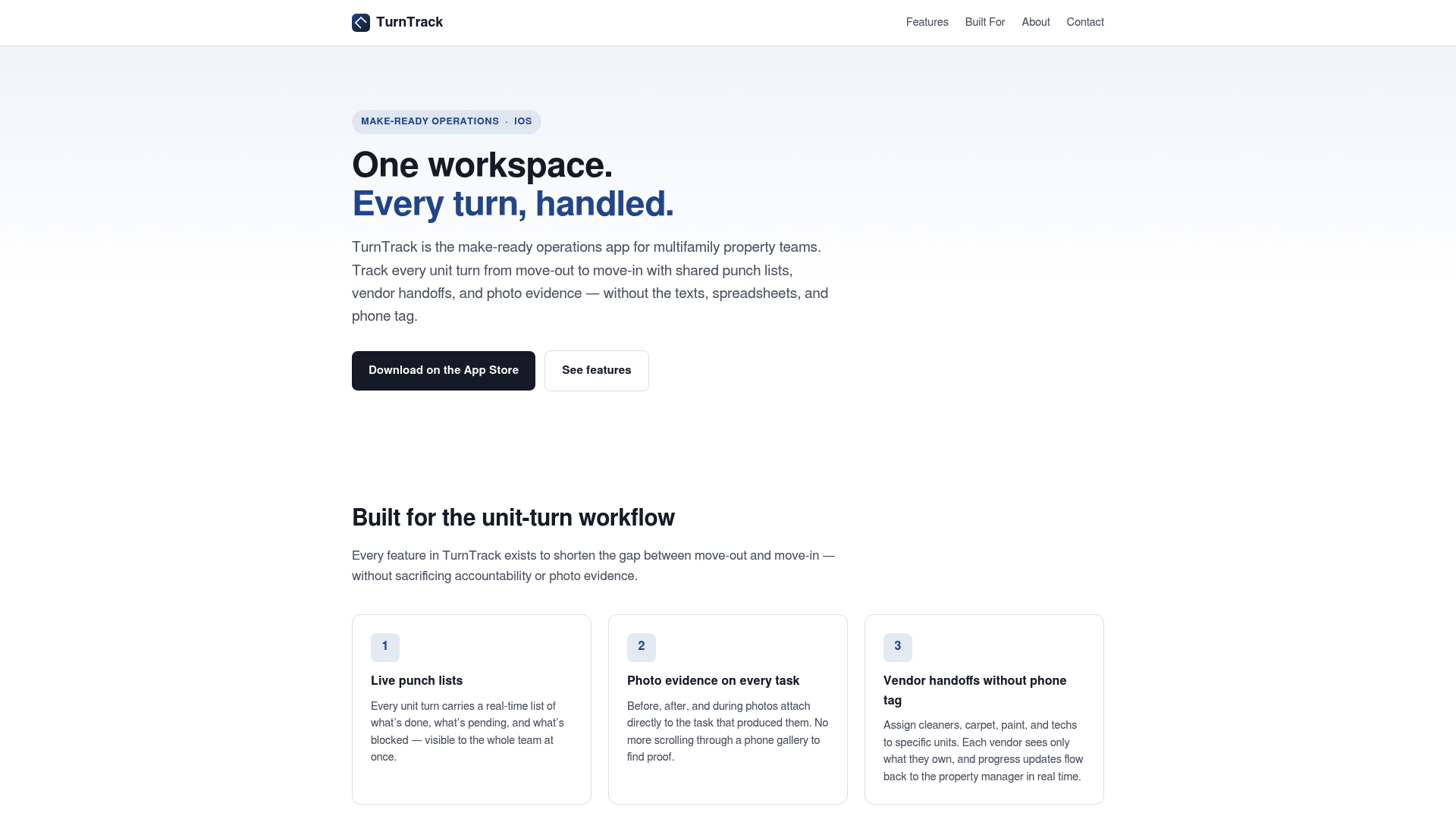
TurnTrack gives every turn a shared record with a live status, a stage-by-stage timeline, and vendor contacts built right in. The Property Standards Library keeps your paint codes, filter sizes, and preferred vendors in one place and shares them to any tech or vendor without requiring a separate account. Inspections are walked area by area on a phone, building a before-and-after condition record as a byproduct of the walkthrough. TurnTrack is $14.99/mo for your workspace, with a free trial, and runs on iOS. It is built for the people still doing the work, not for enterprise teams with a dedicated IT department.
FAQ
What does ATR stand for in property management?
ATR stands for Activity Tracking Report in property management. It is an operational log that tracks maintenance tasks, vendor scheduling, and unit conditions through each stage of a unit turn.
How does ATR improve unit turnover time?
ATR gives the whole team real-time visibility into unit status, which prevents vendor scheduling conflicts and stops units from being shown before they are ready. Synchronized vendor and maintenance tasks directly reduce the time between move-out and make-ready.
Is ATR the same as the mortgage Ability to Repay rule?
No. The federal Ability to Repay rule is a residential lending regulation that requires lenders to verify a borrower's income, debts, and credit history before approving a mortgage. It has no connection to property operations or unit turnover workflows.
What should an ATR include for a unit turn?
A complete ATR for a unit turn includes the current status, a stage-by-stage timeline with timestamps, assigned tech and vendor contacts, unit-specific specs like paint color and filter size, and inspection records for Move-Out, Mid-Turn, and Move-In walkthroughs.
Do small property teams need a digital ATR tool?
A digital ATR tool is most valuable for teams running multiple turns at once, where a shared record prevents the communication gaps that delay units. Smaller operators benefit from purpose-built tools that do not carry the cost or complexity of full enterprise property management platforms.